MCQ
Melting point of  $FeCl_3$  and  $FeCl_2$  is
  • A
    $FeCl_3 > FeCl_2$
  • $FeCl_3 < FeCl_2$
  • C
    $FeCl_3 = FeCl_2$
  • D
    Data Insufficient

Answer

Correct option: B.
$FeCl_3 < FeCl_2$
b
$FeCl_3 < FeCl_2$  (Ionic char. $\uparrow  \uparrow$)

Need a full question paper?

Generate a complete, print-ready paper with questions like this in minutes — across 16+ boards, with answer keys.

Start Generating Free

Similar questions

The complex chlorocompound diaquatriammine cobalt $(III)$  chloride is represented as
Ethylene glycol reacts with excess of $PC{l_5}$ to give
The set that represents the pair of neutral oxides of nitrogen is :
Considering acetic acid dissociates in water, its dissociation constant is $6.25 \times 10^{-5}$. If $5 \mathrm{~mL}$ of acetic acid is dissolved in $1$ litre water, the solution will freeze at $-\mathrm{x} \times 10^{-2}{ }^{\circ} \mathrm{C}$, provided pure water freezes at $0^{\circ} \mathrm{C}$.

$\mathrm{x}=$ . . . . . . . . . (Nearest integer)

Given : $\left(\mathrm{K}_{\mathrm{r}}\right)_{\text {water }}=1.86 \mathrm{~K} \mathrm{~kg} \mathrm{~mol}^{-1}$.

density of acetic acid is $1.2 \mathrm{~g} \mathrm{~mol}^{-1}$

molar mass of water $=18 \mathrm{~g} \mathrm{~mol}^{-1}$.

molar mass of acetic acid $=60 \mathrm{~g} \mathrm{~mol}^{-1}$.

density of water $=1 \mathrm{~g} \mathrm{~cm}^{-3}$

Acetic acid dissociates as

$\mathrm{CH}_3 \mathrm{COOH} \rightleftharpoons \mathrm{CH}_3 \mathrm{COO}^{\oplus}+\mathrm{H}^{\oplus}$
Out of the following, the alkene that exhibits optical isomerism is
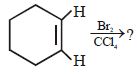
Product of the above reaction is
The potassium ferrocyanide solution gives Prussian blue colour, when added to :
To which of the following four types does this reaction belong ${B^ - } + R - A \to B - R + {A^ - }$
An alkyl bromide $(X)$  reacts with Na to form  $ 4, 5-$ diethyloctane. Compound  $X$  is
The synthesis of  $3$ -octyne is achieved by adding a bromoalkane into a mixture of sodium amide and an alkyne. The bromoalkane and alkyne respectively are