MCQ
Melting point of ice
  • A
    Increases with increasing pressure
  • Decreases with increasing pressure
  • C
    Is independent of pressure
  • D
    Is proportional to pressure

Answer

Correct option: B.
Decreases with increasing pressure
b
(b) Melting point of ice decreases with increase in pressure (as ice expands on solidification).

Need a full question paper?

Generate a complete, print-ready paper with questions like this in minutes — across 16+ boards, with answer keys.
Start Generating Free

Similar questions

A particle is projected from the ground with an initial speed $\upsilon $ at an angle $\theta $ with horizontal. The average velocity of the particle between its point of projection and highest point of trajectory is
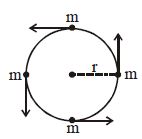
Four similar particles of mass $m$ are orbiting in a circle of radius $r$ in the same  direction because of their mutual gravitation attractive force. Velocity of a particle is  given by
The height $y$ and the distance $x$ along the horizontal plane of a projectile on a certain planet (with no surrounding atmosphere) are given by $y = (8t - 5{t^2})$ meter and $x = 6t\, meter$, where $t$ is in second., the acceleration due to gravity is given by ......... $m/{\sec ^2}$
A beaker contains $200\, gm$ of water. The heat capacity of the beaker is equal to that of $20\, gm$ of water. The initial temperature of water in the beaker is $20°C.$ If $440\, gm$ of hot water at $92°C$ is poured in it, the final temperature (neglecting radiation loss) will be nearest to........ $^oC$
Ratio between maximum range and square of time of flight in projectile motion is
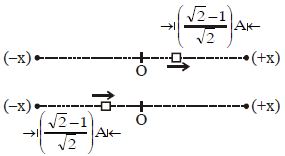
Two bodies performing $SHM$ have same amplitude and frequency. Their phases at a certain instant are as shown in the figure. The phase difference between them is
The molar heat capacity of oxygen gas at STP is nearly 2.5R. As the temperature is increased, it gradually increases and approaches 3.5R. The most appropriate reason for this behaviour is that at high temperatures:
  1. Oxygen does not behave as an ideal gas.
  2. Oxygen molecules dissociate in atoms.
  3. The molecules collide more frequently.
  4. Molecular vibrations gradually become effective.
Stationary waves of frequency $300\, Hz$ are formed in a medium in which the velocity of sound is $1200$ metre/sec. The distance between a node and the neighbouring antinode is ... $m$
The mass of the earth is $6.00 \times {10^{24}}\,kg$ and that of the moon is $7.40 \times {10^{22}}\,kg$. The constant of gravitation $G = 6.67 \times {10^{ - 11}}\,N - {m^2}/k{g^2}$. The potential energy of the system is $ - 7.79 \times {10^{28}}\,joules$. The mean distance between the earth and moon is
A cup of coffee cools from $90^{\circ} \mathrm{C}$ to $80^{\circ} \mathrm{C}$ in $\mathrm{t}$ minutes, when the room temperature is $20^{\circ} \mathrm{C}$. The time taken by a similar cup of coffee to cool from $80^{\circ} \mathrm{C}$ to $60^{\circ} \mathrm{C}$ at a room temperature same at $20^{\circ} \mathrm{C}$ is :