Question
Meninges of CNS.

Answer

  1. Meninges are the connective tissue membranes that cover the brain and the spinal cord. There are three meninges, viz. dura mater, arachnoid mater and pia mater that cover the Central nervous system.
  2. The outermost tough, thick and fibrous meninx is dura mater. It is protective in function as it is attached to the inner side of the cranium.
  3. The middle, thin and vascular membrane formed of reticular connective tissue is called arachnoid mater. It carries out nutritive function and also gives protection to the brain.
  4. The innermost highly vascular and thin membrane is pia mater. It lies in contact with CNS. It is nutritive in function.
  5. There is subdural space between the dura mater and arachnoid mater. It is filled with serous fluid.
  6. Besides, there is a sub-arachnoidal space lying between arachnoid mater and pia mater. It is filled with cerebrospinal fluid.

Need a full question paper?

Generate a complete, print-ready paper with questions like this in minutes — across 16+ boards, with answer keys.
Start Generating Free

Similar questions

Read the following and answer any four questions from (i) to (v) given below:
Gene therapy is the technique of genetic engineering to replace a faulty gene by a normal healthy functional gene. It is a way of treating genetic disease by introducing a piece of DNA into the cells of an affected individual. Liposomes can be used for gene therapy as they target the cells affected by a genetic disease.
  1. A patient suffers from adenosine deaminase (ADA) deficiency, an autosomal recessive immune deficiency in which bone marrow lymphoblasts cannot replicate to generate immuno-competent lymphocytes. The treatment option that would cure the patient is:
  1. Germ-line gene therapy to replace one ADA gene copy.
  2. Germ-line gene therapy to replace both ADA gene copies.
  3. Somatic cell gene therapy to replace both ADA gene copies in circulating lymphocytes.
  4. Somatic cell gene therapy to replace one ADA gene copy in bone marrow lymphoblasts.
  1. Which type of gene therapy is least effective in transferring DNA to the nucleus?
  1. Adenoviruses.
  2. DNA attached to a ligand.
  3. Liposomes.
  4. Retroviruses.
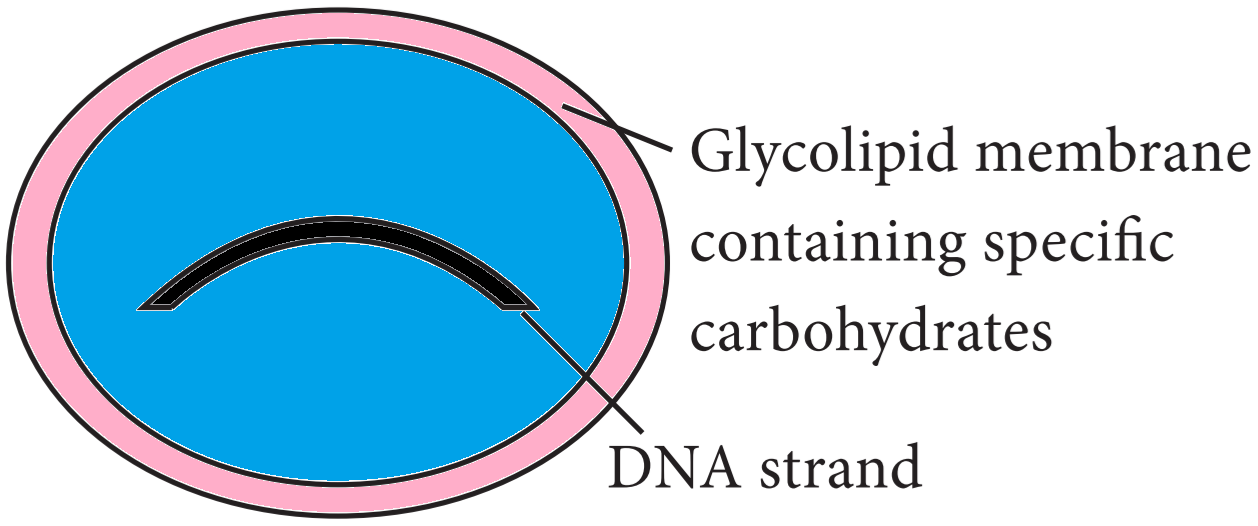
  1. Liposomes can be used for gene therapy as they target the cells affected by a genetic disease. The diagram shows the structure of a liposome.


What feature of a cell surface membrane allows the liposome to target cells affected by a genetic disease?
  1. Carrier molecules.
  2. Phosphate groups.
  3. Protein channels.
  4. Receptor molecules.
  1. Which of the following disorders would gene therapy be least effective?
  1. Cystic fibrosis.
  2. Huntington's disease.
  3. Sickle cell anaemia.
  4. Type II diabetes.
  1. Following are some reasons explaining why gene therapy is not yet fully an effective treatment for genetic diseases.
  1. Lack of knowledge of DNA sequences.
  2. Lack of efficient and safe gene delivery system.
  3. Cost of the technology.
  4. Some diseases involve multiple genes.
  5. Problems with appropriate gene regulation.
Select the correct option.
  1. I, III and V only
  2. II, IV and V only
  3. Ill, IV and V only
  4. I, III and IV only
Write any three differences between benign tumour and malignant tumour.
What is ecological pyramid? Describe the different types of pyramid.
What is mutualism? Describe any four examples.
Placenta.
Arrange the following in the decreasing order (most important first) of their importance, for the welfare of human society. Give reasons for your answer.
Describe the functions of the following:
Epididymis.
Distinguish between Ectotherms and Endotherms.
Sketch and label the V. S. of anatropous ovule and answer the following questions: sac? (a) How many mitotic divisions are required to produce embryo (b) Which part of ovule is converted into seed coat? (c) Which part provides the passage for entry of pollen tube during fertilization?
Vicky's mother was using the same mosquito repellent cream from last six years. She was regularly complaining that this cream has no effects on mosquitoes now. Hearing this, Vicky advised his mother to change the cream as regular usage has led the mosquitoes to develop resistance against it. His mother changed the cream and could notice its effect on mosquitoes.
  1. Explain how mosquitoes were not affected by the previous cream?
  2. On what factors, Darwin's theory was based?
  3. Can you relate this incident to Darwin's concept? How?
  4. Identify the values shown by Vicky.