Question
Mention any two autosomal genetic disorders with their symptoms.

Answer

Two autosomal genetic disorders are as follows:

Sickle cell Anaemia:

It is an autosomal linked recessive disorder, which is caused by point mutation in the beta-globin chain of haemoglobin pigment of the blood. The disease is characterized by sickle shaped red blood cells, which are formed due to the mutant haemoglobin molecule. The disease is controlled by HbA and HbS allele. The homozygous individuals with genotype, HbS HbS, show the symptoms of this disease while the heterozygous individuals with genotype, HbA HbS, are not affected. However, they act as carriers of the disease.

Symptoms:

Rapid heart rate, breathlessness, delayed growth and puberty, jaundice, weakness, fever, excessive thirst, chest pain, and decreased fertility are the major symptoms of sickle cell anaemia disease.

Down's syndrome:

It is an autosomal disorder that is caused by the trisomy of chromosome 21.

Symptoms:

The individual is short statured with round head, open mouth, protruding tongue, short neck, slanting eyes, and broad short hands. The individual also shows retarded mental and physical growth.

Need a full question paper?

Generate a complete, print-ready paper with questions like this in minutes — across 16+ boards, with answer keys.

Start Generating Free

Similar questions

List the various abiotic environmental factors.
  1. Explain Darwinian theory of evolution with the help of one suitable example.
  2. State the two key concepts of the theory.
  3. Amongst pea tendril, Opuntia spines, lemon thorn and Cucurbita tendrils, which ones are homologous structures. Why do you call them so?
Explain the principle of insertional inactivation by giving a suitable example.
Describe the mechanism of inheritance of the ABO system of blood group, highlighting the principle of genetics involved in it.

OR

Explain the genetic basis of blood grouping in human population.
Transcription in eukaryotes is more complex process than in prokaryotes. Justify and compare the initiation, elongation and termination in bacterial cells with eukaryotes.
Write the blood group of people with genotype IAIB. Give reasons in support of your answer.
  1. A true breeding pea plant, homozygous for inflated green pods is crossed with another pea plant with constricted yellow pods (ffgg). What would be the phenotype and genotype of F1 and F2 generations? Give the phenotype ratio of generation.
  2. State the generalisation proposed by Mendel on the basis of the above–Mentioned cross.
Describe the nature of inheritance of the ABO type of blood group in humans. In which ways does this inheritance differ from that of height of the plant in garden pea?

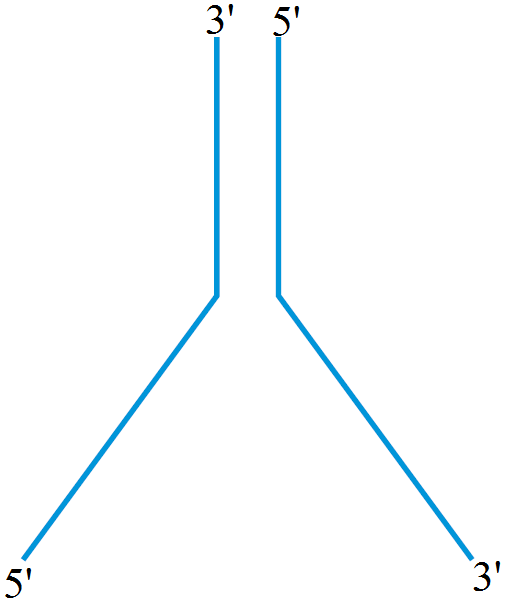
  1. Identify the structure shown above.
  2. Redraw the structure as a replicating fork and label the parts.
  3. Write the source of energy for this replication and list the enzymes involved in this process.
  4. Mention the difference in the synthesis based on the polarity of the two template strands.
Sunny was rushed to a nearby hospital after an accident, which had caused too much blood loss. The hospital failed to supply 'O' negative blood for transfusion. Ahmed, who was attending a patient there, heard about the situation and agreed to donate blood as he had the same blood group. Sunny's mother initially refused but was later convinced by her daughter's view.
  1. Why cannot 'O' positive blood be transfused into Sunny's body?
  2. What is the genetic basis of blood group inheritance?
  3. Human blood grouping is an example of?
  4. What values do you find in Sunny's sister and Ahmed?