Question
Mention any two autosomal genetic disorders with their symptoms.

Answer

Two autosomal genetic disorders are as follows:

Sickle cell Anaemia:

It is an autosomal linked recessive disorder, which is caused by point mutation in the beta-globin chain of haemoglobin pigment of the blood. The disease is characterized by sickle shaped red blood cells, which are formed due to the mutant haemoglobin molecule. The disease is controlled by HbA and HbS allele. The homozygous individuals with genotype, HbS HbS, show the symptoms of this disease while the heterozygous individuals with genotype, HbA HbS, are not affected. However, they act as carriers of the disease.

Symptoms:

Rapid heart rate, breathlessness, delayed growth and puberty, jaundice, weakness, fever, excessive thirst, chest pain, and decreased fertility are the major symptoms of sickle cell anaemia disease.

Down's syndrome:

It is an autosomal disorder that is caused by the trisomy of chromosome 21.

Symptoms:

The individual is short statured with round head, open mouth, protruding tongue, short neck, slanting eyes, and broad short hands. The individual also shows retarded mental and physical growth.

Need a full question paper?

Generate a complete, print-ready paper with questions like this in minutes — across 16+ boards, with answer keys.
Start Generating Free

Similar questions

Answer the following questions:
Explain Mendel’s law of independent assortment by taking a suitable example.
Answer the following questions:
Name the organs where gametogenesis gets completed in human male and female, respectively.
Give an account of Hershey and Chase experiment. What did it conclusively prove? If both DNA and proteins contained phosphorus and sulphur do you think the result would have been the same?
Describe the evidence of evolution from comparative anatomy and morphology?
What is called retrovirus? Show the replication of retrovirus with the help of diagram.
What is population explosion? Discuss the various reason of population explosion.
A tall pea plant with yellow seeds (heterozygous for both the traits) is crossed with a dwarf pea plant with green seeds. Using a Punnett square work out the cross to show the phenotypes and the genotypes of F1 generation.
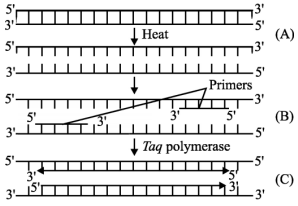
The melding of a technique for repeated rounds of DNA synthesis with the discovery of a thermostable DNA polymerase has given scientists the very powerful technique known as polymerase chain reaction (PCR). PCR is based on three simple steps required for any DNA synthesis reaction: (1) denaturation of the template into single strands; (2) annealing of primers to each original strand for new strand synthesis; and (3) extension of the new DNA strands from the primers.
In the given figure, one cycle of polymerase chain reaction (PCR) is shown:
Image
i. Name the steps A, B and C.
ii. Give the purpose of each of these steps.
iii. State the contribution of Thermus aquaticus in this process.
Explain the various types of interactions between species.
What is Innate Immunity. Explain in detail its various barriers.