Question
Mention differences between light microscope and electron microscope.

Answer

 
Light microscope
 
Electron microscope
1.
It uses glass lenses.
1.
It uses electromagnets.
2.
It uses a beam of light to illuminate the object.
2.
It uses a beam of electrons instead of light.
3.
Internal vacuum is not required.
3.
Internal vacuum is essential.

Need a full question paper?

Generate a complete, print-ready paper with questions like this in minutes — across 16+ boards, with answer keys.
Start Generating Free

Similar questions

State the various postulates of Dalton’s atomic theory of matter.
If one gram of sulphur contains $x$ atoms, calculate the number of atoms in one gram of oxygen element. $($Atomic masses: $S = 32u; O = 16u)$
Give the formulate of the compounds formed from the following sets of elements:
  1. Calcium and fluorine.
  2. Hydrogen and sulphur.
  3. Nitrogen and hydrogen.
  4. Carbon and chlorine.
  5. Sodium and oxygen.
  6. Carbon and oxygen.
Explain the terms 'compression' and 'rarefactions' of a wave. What type of waves consist of compressions and rarefactions?
How could you  convince a small child that when ou speak, it is not necessary for air to travel from your mouth to the ear of a listener?
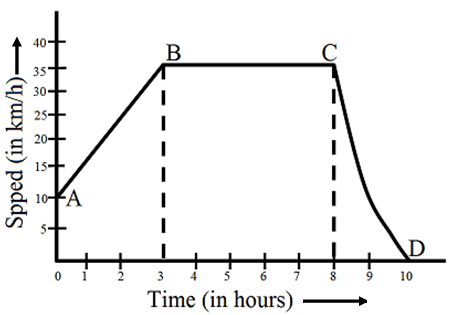
The graph given alongside shows how the speed of a car changes with time:
  1. What is the initial speed of the car?
  2. What is the maximum speed attained by the car?
  3. Which part of the graph shows zero acceleration
  4. Which part of the graph shows varying retardation?
  5. Find the distance travelled in first 8 hours.
Three different vibrating objects produce three types of sounds X, Y and Z. Sounds X and Y cannot be heard by a man having normal range of hearing but sound Z can be heard easily. The sound X is used in hospitals to break kidney stones of a patient into fine grains whioch then get flushed out with urine. The sound Y is similar to that which is produced during an earthquake before the main shock wave is generated.
  1. What type of sounds are (i) X, (ii) Y, and (iii) Z?
  2. Name one device which can produce sound like X.
  3. Name one device in a science laboratory which can produce sound like Y.
  4. Name one device in our homes which can produce sound like Z.
  5. What is the frequency range of sounds like Z?
An atom of an element $X$ may be written as $^{9}_4\text{X} $
  1. What does the figure $9$ indicate?
  2. What does the figure $4$ indicate?
  3. What is the number of protons in atom $X$?
  4. What is the number of neutrons in atom $X$?
  5. What is the number of electrons in atom $X$?
  6. How many electrons are there in the outermost shell of an atom of element $X$?
  7. Write the symbol of ion formed by an element $Z$ is $2, 8, 8.$
State the law of constant proportions. Give one example to illustrate this law.
How is green revolution different from white revolution?