Question
Mention the changes occurring in the geomagnetic components.

Answer

Changes in the geomagnetic components : Magnitudes of geomagnetic components are not only different at different places on the earth and there are usual and unusual changes in their magnitudes at same place also. These changes are as follows:
(1) Long term changes: According to Kelvin, changes in magnitudes of geomagnetic components occur very slowly with time and after one thousand years, they again come back to their original value. According to him, the cause of this change is the spinning of magnetic poles around the geographic poles.
(2) Annual changes: These changes complete their cycle in one year. These changes are maximum in a particular month and minimum in another particular month and their characteristics is of opposite types in both hemispheres. For example, in the month of February, angle of dip is maximum in northern hemisphere and minimum in southern hemisphere. In contract to this, in the month of August, it is minimum in northern hemisphere and maximum in southern hemisphere.
(3) Daily changes : In magnitude of geomagnetic elements, there are daily changes. These changes are maximum at a particular time of the day and minimum at another particular time of the day. This time is different for three components.
(4) Non-periodic changes : Sometimes there are sudden changes in geomagnetic components which are known as magnetic disturbance. Whenever black spot in the sun is towards earth, then there is sudden change in geomagnetic elements.
Need a full question paper?

Generate a complete, print-ready paper with questions like this in minutes — across 16+ boards, with answer keys.

Start Generating Free

Similar questions

Electrons oscillating in a circuit give rise to radiowaves. A transmitting antenna radiates most effectively the radiowaves of wavelength equal to the size of the antenna. The infrared waves incident on a substance set into oscillation all its electrons, atoms and molecules. This increases the internal energy and hence the temperature of the substance.
  1. If $v_g, v_x$ and $v_m$ are the speeds of gamma rays, X-rays and microwaves respectively in vacuum, the
  1. $v_g > v_x > v_m$
  2. $v_g < v_x < v_m$
  3. $v_g > v_x > v_m$
  4. $v_g = v_x = v_m$
  1. Which of the following wi II deflect in electric field?
  1. X-rays.
  2. $\gamma-\text{rays}.$
  3. Cathode rays.
  4. Ultraviolet rays.
  1. $\gamma-\text{rays}$ are detected by:
  1. Point contact diodes.
  2. Thennopiles.
  3. Ionization chamber.
  4. Photocells.
  1. The frequency of electromagnetic wave, which best suited to observe a particle ofradius $3 \times 10^{-4}cm$ is the order of,
  1. $10^{15}Hz$
  2. $10^{14} Hz$
  3. $10^{13}Hz$
  4. $10^{12}Hz$
  1. We consider the radiation emitted by the human body. Which one of the following statements is true?
  1. The radiation emitted is in the infrared region.
  2. The radiation is emitted only during the day.
  3. The radiation is emitted during the summers and absorbed during the winters.
  4. The radiation emitted lies in the ultraviolet region and hence it is not visible.
Two fat astronauts each of mass 120kg are travelling in a closed spaceship moving at a speed of 15km/s in the outer space far removed from all other material objects. The total mass of the spaceship and its contents including the astronauts is 660kg. If the astronauts do slimming exercise and thereby reduce their masses to 90kg each, with what velocity will the spaceship move?
Write the equation of average power for $L - C - R$ series $AC$ circuit and discuss its special cases.
Consider a coin of Example 1.20. It is electrically neutral and contains equal amounts of positive and negative charge of magnitude 34.8kC. Suppose that these equal charges were concentrated in two point charges seperated by,
  1. 1cm $\Big(\sim\frac{1}{2}\times\text{diagonalof theone paisa coin}\Big)$,
  2. 100m (~ length of a long building), and
  3. $10^6m$ (radius of the earth). Find the force on each such point charge in each of the three cases. What do you conclude from these results?
Two q charges of the same nature are located at a distance d from each other, the third charge of value Q Coulomb is at the mid-point of the line joining them. For what value of Q will the system be in equilibrium?
Indian style of cooling drinking water is to keep it in a pitcher having porous walls. Water comes to the outer surface very slowly and evaporates. Most of energy needed for evaporation is taken from the water itself and the water is cooled down. Assume that a pitcher contains 10kg of water and 0.2g of water comes out per second. Assuming no backward heat transfer from the atmosphere to the water, calculate the time in which the temperature decrease by 5°C. Specific heat capacity of water $= {4200J kg^{-1}}^\circ C^{-1}$ and latent heat of vaporization of water $= 2.27 \times 10^6\ J\ kg^{-1}.$
A charge is a property associated with the matter due to which it experiences and produces an electric and magnetic field. Charges are scalar in nature and they add up like real numbers. Also, the total charge of an isolated system is always conserved. When the objects rub against each other charges acquired by them must be
Image
(i) The cause of charging is:
(a) the actual transfer of atoms 
(b) the actual transfer of protons
(c) the actual transfer of electrons  
(d) the actual transfer of neutrons

(ii) Pick the correct statement.
i. The glass rod gives protons to silk when they are rubbed against each other.
ii. The glass rod gives electrons to silk when they are rubbed against each other.
iii. The glass rod gains protons from silk when they are rubbed against each other.
iv. The glass rod gains electrons when they are rubbed against each other.
(a) Option (i)  (b) Option (iv)  (c) Option (iii)   (d) Option (ii)

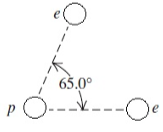
(iii) If two electrons are each $1.5 \times 10^{-10} m$ from a proton, as shown in Figure, magnitude of the net electric force they will exert on the proton is
Image

(a) $1.97 \times 10^{-8} N$
(b) $3.83 \times 10^{-8} N$
(c) $4.63 \times 10^{-8} N$
(d) $2.73 \times 10^{-8} N$

(iv) A charge is a property associated with the matter due to which it produces and experiences:
(a) electric effects only
(b) magnetic effects only
(c) both electric and magnetic effects
(d) non magnetic effects only

OR

The cause of quantization of electric charges is:
(a) transfer of an integral number of electrons
(b) transfer of an integral number of neutrons
(c) transfer of an integral number of protons
(d) transfer of an integral number of Atom
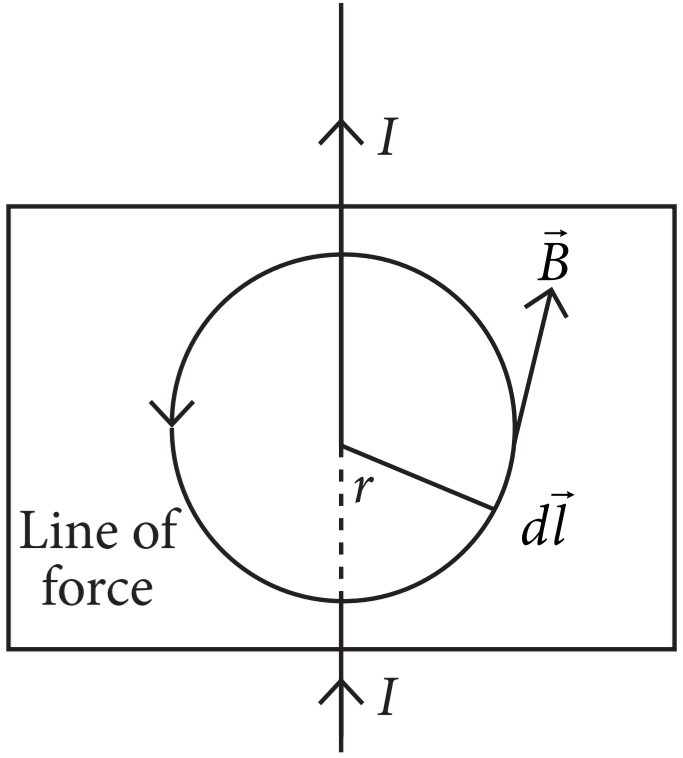
Ampere's law gives a method to calculate the magnetic field due to given current distribution. According to it, the circulation $\oint\vec{\text{B}}.\text{d}\vec{\text{l}}$ di of the resultant magnetic field along a closed plane curve is equal to $\mu_0$ times the total current crossing the area bounded by the closed curve provided the electric field inside the loop remains constant. Ampere's law is more useful under certain synunetrical conditions. Consider one such case of a long Straight wire with circular cross-section (radius R) carrying current f uniformly distributed across this cross-section.
  1. The magnetic field at a radial distance r from the centre of the wire in the region r > R, is:
  1. $\frac{\mu_0\text{I}}{2\pi\text{r}}$
  2. $\frac{\mu_0\text{I}}{2\pi\text{R}}$
  3. $\frac{\mu_0\text{IR}^2}{2\pi\text{r}}$
  4. $\frac{\mu_0\text{Ir}^2}{2\pi\text{R}}$
  1. The magnetic field at a distance r in the region r < R is:
  1. $\frac{\mu_0\text{I}}{2\text{r}}$
  2. $\frac{\mu_0\text{Ir}^2}{2\pi\text{R}^2}$
  3. $\frac{\mu_0\text{I}}{2\pi\text{r}}$
  4. $\frac{\mu_0\text{Ir}}{2\pi\text{R}^2}$
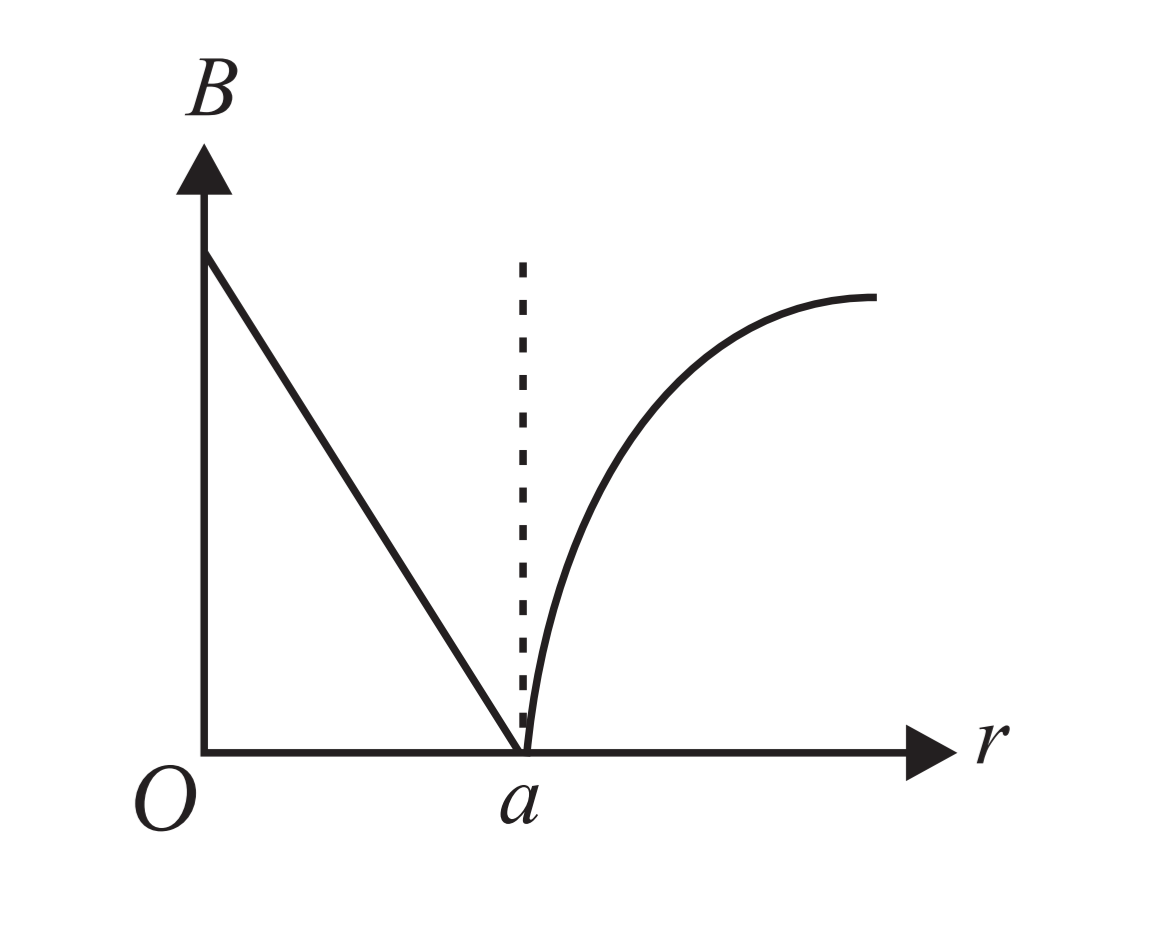
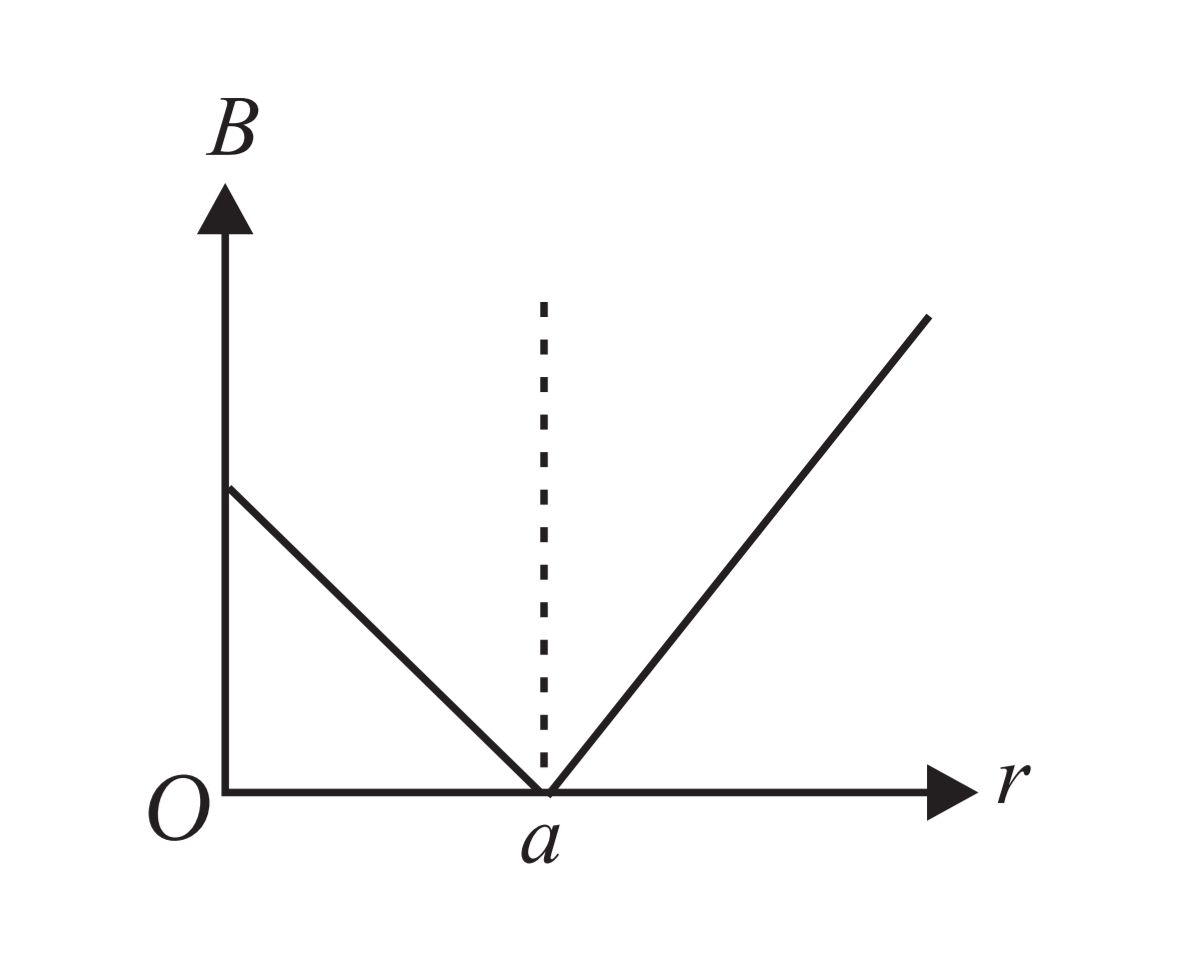
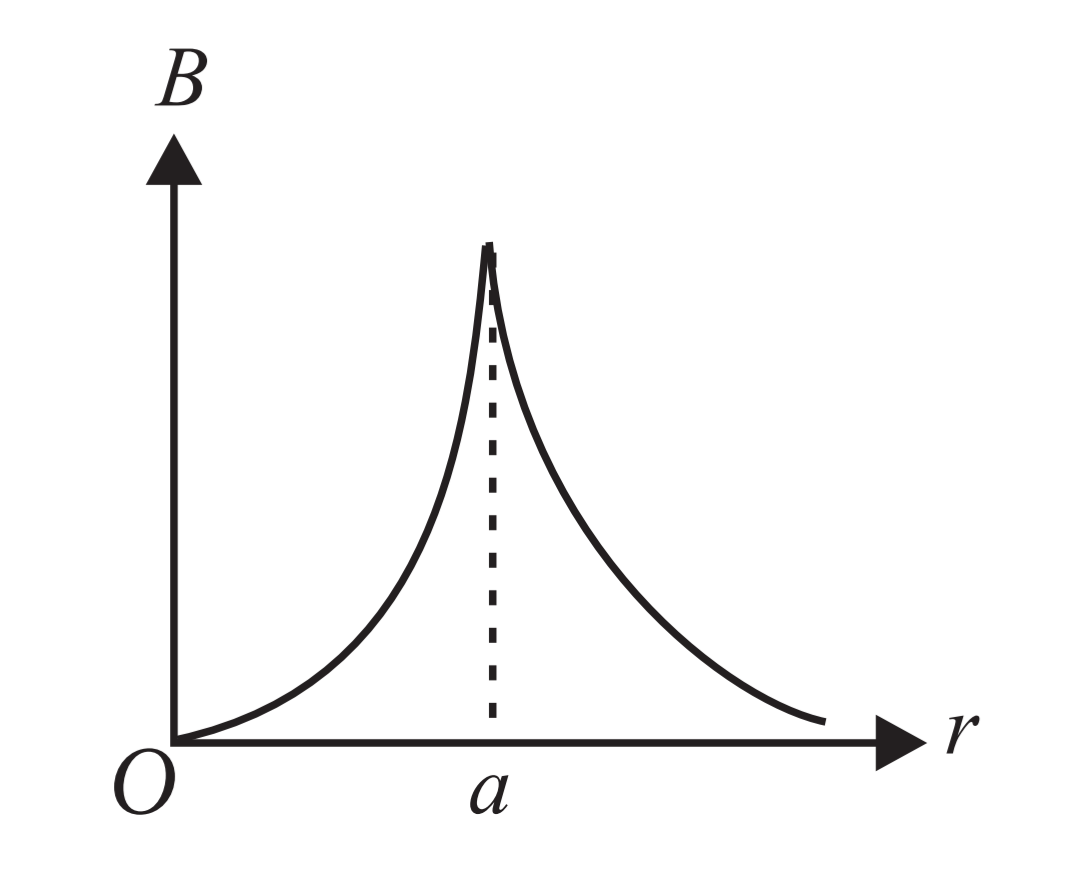
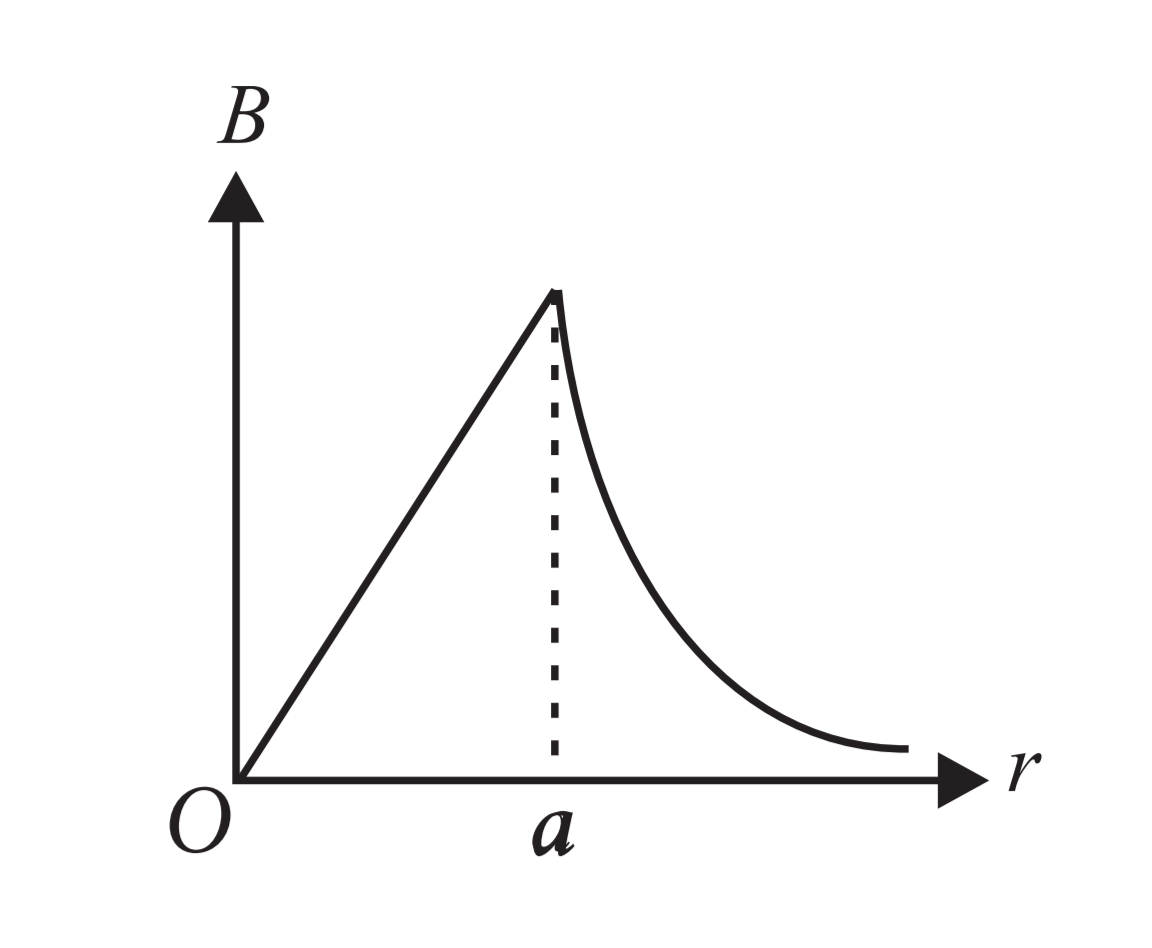
  1. A long straight wire of a circular cross section (radius a) carries a steady current I and the current I is uniformly distributed across this cross-section. Which of the following plots represents the variation of magnitude of magnetic field B with distance r from the centre of the wire?
  1.  
  1.  
  1.  
  1.  
  1. A long straight wire of radius R carries a steady current I. The current is uniformly distributed across its cross-section. The ratio of magnetic field at $\frac{\text{R}}{2}$ and 2R is:
  1. $\frac{\text{1}}{\text{2}}$
  2. $2$
  3. $\frac{\text{1}}{\text{4}}$
  4. $1$
  1. A direct current I flows along the length of an infinitely long straight thin walled pipe, then the magnetic field is:
  1. Uniform throughout the pipe but not zero.
  2. Zero only along the axis of the pipe.
  3. Zero at any point inside the pipe.
  4. Maximum at the centre and minimum at the edges.
Suppose the bent part of the frame of the previous problem has a thermal conductivity of ${780Js^{-1}m^{-1}}^\circ C^{-1}$ whereas it is ${390Js^{-1}m^{-1}}^\circ C^{-1}$ for the straight part. Calculate the ratio of the rate of heat flow through the bent part to the rate of heat flow through the straight part.
A magnetic dipole of magnetic moment $0.72\sqrt{2}\text{ A-m}^2$ -is placed horizontally with the north pole pointing towards east. Find the position of the neutral point if the horizontal component of the earth's magnetic field is $18\mu\text{T.}$