Question
Mention the changes occurring in the geomagnetic components.

Answer

Changes in the geomagnetic components : Magnitudes of geomagnetic components are not only different at different places on the earth and there are usual and unusual changes in their magnitudes at same place also. These changes are as follows:
(1) Long term changes: According to Kelvin, changes in magnitudes of geomagnetic components occur very slowly with time and after one thousand years, they again come back to their original value. According to him, the cause of this change is the spinning of magnetic poles around the geographic poles.
(2) Annual changes: These changes complete their cycle in one year. These changes are maximum in a particular month and minimum in another particular month and their characteristics is of opposite types in both hemispheres. For example, in the month of February, angle of dip is maximum in northern hemisphere and minimum in southern hemisphere. In contract to this, in the month of August, it is minimum in northern hemisphere and maximum in southern hemisphere.
(3) Daily changes : In magnitude of geomagnetic elements, there are daily changes. These changes are maximum at a particular time of the day and minimum at another particular time of the day. This time is different for three components.
(4) Non-periodic changes : Sometimes there are sudden changes in geomagnetic components which are known as magnetic disturbance. Whenever black spot in the sun is towards earth, then there is sudden change in geomagnetic elements.
Need a full question paper?

Generate a complete, print-ready paper with questions like this in minutes — across 16+ boards, with answer keys.

Start Generating Free

Similar questions

A metallic loop is placed in a nonuniform magnetic field. Will an emf be induced in the loop?
Suppose the density of air at Madras is P0 and atomospheric pressure is P0. If we go up, the density and the pressure both decrease. Suppose we wish to calculate the pressure at a height 10km above Madras. If we use the equation P- P = pogz, will we get a pressure more than the actual or less than the actual? Neglect the variation in g. Does your answer change if you also consider the variation in g?
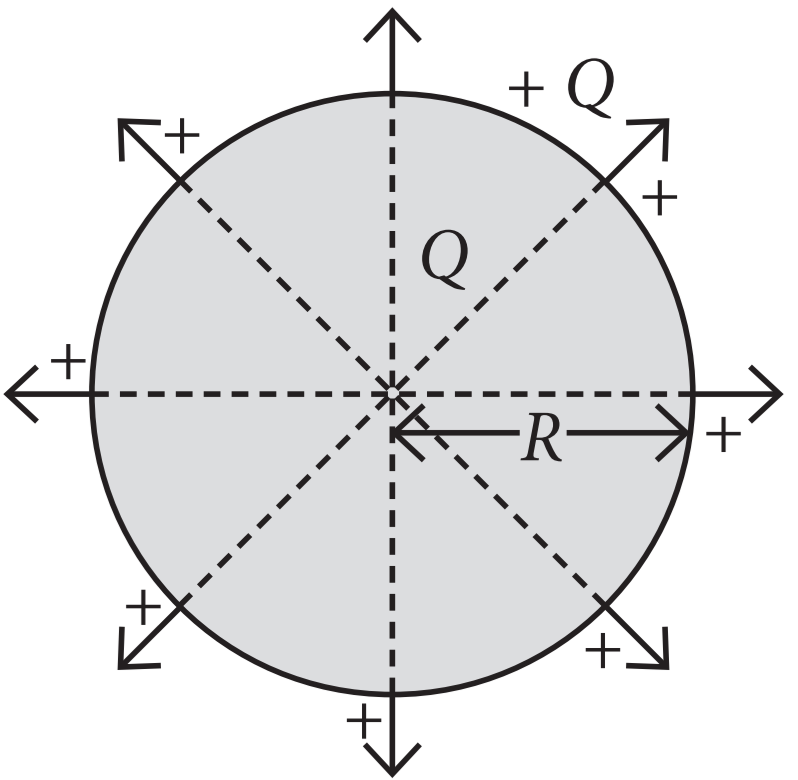
The electrical capacitance of a conductor is the measure of its ability to hold electric charge. An isolated spherical conductor of radius R. The charge Q is uniformly distributed over its entire surface. It can be assumed to be concentrated at the centre of the sphere. The potential at any point on the surface of the spherical conductor will be $\text{V}=\frac{1}{4\pi\in_0}\frac{\text{Q}}{\text{R}}.$

Capacitance of the spherical conductor situated in vacuum is $\text{C}=\frac{\text{Q}}{\text{V}}=\frac{\text{Q}}{\frac{1}{4\pi\in_0}.\frac{\text{Q}}{\text{R}}}$ or $\text{C}=4\pi\in_0\text{R}$ Clearly, the capacitance of a spherical conductor is proportional to its radius.

The radius of the spherical conductor of 1F capacitance is $\text{R}=\frac{1}{4\pi\in_0}.$ C and this radius is about 1500 times the radius of the earth $(\sim6\times10^3\text{km}).$

  1. If an isolated sphere has a capacitance 50pE Then radius is:
  1. 90cm
  2. 45cm
  3. 45m
  4. 90m
  1. How much charge should be placed on a capacitance of 25 pF to raise its potential to 105V?
  1. $1\mu\text{C}$
  2. $1.5\mu\text{C}$
  3. $2\mu\text{C}$
  4. $2.5\mu\text{C}$
  1. Dimensions of capacitance is:
  1. [M L-2 T4 A2]
  2. [M-1 L-1 T3 A1]
  3. [ML-2 T4 A2]
  4. [M0 L-2 T4 A1]
  1. Metallic sphere of radius R is charged to potential V. Then charge q is proportional to:
  1. V
  2. R
  3. Both V and R
  4. None of these
  1. If 64 identical spheres of charge q and capacitance C each are combined to form a large sphere. The charge and capacitance of the large sphere is:
  1. 64q, C
  2. 16q, 4C
  3. 64q, 4C
  4. 16q, 64C
The magnetic moment of the assumed dipole at the earth's centre is 8.0 × 1022 A-m2. Calculate the magnetic field B at the geomagnetic poles of the earth. Radius of the earth is 6400km.
Explain full wave rectification with the help of proper circuit diagram and draw the waveform of input and output voltage.
A short magnet oscillates in an oscillation magnetometern with a time period of 0.10s where the earth's horizontal magnetic field is $24\mu\text{T}.$ A downward current of 18 A is established in a vertical wire placed 20cm east of the magnet. Find the new time period.
According to de-Broglie, a moving material particle sometimes acts as a wave and sometimes as a particle or a wave associated with moving material particle which controls the particle in every respect. The wave associated with moving particle is called matter wave or de-Broglie wave where wavelength called de-Broglie wavelength, rs given by $\lambda=\frac{\text{h}}{\text{mv}}$.

  1. If a proton and an electron have the same de Broglie wavelength, then:
  1. Kinetic energy of electron < kinetic energy of proton.
  2. Kinetic energy of electron = kinetic energy of proton.
  3. Momentum of electron = momentum of proton.
  4. momentum of electron < momentum of proton.
  1. Which of these particles having the same kinetic energy has the largest de Broglie wavelength?
  1. Electron
  2. Alpha particle
  3. Proton
  4. Neutron
  1. Two particles A1 and A2 of masses m1, m2 (m1 > m2) have the same de Broglie wavelength. Then:
  1. Their momenta are the same.
  2. Their energies are the same.
  3. Momentum of A1 is less than the momentum of A1.
  4. Energy of A1 is more than the energy of A2.
  1. When the velocity of an electron increases, its de Broglie wavelength:
  1. Increases.
  2. Decreases.
  3. Remains same.
  4. May increase or decrease.
  1. Proton and $\alpha$ - particle have the same de-Broglie wavelength. What is same for both of them?
  1. Time period
  2. Energy
  3. Frequency
  4. Momentum
A beam of light converges at a point $P$. Now a lens is placed in the path of the convergent beam 12 cm from P. At what point does the beam converge if the lens is (a) a convex lens of focal length 20 cm , and (b) a concave lens of focal length 16 cm ?
A container contains water upto a height of 20cm and there is a point source at the centre of the bottom of the container. A rubber ring of radius r floats centrally on the water. The ceiling of the room is 2.0m above the water surface.
  1. Find the radius of the shadow of the ring formed on the ceiling if r = 15cm.
  2. Find the maximum value of r for which the shadow of the ring is formed on the ceiling. Refractive index of water $\frac{4}{3}.$