Question
Mention the difference between $n$-type and $p$-type semiconductors.

Answer

Difference betwen $n$-type and $p$-type semiconductors
$n$-type Semiconductor$p$-type Semiconductor
1. It is an extrinsic semicon-ductor obtained by adding a pentavalent impurity to a pure intrinsic semi-conductor.It is also an extrinsic semi-conductor obtained by adding a trivalent impurity to a pure intrinsic semiconductor.
2. The impurity atoms added provide extra free electrons to the crystal lattice and are called donor atoms.The impurity atoms added create holes in the crystal lattice and are called acceptor atoms because the created holes accept electrons.
3. The electrons are majority carriers and the holes are minority carriers.The holes are majority carriers and the electrons are mino-rity carriers.
4. The electron concentration is much more than the hole concentration $\left(n_e \gg n_h\right)$.The hole concentration is much more than the electron concentration $\left(n_h \gg n_e\right)$.

Need a full question paper?

Generate a complete, print-ready paper with questions like this in minutes — across 16+ boards, with answer keys.
Start Generating Free

Similar questions

A container contains water upto a height of 20cm and there is a point source at the centre of the bottom of the container. A rubber ring of radius r floats centrally on the water. The ceiling of the room is 2.0m above the water surface.
  1. Find the radius of the shadow of the ring formed on the ceiling if r = 15cm.
  2. Find the maximum value of r for which the shadow of the ring is formed on the ceiling. Refractive index of water $\frac{4}{3}.$
A police jeep is chasing a culprit going on a motorbike. The motorbike crosses a turning at a speed of $72\ km/h.$ The jeep follows it at a speed of $90\ km/h,$ crossing the turning ten seconds later than the bike. Assuming that they travel at constant speeds, how far from the turning will the jeep catch up with the bike?
An electromagnetic wave transports linear momentum as it travels through space. If an electromagnetic wave transfers a total energy $U$ to a surface in time $t,$ then total linear momentum delivered to the surface is $\text{p}=\frac{\text{U}}{\text{c}}.$ When an electromagnetic wave falls on a surface, it exerts pressure on the surface. ln $1903,$ the American scientists Nichols and Hull succeeded in measuring radiation pressures of visible light where other had failed, by making a detailed empirical analysis of the ubiquitous gas heating and ballistic effects.
  1. The pressure exerted by an electromagnetic wave of intensity $I (Wm^{-2})$ on a non$-$reflecting surface is $(c$ is the velocity of light$).$ 
  1. $\text{Ic}$
  2. $\text{Ic}^2$
  3. $\frac{\text{I}}{\text{c}}$
  4. $\frac{\text{I}}{\text{c}^2}$
  1. Light with an energy flux of $18\frac{\text{W}}{\text{cm}^2}$ falls on a non$-$reflecting surface at normal incidence. The pressure exerted on the surface is:
  1. $3\frac{\text{N}}{\text{m}^2}$
  2. $2\times10^{-4}\frac{\text{N}}{\text{m}^2}$
  3. $6\frac{\text{N}}{\text{m}^2}$
  4. $6\times10^{-4}\frac{\text{N}}{\text{m}^2}$
  1. Radiation of intensity $0.5Wm^{-2}$ are striking a metal plate. The pressure on the plate is:
  1. $0.166 \times 10^{-8}Nm^{-2}$
  2. $0.212 \times 10^{-8}Nm^{-2}​​​​​​​$
  3. $0.132 \times 10^{-8}Nm^{-2}​​​​​​​$
  4. $0.083 \times 10^{-8}Nm^{-2}​​​​​​​$
  1. A point source of electromagnetic radiation has an average power out$-$put of $1500W.$ The maximum value of electric field at a distance of 3m from this source $($in $Vm^{-1})$ is:
  1. $500$
  2. $100$
  3. $\frac{500}{3}$
  4. $\frac{250}{3}$
  1. The radiation pressure of the visible light is of the order of,
  1. $10^{-2}\frac{\text{N}}{\text{m}^2}$
  2. $10^{-4}\frac{\text{N}}{\text{m}}$
  3. $10^{-6}\frac{\text{N}}{\text{m}^2}$
  4. $10^{-8}\text{N}$
Coulomb's law states that the electrostatic force of attraction or repulsion acting between two stationary point charges is given by : $\text{F}=\frac{1}{4\pi\epsilon_0}\frac{\text{q}_1\text{q}_2}{\text{r}^2}$

Where $F$ denotes the force between two charges $q_1$ and $q_2$ separated by a distance $r$ in free space, $\epsilon_0$ is a constant known as permittivity of free space. Free space is vacuum and may be taken to be air practically. If free space is replaced by a medium, then $\epsilon_0$ is replaced by $(\epsilon_0\text{k})$ or $(\epsilon_0\epsilon_\text{r})$ where $k$ is known as dielectric constant or relative permittivity.
  1. In coulomb's law, $\text{F}=\text{k}\frac{\text{q}_1\text{q}_2}{\text{r}^2}$ then on which of the following factors does the proportionality constant $k$ depends?
  1. Electrostatic force acting between the two charges.
  2. Nature of the medium between the two charges.
  3. Magnitude of the two charges.
  4. Distance between the two charges.
  1. Dimensional formula for the permittivity constant $\epsilon_0$ of free space is:
  1. $[ML^{-3 }T^4 A^2]$
  2. $[M^{-1} L^3 T^2 A^2]$
  3. $[M^{-1} L^{-3} T^4 A^2]$
  4. $ML^{-3} T^4 A^{-2}]$
  1. The force of repulsion between two charges of $1C$ each, kept $1m$ apart in vaccum is:
  1. $\frac{1}{9\times10^9}\text{N}$
  2. $9 \times 10^9N$
  3. $9 \times 10^7N$
  4. $\frac{1}{9\times10^{12}}\text{N}$
  1. Two identical charges repel each other with a force equal to $10$ mgwt when they are $0.6m$ apart in air.$(g = 10m s^{-2})$. The value of each charge is:
  1. $2mC$
  2. $2 \times 10^{-7}mC$
  3. $2 nC$
  4. $2\mu\text{C}$
  1. Coulomb's law for the force between electric charges most closely resembles with:
  1. Law of conservation of energy.
  2. Newton's law of gravitation.
  3. Newton's $2^{nd}$ law of motion.
  4. Law of conservation of charge.
A container contains water upto a height of 20cm and there is a point source at the centre of the bottom of the container. A rubber ring of radius r floats centrally on the water. The ceiling of the room is 2.0m above the water surface.
  1. Find the radius of the shadow of the ring formed on the ceiling if r = 15cm.
  2. Find the maximum value of r for which the shadow of the ring is formed on the ceiling. Refractive index of water $\frac{4}{3}.$
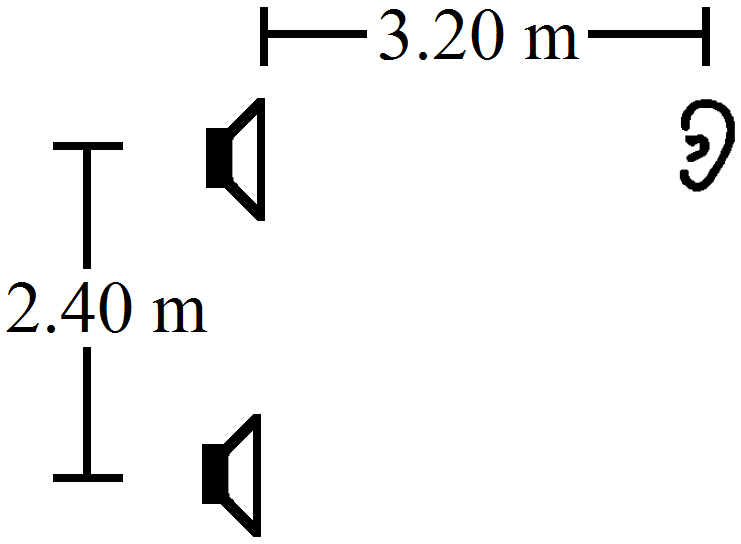
Two stereo speakers are separated by a distance of 2.40m. A person stands at a distance of 3.20m directly in front of one of the speakers as shown in figure, Find the frequencies in the audible range (20-2000Hz) for which the listener will hear a minimum sound intensity. Speed of sound in air = 320m/s.
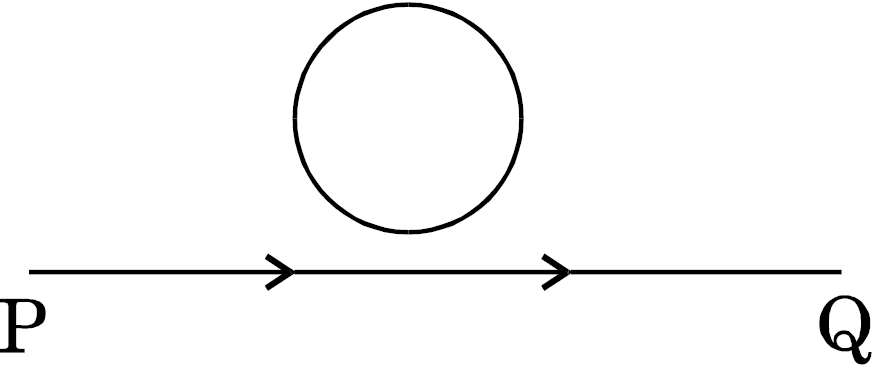
A conducting loop is held above a current carrying wire ‘PQ’ as shown in the figure. Depict the direction of the current induced in the loop when the current in the wire PQ is constantly increasing.
For a single slit of width "a", the first minimum of the interference pattem of a monochromatic light of wavelength$\lambda$. Occurs at an angle of$\frac{\lambda}{\text{a}}$. At the same angle of$\frac{\lambda}{\text{a}},$ we get a maximum for two narrow slits separated by a distance "a". Explain.
Describe with diagram the working method of $p-n-p$ and $n-p-n$ transistors.
Sunita and her friends visited an exhibition. The policeman asked them to pass through a metal detector. Sunita’s friends were initially scared of it. Sunita, however, explained to them the purpose and working of the metal detector.
Answer the following questions:
  1. On what principle does a metal detector work?
  2. Why does the detector emit sound when a person carrying any metallic object walks through it?
  3. State any two qualities which Sunita displayed while explaining the purpose of walking through the detector.