Question
Mention the three characteristics of a mixture.

Answer

The three characteristics of a mixture:
  1. Mixture are both homogenous and hetrogenous.
  2. Mixture are soluble in water.
  3. Mixture is the type of impure matter.
  4. They can be mixed in any ratio.

Need a full question paper?

Generate a complete, print-ready paper with questions like this in minutes — across 16+ boards, with answer keys.
Start Generating Free

Similar questions

What are lysosomes? How are they formed? Give their functions.
Distinguish between polyp and medusa.
An element A forms an oxide $A_2O_5$.
  1. What is the valency of element A?
  2. What will be the formula of chloride of A?
Three different atoms of oxygen are represented as:$^{16}_{\ 8}\text{O},\ ^{17}_{\ 8}\text{O}\text{ and }^{18}_{\ 8}\text{O}$
  1. What do the subscripts (lower figures) and superscripts (upper figures) represent?
  2. What factor is responsible for the change in the superscripts $16, 17$ and $18$, though the element is the same?
  3. What is the usual name for such atoms of an element?
  4. Give the nuclear composition of $​​^{18}_{\ 8}\text{O}$
Bromine and air take about $15$ minutes to diffuse completely but bromine diffuses into a vacuum very rapidly. Why is this so?
A sample of water under study was found to boil at $102^\circ C$ at normal pressure. Is the water pure? Will this water freeze at $0^\circ C?$ Comment.
Discuss a few strategies that can be used as preventive measures to reduce the occurrence of any infectious disease.
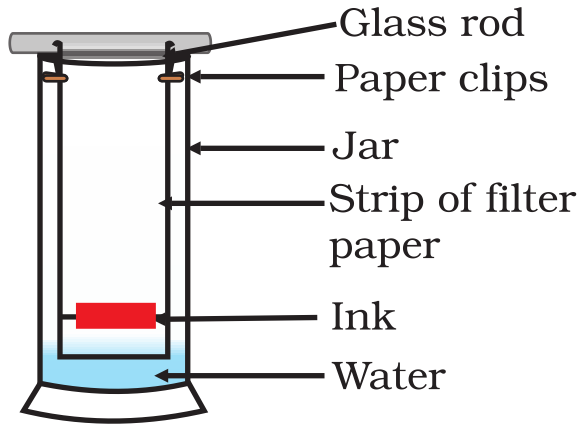
A child wanted to separate the mixture of dyes constituting a sample of ink. He marked a line by the ink on the filter paper and placed the filter paper in a glass containing water as shown in the filter paper was removed when the water moved near the top of the filter paper.

  1. What would you expect to see, if the ink contains three different coloured components?
  2. Name the technique used by the child.
  3. Suggest one more application of this technique.
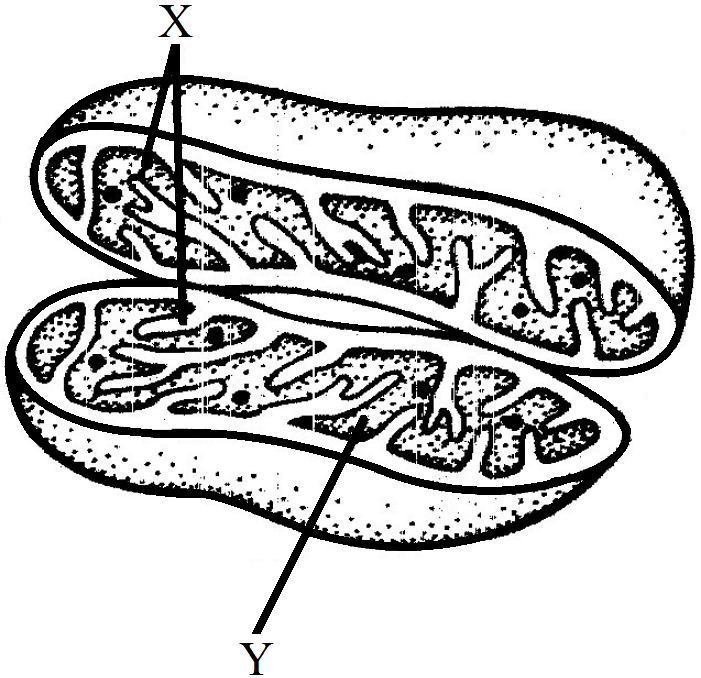
  1. Label $X$ and $Y.$
  2. What is the function of $X?$
  3. What is the composition of $Y?$
  4. Identify the above diagram and what is its common name?
Write short notes on:
$(1)$ Mitochondria.
$(2)$ Plastids.