MCQ
Mercury does not wet glass, wood or iron because
  • A
    Cohesive force is less than adhesive force
  • Cohesive force is greater than adhesive force
  • C
    Angle of contact is less than $90^o$
  • D
    Cohesive force is equal to adhesive force

Answer

Correct option: B.
Cohesive force is greater than adhesive force
b
(b) Cohesive force is greater than adhesive force.

Therefore, no mercury particles are left behind on glass, wood or iron.

Need a full question paper?

Generate a complete, print-ready paper with questions like this in minutes — across 16+ boards, with answer keys.
Start Generating Free

Similar questions

A polyatomic gas with six degrees of freedom does $25\,\,J$ of work when it is expanded at constant pressure. The heat given to the gas is ..... $J$
For the given vector $\vec A =3\hat i -4\hat j+10\hat k$ , the ratio of magnitude of its component on the $x-y$ plane and the component on $z-$ axis is
A body of mass $M$ hits normally a rigid wall with velocity $V$ and bounces back with the same velocity. The impulse experienced by the body is
What is the cause of Green house effect?
The volume of a gas at $20°C$ is $100 \,cm^3$ at normal pressure. If it is heated to $100°C$, its volume becomes $125\, cm^3$ at the same pressure, then volume coefficient of the gas at normal pressure is
If source and observer both are relatively at rest and if speed of sound is increased then frequency heard by observer will
A ray of light is incident normally on one of the face of a prism of angle $30^o$ and refractive index $\sqrt 2 $. The angle of deviation will be.....$^o$
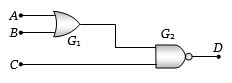
For the given combination of gates, if the logic states of inputs $ A, B, C$ are as follows $A = B = C = 0$ and $A = B = 1, C = 0$ then the logic states of output $D $ are
Two exactly similar wires of steel and copper are stretched by equal forces. If the total elongation is $2 \ cm$, then how much is the elongation in steel and copper wire respectively? Given, $Y_{\text {steel }}=20 \times 10^{11} dyne / \ cm ^2, Y_{\text {copper }}=12 \times 10^{11} dyne / \ cm ^2$
A block of mass $m$ is connected to another block of mass $M$ by a spring (massless) of spring constant $k$. The block are kept on a smooth horizontal plane. Initially the blocks are at rest and the spring is unstretched. Then a constant force $F$ starts acting on the block of mass $M$ to pull it. Find the force of the block of mass $m.$