MCQ
Mercury is a liquid at $0\,^o C$ because of
  • A
    very high ionisation energy
  • B
    weak metallic bonds
  • C
    high heat of hydration
  • Both $(a)$ and $(b)$

Answer

Correct option: D.
Both $(a)$ and $(b)$
d

Need a full question paper?

Generate a complete, print-ready paper with questions like this in minutes — across 16+ boards, with answer keys.

Start Generating Free

Similar questions

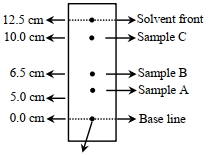
Using the given figure, the ratio of $R_t$ values of sample $A$ and sample $\mathrm{C}$ is $\mathrm{x} \times 10^{-2}$. Value of $\mathrm{x}$ is . . . . . . . . 

(Image)

Samples $(A, B, C)$

Fig : Paper chromatography of Samples
Consider the following statements :

$(a)$ Electron density in the $XY$ plane in $3d_x^2 - 3d_y^2$ orbital is zero

$(b)$ Electron density in the $XY$ plane in $3d_z^2$ orbital is zero

$(c)$ $2s$ orbital has one nodal surface

$(d)$ For $2pz$ orbital $YZ$ is the nodal plane.

Specify True or False.

Oxidation state of both the chlorine atoms in bleaching powder are ?
The relation between equilibrium constant ${K_p}$ and ${K_c}$ is
$3.2$ moles of hydrogen iodide were heated in a scaled bulb at $444\,^oC$ till the equilibrium was reached. The degree of dissociation of $HI$ at this temperature was found to be $22\%$. The number of moles of hydrogen iodide present at equilibrium are
${H_3}C - C \equiv CH\,\xrightarrow{{NaN{H_2}}}A\,\xrightarrow{{C{H_3}C{H_2}Br}}B\xrightarrow[{BaS{O_4}}]{{{H_2}/Pd}}C$

Identify product $(C)$ ?

It is found that for every $10^o$ rise in temperature, the rate of the reaction doubles itself. This is mainly because
Which blue liquid is obtained on reacting equimolar amounts of two gases at $ - 30\,^oC$ 
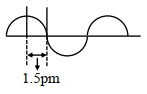
A hypothetical electromagnetic wave is show below.

(Image)

The frequency of the wave is $\mathrm{x} \times 10^{19} \mathrm{~Hz}$. $x=$ . . . .  (nearest integer)
The ionisation energy of nitrogen is more than that of oxygen because :-