MCQ
Metallic solids are always opaque because
  • A
    Solids effect the incident light
  • Incident light is readily absorbed by the free electron in a metal
  • C
    Incident light is scattered by solid molecules
  • D
    Energy band traps the incident light

Answer

Correct option: B.
Incident light is readily absorbed by the free electron in a metal
b
(b)Metallic solids are opaque because incident light is absorbed by the free electrons in a metal.

Need a full question paper?

Generate a complete, print-ready paper with questions like this in minutes — across 16+ boards, with answer keys.

Start Generating Free

Similar questions

To light, a $50\,W , 100\,V$ lamp is connected, in series with a capacitor of capacitance $\frac{50}{\pi \sqrt{ x }} \mu F$, with $200 V , 50 Hz AC$ source. The value of $x$ will be........
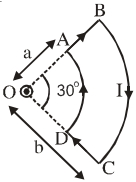
A current loop $ABCD$ is held fixed on the plane of the paper as shown in the figure. The arcs $ BC$ (radius $= b$) and $DA $ (radius $= a$) of the loop are joined by two straight wires $AB $  and $CD$. A steady current $I$ is flowing in the loop. Angle made by $AB$ and $CD$ at the origin $O$ is $30^o $. Another straight thin wire with steady current $I_1$ flowing out of the plane of the paper is kept at the origin.

The magnitude of the magnetic field $(B)$ due to the loop $ABCD$ at the origin $(O)$ is :
Two simple harmonic motions, as shown, are at right angles. They are combined to form Lissajous figures

$x\left( t \right) = A\,\sin \,\left( {at + \delta } \right)$

$y\left( t \right) = B\,\sin \,\left( {bt} \right)$

Identify the correct match below
A physical quantity $'x'$ is calculated from the relation $x = \frac{{{a^2}{b^3}}}{{c\sqrt d }}$ in $a$,$b$,$c$ and $d$ are $2\%$, $1 \%$, $3\%$ and $4\%$ respectively, what is the percentage error in $x$.
In a turbulent flow, the velocity of the liquid molecules in contact with the walls of the tube is
Maximum density of ${H_2}O$ is at the temperature  .......... $^oF$ 
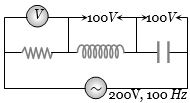
In the circuit given below, what will be the reading of the voltmeter.....$V$
A particle of mass $m$ and charge $q$ is placed at rest in a uniform electric field $E$ and then released. The kinetic energy attained by the particle after moving a distance $y$ is
Two bodies $A$ and $B$ of masses $5.00\  kg$ and $10.0\  kg$ respectively moving in opposite directions with velocities $4.00\  m/s$ and $0.50\  m/s$ respectively make head-on collision in free space. The force of their mutual interaction varies according to the given graph. The coefficient of restitution is
A sample of gas at temperature $T$ is adiabatically expanded to double its volume. The work done by the gas in the process is $\left(\right.$ given, $\left.\gamma=\frac{3}{2}\right)$ :