Question
Metallic solids are always opaque because

Answer

(b)Metallic solids are opaque because incident light is absorbed by the free electrons in a metal.

Need a full question paper?

Generate a complete, print-ready paper with questions like this in minutes — across 16+ boards, with answer keys.
Start Generating Free

Similar questions

The device that does not work on the principle of mutual induction is
Choose the correct statement from the following : The radius of the orbit of a geostationary satellite depends upon
Calculate the time (in $minutes$) interval between $33 \,\%$ decay and $67\, \%$ decay if half-life of a substance is $20\, minutes.$
A diamagnetic material in a magnetic field moves
Two bodies of masses $2\,kg$ and $4\,kg$ are moving with velocities $2\,m/s$ and $10\,m/s$ respectively towards each other due to mutual gravitational attraction. ....... $m/s$ is the velocity of their centre of mass (Bodies are at rest initially)
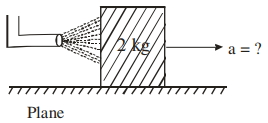
A block of metal weighing $2 \,kg$ is resting on a frictionless plane (as shown in figure). It is struck by a jet releasing water at a rate of $1 \,kgs ^{-1}$ and at a speed of $10 \,ms ^{-1}$. Then, the initial acceleration of the block, in $ms ^{-2}$, will be .................
A spherical soap bubble of radius $3\,cm$ is formed inside another spherical soap bubble of radius $6\,cm$. If the internal pressure of the smaller bubble of radius $3\,cm$ in the above system is equal to the internal pressure of the another single soap bubble of radius $r\,cm$. The value of $r$ is.......
A train is moving on a straight track with speed $20\ ms^{-1}$. It is blowing its whistle at the frequency of $1000\ Hz$. The percentage change in the frequency heard by a person standing near the track as the train passes him is ( speed of sound $=320$ $ms^{-1}$ ) close to .... $\%$
The decay constant of radium is $4.28 \times {10^{ - 4}}$ per year. Its half life will be ..........$years$
Force acting on a particle moving in a straight line varies with the velocity of the particle as $F = \frac {K}{v}$ . Here $K$ is a constant. The work done by this force in time $t$ is