MCQ
Metallic solids are always opaque because
  • A
    Solids effect the incident light
  • Incident light is readily absorbed by the free electron in a metal
  • C
    Incident light is scattered by solid molecules
  • D
    Energy band traps the incident light

Answer

Correct option: B.
Incident light is readily absorbed by the free electron in a metal
b
(b)Metallic solids are opaque because incident light is absorbed by the free electrons in a metal.

Need a full question paper?

Generate a complete, print-ready paper with questions like this in minutes — across 16+ boards, with answer keys.
Start Generating Free

Similar questions

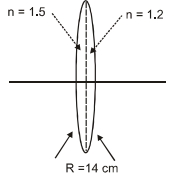
A bi-convex lens is formed with two thin plano-convex lenses as shown in the figure. Refractive index $n$ of the first lens is $1.5$ and that of the second lens is $1.2$. Both the curved surfaces are of the same radius of curvature $R=$ $14 \ cm$. For this bi-convex lens, for an object distance of $40 \ cm$, the image distance will be
Two resistors of resistance $R_1$ and $R_2$ having $R_1 > R_2$ are connected in parallel. For equivalent resistance R, the correct statement is
When the current $i$ is flowing through a conductor, the drift velocity is $v$. If $2i$ current is flowed through the same metal but having double the area of cross-section, then the drift velocity will be
In a region of uniform magnetic induction $B = {10^{ - 2}}\,tesla$, a circular coil of radius $30\, cm$ and resistance $\pi^2 \;ohm$ is rotated about an axis which is perpendicular to the direction of $B$ and which forms a diameter of the coil. If the coil rotates at  $200\, rpm$ the amplitude of the alternating current induced in the coil is.....$mA$
The electric field at a point on equatorial line of a dipole and direction of the dipole moment:
The electric field in a region is directed outward and is proportional to the distance r from the origin. Taking the electric potential at the origin to be zero,
A photon of wavelength $6630 \  Å$ is incident on a totally reflecting surface. The momentum delivered by the photon is equal to
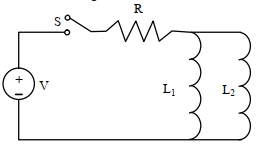
A source of constant voltage $V$ is connected to a resistance $R$ and two ideal inductors $L_1$ and $L_2$ through a switch $S$ as shown. There is no mutual inductance between the two inductors. The switch $S$ is initially open. $At$ $t=0$, the switch is closed and current begins to flow. Which of the following options is/are correct?

(image)

$[A]$ After a long time, the current through $L_1$ will be $\frac{V}{R} \frac{L_2}{~L_1+L_2}$

$[B]$ After a long time, the current through $\mathrm{L}_2$ will be $\frac{\mathrm{V}}{\mathrm{R}} \frac{\mathrm{L}_1}{\mathrm{~L}_1+\mathrm{L}_2}$

$[C]$ The ratio of the currents through $L_1$ and $L_2$ is fixed at all times $(t>0)$

$[D]$ At $t=0$, the current through the resistance $R$ is $\frac{V}{R}$
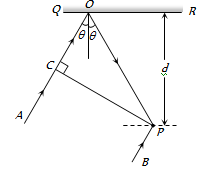
In the adjacent diagram, CP represents a wavefront and AO & BP, the corresponding two rays. Find the condition on q for constructive interference at P between the ray BP and reflected ray OP
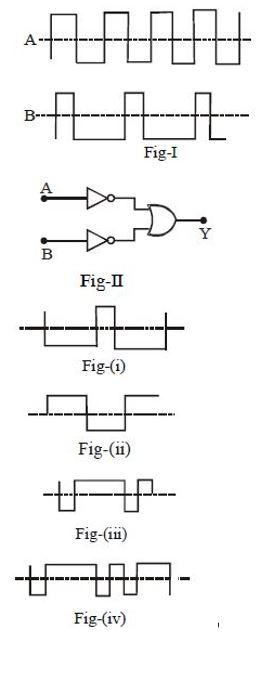
Input waveforms $A$ and $B$ as shown in fig $I$ are applied to the combination of gates as shown in Fig.$II$. Which of the waveforms shown in Fig. $(i)$ to $(iv)$ correctly represents the output waveform?