MCQ
Methanol and ethanol are miscible in water due to
  • A
    Covalent character
  • Hydrogen bonding character
  • C
    Oxygen bonding character
  • D
    None of these

Answer

Correct option: B.
Hydrogen bonding character
b
Methanol and ethanol contain polar covalent $O - H$ bond. Hence, they can form hydrogen bonds. Due to their hydrogen bonding character, they are miscible with water.

Need a full question paper?

Generate a complete, print-ready paper with questions like this in minutes — across 16+ boards, with answer keys.

Start Generating Free

Similar questions

Three moles of an ideal gas are compressed isothermally from $60 \mathrm{~L}$ to $20 \mathrm{~L}$ using constant pressure of $5 \mathrm{~atm}$. Heat exchange $Q$ for the compression is - . . . . . . . . . .Lit. atm.
If the density of a solution is $3.12 g mL ^{-1}$, the mass of 1.5 mL solution in significant figures is ___________ .
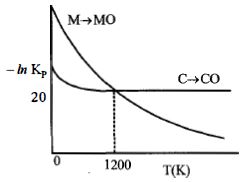
The plot shows the variation of $- In\,K_p$ versus temperature for the two reactions.

$M(s) + \frac{1}{2}{O_2}(s)\, \to \,MO(s)\,$  and  $C(s) + \frac{1}{2}{O_2}(g)\, \to \,CO(s)\,$

Identify the correct statement
In which of the following molecule all the effect namely inductive, mesomeric $\&$ hyperconjugation operate
For the reaction:

$I ^{-}+ ClO _3^{-}+ H _2 SO _4 \longrightarrow Cl ^{-}+ HSO _4^{-}+ I _2$

The correct statement(s) in the balanced equation is/are:

$(A)$ Stoichiometric coefficient of $HSO _4^{-}$is 6 .

$(B)$ lodide is oxidized.

$(C)$ Sulphur is reduced.

$(D)$ $H _2 O$ is one of the products.

The interaction between $\pi$ bond and lone pair of electrons present on an adjacent atom is responsible for
Which of the following is a pair of metamers
A mixture of potassium chlorate, oxalic acid and sulphuric acid is heated. During the reaction which element undergoes maximum change in the oxidation number ?
The major product $[B]$ in the following sequence of reactions is

$\begin{array}{*{20}{c}}
  {C{H_3} - C = CH - C{H_2}C{H_3}} \\ 
  {|\,\,\,\,\,\,\,\,\,\,\,\,\,\,\,\,\,\,\,\,\,\,\,\,\,\,\,\,\,\,\,\,} \\ 
  {CH{{(C{H_3})}_2}\,\,\,\,\,\,\,\,\,\,} 
\end{array}\xrightarrow[{(ii)\,{H_2}{O_2},O{H^ - }}]{{(i)\,{B_2}{H_6}}}[A]$$\xrightarrow[\Delta ]{{dil.\,{H_2}S{O_4}}}[B]$

Which of the following are correct order of stability of oxidation states of cations

$(a)\ Pb^{+2} > Pb^{+4} , Tl^{+1} < Tl^{+3}$

$(b)\ Bi^{+3} < Sb^{+3 }, Sn^{+2} < Sn^{+4}$

$(c)\ Pb^{+2} > Pb^{+4} , Bi^{+3} > Bi^{+5}$

$(d)\ Tl^{+3} < In^{+3} , Sn^{+2} > Sn^{+4}$

$(e)\ Sn^{+24} < Pb^{+2} , Sn^{+4} > Pb^{+4}$

$(f)\ Sn^{+2} < Pb^{+2} , Sn^{+4} < Pb^{+4}$