MCQ
Methanol can be distinguish from ethanol by
  • A
    Sodium
  • B
    Lucas reagent
  • C
    Tollens reagent
  • $I_2 + NaOH$

Answer

Correct option: D.
$I_2 + NaOH$
d

Need a full question paper?

Generate a complete, print-ready paper with questions like this in minutes — across 16+ boards, with answer keys.

Start Generating Free

Similar questions

The first, second and third Ionisation energies $(E_1 , E_2$ and $E_3)$ for an element  are $7\, eV, 12.5\,eV$ nnd $42.5\, eV$ respectively. The most stable oxidation state of the  element will be
Match List $I$ with List $II$
List $I$ (Natural amino acid) List $II$ (Code)
$A$ Glutamic acid $I$ $Q$
$B$ Glutamine $II$ $W$
$C$ Tyrosine $III$ $E$
$D$ Tryptophan $IV$ $Y$
The catalyst used in the hydrogenation of oils is
The product of oxidation of ${I^ - }$ ion by $MnO_4^ - $ in alkaline medium is
An ideal gas, $\overline{\mathrm{C}}_{\mathrm{V}}=\frac{5}{2} \mathrm{R}$, is expanded adiabatically against a constant pressure of $1 \mathrm{~atm}$ untill it doubles in volume. If the initial temperature and pressure is $298 \mathrm{~K}$ and $5 \mathrm{~atm}$, respectively then the final temperature is. . . . . . .$\mathrm{K}$ (nearest integer). [ $\overline{\mathrm{C}}_{\mathrm{V}}$ is the molar heat capacity at constant volume]
The magnetic moment of a metal ion of first transition series is $2.83 $ $BM$. Therefore it will have unpaired electrons
The correct statements among $I$ to $III$ are

$I$. Valence bond theory cannot explain the color exhibited by transition metal complexes

$II$. Valence bond theory can predict quantitatively the magnetic properties of transition metal complexes

$III$. Valence bond theory cannot distinguish ligands as weak and strong field ones
Which of the following compounds is expected to be coloured
Chlorine water on standing loses its colour and forms
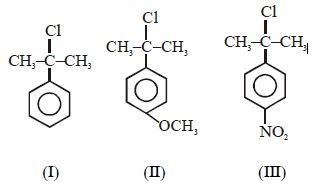
The decreasing order of reactivity of the compound given below towards solvolysis under identical condition is