MCQ
Microwave oven acts on the principle of
  • A
    giving rotational energy to water molecules
  • B
    giving translational energy to water molecules
  • giving vibrational energy to water molecules
  • D
    transferring electrons from lower to higher energy levels in water molecule
Answer

Correct option: C.
giving vibrational energy to water molecules
c
Microwave oven acts on the principle of giving vibrational energy to water molecules.

Need a full question paper?

Generate a complete, print-ready paper with questions like this in minutes — across 16+ boards, with answer keys.

Start Generating Free

Similar questions

The length of a spring is $l$ and its force constant is $k$. When a weight $W$ is suspended from it, its length increases by $x$. If the spring is cut into two equal parts and put in parallel and the same weight $W$ is suspended from them, then the extension will be
Which of the following figure shows the correct equipotential surfaces of a system of two positive charges?
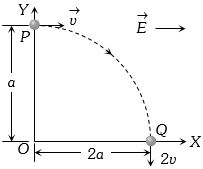
A particle of charge $+q$ and mass $m$ moving under the influence of a uniform electric field $E\hat i$ and a uniform magnetic field $B\hat k$ follows trajectory from $P$ to $Q$ as shown in figure. The velocities at $P$ and $Q$ are $v\hat i$ and $ - 2v\hat j$ respectively. Which of the following statement(s) is/are correct
The maximum efficiency of full wave rectifier is.........$\%$
The heat is flowing through a rod of length $50 cm$ and area of cross-section $5c{m^2}$. Its ends are respectively at ${25^o}C$ and ${125^o}C$. The coefficient of thermal conductivity of the material of the rod is $0.092 kcal/m×s×^\circ C$. The temperature gradient in the rod is
If a spring is extended to length $l,$ then according to Hook's law
Two point charges $ + 9e$ and $ + e$ are at $16\, cm$ away from each other. Where should another charge $q$ be placed between them so that the system remains in equilibrium
Wave nature of light is verified by
The incident ray, reflected ray and the outward drawn normal are denoted by the unit vectors $\overrightarrow{ a }, \overrightarrow{ b }$ and $\overrightarrow{ c }$ respectively. Then choose the correct relation for these vectors.
A hot metallic sphere of radius $r$ radiates heat. It's rate of cooling is