Question
Minimum value of $5{\sin ^2}\theta + 4{\cos ^2}\theta $ is

Answer

d
(d) Let $f(\theta ) = 5{\sin ^2}\theta + 4{\cos ^2}\theta = 4 + {\sin ^2}\theta $ 

$\therefore f(\theta ) \ge 4 + 0$         $( \because {\sin ^2}\theta  \ge 0)$ 

$\therefore $ The minimum value of $f(\theta )$ is $4.$

Need a full question paper?

Generate a complete, print-ready paper with questions like this in minutes — across 16+ boards, with answer keys.
Start Generating Free

Similar questions

Let $x _{1}, x _{2}, x _{3}, \ldots ., x _{20}$ be in geometric progression with $x_{1}=3$ and the common ration $\frac{1}{2}$. A new data is constructed replacing each $x_{i}$ by $\left(x_{i}-i\right)^{2}$. If $\bar{x}$ is the mean of new data, then the greatest integer less than or equal to $\bar{x}$ is $.....$
Let a conic $\mathrm{C}$ pass through the point $(4,-2)$ and $\mathrm{P}(\mathrm{x}, \mathrm{y}), \mathrm{x} \geq 3$, be any point on $\mathrm{C}$. Let the slope of the line touching the conic $\mathrm{C}$ only at a single point $\mathrm{P}$ be half the slope of the line joining the points $P$ and $(3,-5)$. If the focal distance of the point $(7,1)$ on $C$ is $d$, then $12 \mathrm{~d}$ equals ...........
The position vectors of two points $ A$ and $B$  are $i + j - k$ and $2i - j + k$ respectively. Then $|\overrightarrow {AB} |\,\, = $
If sum of the coefficient of the first, second and third terms of the expansion of ${\left( {{x^2} + \frac{1}{x}} \right)^m}$ is $46$, then the coefficient of the term that doesnot contain $x$ is :-
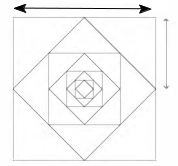
Let $S_1$ be the sum of areas of the squares whose sides are parallel to coordinate axes. Let $S_2$ be the sum of areas of the slanted squares as shown in the figure. Then, $\frac{S_1}{S_2}$ is equal to
The sum of all two digit positive numbers which when divided by $7$ yield $2$ or $5$ as remainder is
Let the first term of a series be $T_1=6$ and its $\mathrm{r}^{\text {th }}$ term $T_r=3 T_{r-1}+6^r, r=2,3, \ldots . ., n$. If the sum of the first $\mathrm{n}$ terms of this series is $\frac{1}{5}\left(n^2-12 n+39\right)$ $\left(4.6^n-5.3^n+1\right)$. Then $n$ is equal to ...........
If the sum of the roots of the quadratic equation $a{x^2} + bx + c = 0$is equal to the sum of the squares of their reciprocals, then $\frac{{{b^2}}}{{ac}} + \frac{{bc}}{{{a^2}}} = $
If the sum of series $\frac{1}{1 \cdot(1+d)}+\frac{1}{(1+d)(1+2 d)}+\ldots \ldots+\frac{1}{(1+9 d)(1+10 d)}$ is equal to $5$ , then $50 \mathrm{~d}$ is equal to :
Let $A=\left[a_{i j}\right], a_{i j} \in Z \cap[0,4], 1 \leq i, j \leq 2$. The number of matrices $A$ such that the sum of all entries is a prime number $p \in(2,13)$ is $........$.