MCQ
Minimum value of the function $f(x) = \left| {\sin \,x + \cos \,x + \tan \,x + \cot \,x + \sec \,x + \ cosec\ x} \right|$ is equal to
  • A
    $2\sqrt 2$
  • $2\sqrt 2  - 1$
  • C
    $2 + 3\sqrt 2 $
  • D
    $2\sqrt 2  + 1$

Answer

Correct option: B.
$2\sqrt 2  - 1$
b
Put $=\sin x+\cos x=p \Rightarrow 1+2 \sin x \cos x=p^{2}$

$\sin x \cos x=\left(\frac{p^{2}-1}{2}\right)$

$\therefore f(x) = \left| {p + \frac{2}{{\left( {{p^2} - 1} \right)}} + \frac{{2p}}{{{p^2} - 1}}} \right|$

${=\left|p+\frac{2}{(p-1)}\right|} $

${=\left|(p-1)+\frac{2}{(p-1)}+1\right|}$

$\therefore \frac{(p-1)+\left(\frac{2}{p-1}\right)}{2} \geq\left((p-1) \cdot \frac{2}{p-1}\right)^{1 / 2}$

$\therefore(p-1)+\left(\frac{2}{p-1}\right) \geq 2 \sqrt{2}$

$\therefore \quad f(x)_{\min } \geq 2 \sqrt{2}+1$

Need a full question paper?

Generate a complete, print-ready paper with questions like this in minutes — across 16+ boards, with answer keys.

Start Generating Free

Similar questions

Let $S$ be the set of all complex numbers $z$ satisfying $\left|z^2+z+1\right|=1$. Then which of the following statements is/are $TRUE$?

$(A)$ $\left|z+\frac{1}{2}\right| \leq \frac{1}{2}$ for all $z \in S$  $(B)$ $|z| \leq 2$ for all $z \in S$

$(C)$ $\left|z+\frac{1}{2}\right| \geq \frac{1}{2}$ for all $z \in S$  $(D)$ The set $S$ has exactly four elements

Let $f(x) = 4$ and $f'(x) = 4$, then $\mathop {\lim }\limits_{x \to 2} \,\frac{{xf(2) - 2f(x)}}{{x - 2}}$ equals
The sum of all the elements in the set $\{\mathrm{n} \in\{1,2, \ldots \ldots ., 100\} \mid$ $H.C.F.$ of $n$ and $2040$ is $1\,\}$ is equal to $.....$
Let $a, \lambda, \mu \in \mathbb{R}$. Consider the system of linear equations

$a x+2 y=\lambda$

$3 x-2 y=\mu$Which of the following statement($s$) is(are) correct?

($A$) If $a=-3$, then the system has infinitely many solutions for all values of $\lambda$ and $\mu$

($B$) If $a \neq-3$, then the system has a unique solution for all values of $\lambda$ and $\mu$

($C$) If $\lambda+\mu=0$, then the system has infinitely many solutions for $a=-3$

($D$) If $\lambda+\mu \neq 0$, then the system has no solution for $a=-3$
The eccentricity of the conic $4{x^2} + 16{y^2} - 24x - 3y = 1$ is
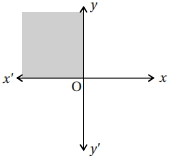
The shaded region given in the figure represent the $\ldots \ldots \ldots .$ inequality.
The solution of the differential equation, $x^2 \frac{{dy}}{{dx}} \cdot \cos \frac{1}{x} - y \sin  \frac{1}{x} = - 1,$ where $y \rightarrow - 1$ as $x \rightarrow \infty$ is
If $m$ is chosen in the quadratic equation $\left( {{m^2} + 1} \right)\,{x^2} - 3x + {\left( {{m^2} + 1} \right)^2} = 0$ such that the sum of its roots is greatest, then the absolute difference of the cubes of its roots is
The maximum value of $\mathrm{Z}=x+3 y$ subject to the constraints $2 x+y \leq 20, x+2 y \leq 20$ $x \geq 0, y \geq 0$ is $....$
If sum of $n$ terms of an $A.P.$ is $3{n^2} + 5n$ and ${T_m} = 164$ then $m = $