Question
Mohit borrowed a certain sum at $5\%$ per annum compound interest and cleared this loan by paying $Rs. 12,600$ at the end of the first year and $Rs. 17,640$ at the end of the second year. Find the sum borrowed.

Answer

For the payment of $Rs. 12,600$ at the end of first year : $A= Rs. 12,600 ; n=1$ year and $r=5 \%$
Now, $\mathrm{A}=\mathrm{P}\left(1+\frac{r}{100}\right)^n$
$\Rightarrow 12,600=\mathrm{P}\left(1+\frac{5}{100}\right)^1$
$ \Rightarrow 12,600=\mathrm{P}\left(\frac{21}{20}\right)$
$ \Rightarrow \mathrm{P}=\frac{20}{21} \times 12,600=\text { Rs. } 12,000$
For the payment of $Rs. 17,640$ at the end of second year : $A= Rs. 17,640, n=2$ years and $r=5 \%$
Now, $\mathrm{A}=\mathrm{P}\left(1+\frac{r}{100}\right)^n$
$\Rightarrow 17,640=\mathrm{P}\left(1+\frac{5}{100}\right)^2$
$ \Rightarrow 17,640=\mathrm{P}\left(\frac{21}{20}\right)^2$
$ \Rightarrow \mathrm{P}=\frac{20}{21} \times \frac{20}{21} \times 17,640=\text { Rs. } 16,000$
$\therefore$ Sum borrowed $= Rs. (12,000+16,000)= Rs. 28,000$.

Need a full question paper?

Generate a complete, print-ready paper with questions like this in minutes — across 16+ boards, with answer keys.

Start Generating Free

Similar questions

The perimeter of a rectangular field is $100 \ m$. If its length is decreased by $2 \ m$ and breadth increased by $3 \ m$, the area of the field is increased by $44 m^2.$ Find the dimensions of the field.
If $\sec A =\frac{17}{8}$, verify that $\frac{3-4 \sin ^2 A }{4 \cos ^2 A -3}=\frac{3-\tan ^2 A }{1-3 \tan ^2 A }$
Solve, graphically, the following pairs of equation :$2x + y = 23;4x - y = 19$
Case Study III: Tanusha went to a bank to withdraw money. She asked the cashier to give her ₹100 and ₹ 500 notes only. The cashier agreed. Tanusha got x, 100-rupee notes and y, 500-rupee notes. Based on the above information, answer the following questions.
1. If Tanusha withdrew ₹ 15,000, then the above information can be represented by the linear equation:
(a) x + 5y = 150
(b) 5x + y = 150
(c) x + 5y + 150 = 0
(d) x + y = 150
2. If she got 54 notes in all, then the above information can be represented by the linear equation:
(a) 100x + 500y = 54
(b) x + y = 54
(c) 500x + 100y = 54
(d) 100x + y = 54
3. If Tanusha withdraws ₹ 16,000, then which of the following combination of notes she may get?
(a) ₹ 500 notes - 30, ₹ 100 notes - 20
(b) ₹ 500 notes - 25, ₹ 100 notes - 25
(c) ₹ 500 notes - 20, ₹ 100 notes - 30
(d) ₹ 500 notes - 30, ₹ 100 notes - 10
4. If she gets twenty 500-rupee notes and twenty five 100-rupee notes, then the amount she withdraws is:
(a) ₹ 10000 (b) ₹ 11000 (c) ₹ 12000 (d) ₹ 12500
5. Can Tanusha withdraw ₹ 10050, under the given conditions?
(a) yes
(b) no
(c) can't say anything
(d) none of these
Solve the following simultaneous equations by the substitution method$:\ 3 - (x + 5) = y + 2;2(x + y) = 10 + 2y$
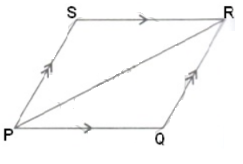
$\text{PQR}$ is a triangle formed by the adjacent sides $PQ$ and $QR$ and diagonal $PR$ of a parallelogram $\text{PQRS}$. If in $\triangle PQR, \angle P : \angle Q : \angle R = 3 : 8 : 4$, Calculate the measures of all the angles of parallelogram $\text{PQRS}.$
Image ​​​​​​​
If $x=3+2 \sqrt{2 } $, find(i) $\frac{1}{x}$(ii) $x-\frac{1}{x}$(iii) $\left(x-\frac{1}{x}\right)^3$(iv) $x^3-\frac{1}{x^3}$
Write the following in descending order:$\sqrt{6}, \sqrt[3]{8}$ and $\sqrt[4]{3}$
Find the amount and compounded interest on $Rs.15000$ in $2 \frac{1}{2}$years at $10\%p.a.$ compounded annually.
Using the same axes of co$-$ordinates and the same unit, solve graphically :$x + y = 0$ and $3x - 2y = 10.($Take at least $3$ points for each line drawn$).$