MCQ
Molecular shapes of $SF_4 , CF_4$ and $XeF_4$ are
  • A
    the same with $2, 0$ and $1$ lone pair of electrons respectively
  • B
    the same, with $1, 1$ and $1$ lone pair of electrons, respectively
  • C
    different, with $0,1$ and $2$ lone pair of electrons, respectively
  • different with $1,0$ and $2$ lone pair of electrons, respectively

Answer

Correct option: D.
different with $1,0$ and $2$ lone pair of electrons, respectively
d
Molecular shapes of $SF _4$ is square pyramid due to one lone pair of $S$. $CF _4$ has tetrahedral geometry and $XeF _4$ has square planar structure with two lone pair of $Xe.$

Need a full question paper?

Generate a complete, print-ready paper with questions like this in minutes — across 16+ boards, with answer keys.

Start Generating Free

Similar questions

Consider the following reaction :

$xMnO_4^ - \, + \,y{C_2}O_4^{2 - }\, + \,z{H^ + }\, \rightarrow $$\,xM{n^{2 + }} + 2yC{O_2} + \frac{z}{2}{H_2}O$

The value's of $x, y$ and $z$ in the reaction are, respectively :

Write the $IUPAC$ name of the following compound
The correct order of heat of hydrogenation of given molecules is
Normality of $2\,M$ sulphuric acid is
The $IUPAC$ name of $\begin{matrix}
   \,\,\,\,\,\,\,\,\,\,\,\,\,\,\,\,\,\,\,\,\,\,\,OC{{H}_{3}}  \\
   \,\,\,\,\,\,\,\,\,\,\,\,\,\,|  \\
   C{{H}_{3}}-CH=C-C{{H}_{3}}  \\
\end{matrix}$ is
Among the following, which has the maximum hydration energy?
Match List-$I$ with List-$II$.

List $-I$ (Process)

List $-II$ (Conditions)
$A$. Isothermal process $I$. No heat exchange
$B$. Isochoric process $II$. Carried out at constant temperature
$C$. Isobaric process $III$. Carried out at constant volume
$D$. Adiabatic process $IV$. Carried out at constant pressure

Choose the correct answer from the options given below:

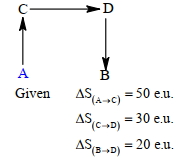
The direct conversion of $\mathrm{A}$ to $\mathrm{B}$ is difficult, hence it is carried out by the following shown path: where $e.u.$ is entropy unit then $\Delta \mathrm{S}_{(A \rightarrow B)}$ is
Which of the following statements does not form part of Bohr's model of the hydrogen atom
$CaCO_3 + 2HCl \to  CaCl_2 + CO_2 + H_2O$, in this chemical reaction what will be the amount of $CaCl_2$. When $10\,g$ calcium carbonate and $200\, mL\, 0.75\, M\, HCl$ is used? ............... $\mathrm{g}$