MCQ
Monocarboxylic acids are functional isomers of
- AEthers
- BAmines
- ✓Esters
- DAlcohols
$\mathop {C{H_3}COOH}\limits_{{\text{Acetic acid}}} \,$ $\mathop {HCOOC{H_3}}\limits_{{\text{Methyl formate}}} \,$
Generate a complete, print-ready paper with questions like this in minutes — across 16+ boards, with answer keys.
$\mathrm{A}+\mathrm{B} \underset{\text { Step } 3}{\text { Step } 1} \mathrm{C} \xrightarrow{\text { Step } 2} \mathrm{P}$
Some details of the above reaction are listed below.
| Step |
Rate constant $\left(\sec ^{-1}\right)$ |
Activation energy $\left(\mathrm{kJ} \mathrm{mol}^{-1}\right)$ |
| $1$ | ${k}_1$ | $300$ |
| $2$ | ${k}_2$ | $200$ |
| $3$ | ${k}_3$ | $\mathrm{Ea}_3$ |
If the overall rate constant of the above transformation (k) is given as $\mathrm{k}=\frac{\mathrm{k}_1 \mathrm{k}_2}{\mathrm{k}_3}$ and the overall activation energy $\left(E_2\right)$ is $400 \mathrm{~kJ} \mathrm{~mol}^{-1}$, then the value of $\mathrm{Ea}_3$ is $\qquad$ $\mathrm{kJ} \mathrm{mol}^{-1}$ (nearest integer)

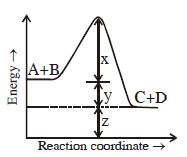
$A + B \to C + D$
The enthalpy change and activation energy for the reverse reaction $C + D \to A + B$ are respectively