MCQ
Monocarpic plants are those which:
- ABear flowers with one ovary.
- BFlower once and die.
- ✓Bear only one flower.
- DAll of the above.
Generate a complete, print-ready paper with questions like this in minutes — across 16+ boards, with answer keys.
| Column $- I$ | Column $- II$ |
| $(1)$ Psilopsida | A. Sellaginella |
| $(2)$ Lycopsida | $(B)$ Adiantum |
| $(3)$ Sphenopsida | $(C)$ Equisetum |
| $(4)$ Pteropsida | $(D)$ Psilotum |
$‘A’ $ $ ‘B’$
$(1) $ Auxin $(I)$ Ripening and maturity of fruits
$(2)$Gibberellin $(II)$Differentiation of xylem elements
$(3) $ Cytokinin $(III)$ Prevention of genetic and physiological dwarfism
$(4) $ Ethylene $(IV)$ Found from tumour tissue of tobacco
$(1)$ $(2)$ $(3)$ $(4)$
Statements :
$(i)$ In vexillary aestivation, the large posterior petal is calledstandard, two lateral ones are wings and two small anterior petals are termed keel.
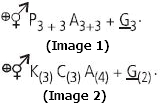
$(ii)$ The floral formula for Liliaceae is (image 1)
$(iii)$ Inpeaflowerthestamensare monadelphous.
$(iv)$ The floral formula for Solanaceae is (image 2)
The correct statements are