Question
Monochromatic light entering from one medium to another, its wavelength changes but the frequency does not change, explain.

Answer

When monochromatic light enters from one medium to another then the velocity $v$ of light changes. Since the source producing the wave remains the same, its frequency $v$ does not change. Therefore, the wavelength $\lambda$ changes on the basis of the formula $\lambda= v / v$.

Need a full question paper?

Generate a complete, print-ready paper with questions like this in minutes — across 16+ boards, with answer keys.
Start Generating Free

Similar questions

Draw the series L-C-R AC circuit and obtain the relationship between voltage and current for this circuit. (Derive the necessary equations.)
The peak power consumed by a resistive coil, when connected to an AC source, is 80W. Find the energy consumed by the coil in 100 seconds, which is many times larger than the time period of the source.
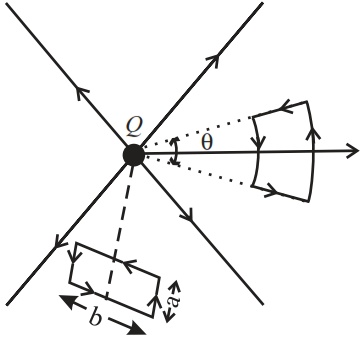
A test charge q is made to move in the electric field of a point charge Q along two different closed paths Fig. First path has sections along and perpendicular to lines of electric field. Second path is a rectangular loop of the same area as the first loop. How does the work done compare in the two cases?

An $\alpha$–particle and a proton are moving in the plane of paper in a region where there is a uniform magnetic field directed normal to the plane of the paper. If the particles have equal linear momenta, what would be the ratio of the radii of their trajectories in the field?
The potential difference between the terminals of a 6.0V battery is 7.2V when it is being charged by a current of 2.0A. What is the internal resistance of the battery?
If a person lives on the average 100 years in his rest frame how long does he live in the earth frame if he spends all his life on a spaceship going at 60% of the speed of light.
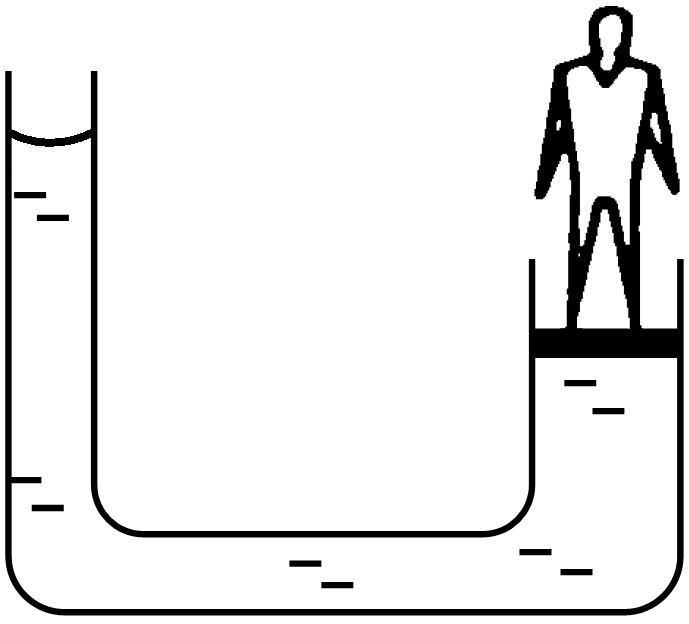
The area of cross-section of the wider tube shown in  is 900cm2. If the boy standing on the. Piston weighs 45kg, find the difference in the levels of water in the two tubes.

A proton and an a particle are accelerated through the same potential difference. Which one of the two has (i) greater de-Broglie wavelength, and (ii) less kinetic energy? Justify your answer.
Consider the situation of the previous problem. Take "the table plus the ball" as the system. Friction between the table and the ball is then an internal force. As the ball slows down, the momentum of the system decreases. Which external force is responsible for this change in the momentum?
How does the energy stored in a capacitor change if after disconnecting the battery, the plates of a charged capacitor are moved farther?