Question
Monocistronic structural genes in eukaryotes have interrupted coding sequences. Explain. How are they different in prokaryotes?

Answer

  1. In eukaryotes, the hnRNA (primary transcript of mRNA) has coding sequences, called exons as well as non-coding sequences, called introns, i.e. the information is split.
  2. It undergoes a process, called splicing, in which the introns are removed and the exons are joined together in a particular manner, to form the functional mRNA.
  • In prokaryotes, the mRNA is polycistronic, i.e. codes for more than one polypeptide.
  1. The information is continuous and no splicing is required.

Need a full question paper?

Generate a complete, print-ready paper with questions like this in minutes — across 16+ boards, with answer keys.

Start Generating Free

Similar questions

Why are the conventional methods not suitable for the assessment of biodiversity of bacteria?
Mention the advantages of selecting pea plant for experiment by Mendel.

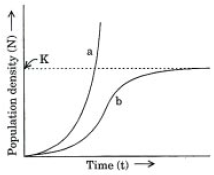
Study the population growth curves shown above.

  1. Identify curves ‘a’ and ‘b’.
  2. Mention the responsible for the curves ‘a’ and ‘b’ respectively.
  3. Give the necessary equation for the curve ‘b’.
In a typical nucleus some regions of chromatin are stained light and others dark. Explain why it is so and what is its significance.
Write a note on cultural and religious importance of biodiversity Which type of conservation measures, in situ or ex-situ will help the larger number species to survive? Explain.
What is the basic principle of vaccination? How do vaccines prevent microbial infections? Name the organism from which hepatitis B vaccine is produced.
Compare in any three ways the chromosomal theory of inheritance as proposed by Sutton and Boveri; with that of experimental results on pea plant presented by Mendel.
Explain any three inbreeding devices in flowering plants.
Name the two different categories of microbes naturally occurring in sewage water. Explain their role in cleaning sewage water into usable water.
(i) EcoRI has played a very important role in recombinant DNA technology.
(a) Explain the naming convention of Eco RI.
(b) Write the name of the recognition site and cleavage site of this restriction enzyme.
(ii) What is the longitudinal extension of DNA produced by these restriction enzymes called? Describe their role in the formation of r-DNA.