MCQ
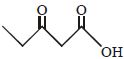
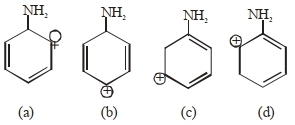
Most reactive for decarboxylation is
- ✓
- B
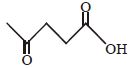
- C
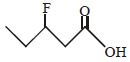
- D
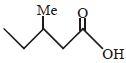
Generate a complete, print-ready paper with questions like this in minutes — across 16+ boards, with answer keys.
[Atomic Number: $\mathrm{Fe}=26, \mathrm{Mn}=25, \mathrm{Co}=27$ ]
| List-$I$ | List-$II$ |
| ($P$) $ t_{2 g}^6 e_g^0$ | ($1$)$\left[\mathrm{Fe}\left(\mathrm{H}_2 \mathrm{O}\right)_6\right]^{2+}$ |
| ($Q$) $t_{2 g}^3 e_g^2$ | ($2$) $\left[\mathrm{Mn}\left(\mathrm{H}_2 \mathrm{O}\right)_6\right]^{2+}$ |
| ($R$) $e^2 t_2^3$ | ($3$)$\left[\mathrm{Co}\left(\mathrm{NH}_3\right)_6\right]^{3+}$ |
| ($S$) $t_{2 g}^{+} e_g^2$ | ($4$)$\left[\mathrm{FeCl}_4\right]^{-}$ |
| $\left[\mathrm{CoCl}_4\right]^{2-}$ |
[Given $: h =6.626 \times 10^{-34}\,Js$,Mass of electron $=9.1 \times 10^{-31}$ ]
$O(g) + e^- = O^-(g)$ $\Delta {H_{eg}} = - 142\,kJ\,mo{l^{ - 1}}$
$O^-(g) + e^- = O^{2-}(g)$ $\Delta {H_{eg}} = +844\,kJ\,mo{l^{ - 1}}$
This is because