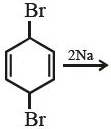
MCQ
Most stable carbocation among following is
- A

- B

- ✓

- D

Generate a complete, print-ready paper with questions like this in minutes — across 16+ boards, with answer keys.
Step$-1$ : ${\text{A + E }} \rightleftharpoons AE$ (fast)
Step$-2$ :${\text{AE + A }} \to {A_2} + E$ (slow)
Step$-3$ :${{\text{A}}_2}{\text{ + B }} \to {\text{D}}$ (fast)
what rate law best agrees with this mechanism
$(1)$ $\begin{array}{*{20}{c}}
{C{H_3}CH = C - C{H_3}} \\
{\,\,\,\,\,\,\,\,\,\,|} \\
{\,\,\,\,\,\,\,\,\,\,\,\,\,\,\,\,C{H_3}}
\end{array}$
$(2)$ $C{H_3}CH = CHC{H_3}$
$(3)$ $\mathop {C{H_3}C}\limits^{\begin{subarray}{l}
\,\,\,\,\,\,\,\,{\begin{array}{*{20}{c}}
{}&H
\end{array}} \\
\,\,\,\,\,\,\,\,\,\,\,\,\,\,|
\end{subarray} } = CHC{H_2}C{H_3}$
$(4)$ $\begin{array}{*{20}{c}}
{C{H_3}C = C - C{H_3}} \\
{\,\,\,\,\,\,\,|\,\,\,\,\,\,\,\,\,\,\,\,|\,\,\,\,\,\,\,\,\,\,\,\,\,} \\
{\,\,\,\,\,\,\,\,\,\,\,\,\,C{H_{3\,\,}}\,\,C{H_3}\,\,\,\,\,\,\,\,\,\,\,\,\,\,\,\,}
\end{array}$
$Mn{O_2}(s)\, + \,4{H^ + }(aq)\, + \,2{e^ - }\, \to \, M{n^{ + 2}}(aq)\, + \,2{H_2}O(l)\,;$ $E_2^o\, = \,1.21\,\,V$
$MnO_4^{ - 1}(aq)\, + \,4{H^ + }(aq)\, + \,3{e^ - }\, \to \, Mn{O_2}(s)\, + \,3{H_2}O(l)\,;$ $E_3^o\,?$
value of $E_3^o$ will be ............ $\mathrm{V}$