MCQ
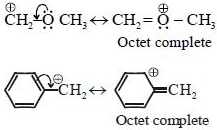
Most stable carbocation is
- A$C{H_3} - \mathop C\limits^ \oplus {H_2}$
- B$Ph - \mathop C\limits^ \oplus {H_2}$
- C$\mathop C\limits^ \oplus {H_2}C{H_2}Cl$
- ✓$\mathop C\limits^ \oplus {H_2} - OC{H_3}$
Generate a complete, print-ready paper with questions like this in minutes — across 16+ boards, with answer keys.
$(a)\,0.075\,\,M\,CuS{O_4}$ $(b)\,0.060\,\,M\,(NH_4)_2SO_4$
$(c)\,0.14\,\,M\,urea$ $(d)\,0.04\,M\,MgCl_2$
| List $I$ | List $II$ |
| $P$. $\quad \underset{X}{\left( C _2 H _5\right)_3 N }+\underset{ Y }{ CH _3 COOH }$ | $1.$ Conductivity decreases and then increases |
| $Q.$ $\quad \underset{X}{ KI (0.1 M )}+\underset{ Y }{ AgNO _3(0.01 M )}$ | $2.$ Conductivity decreases and then does not change much |
| $R.$ $\quad \underset{X}{ CH _3 COOH }+\underset{ K }{ KOH }$ | $3.$ Conductivity increases and then does not change much |
| $S$. $\quad \underset{X}{ NaOH }+\underset{Y}{ HI }$ | $4.$ Conductivity does not change much and then increases |
Codes: $ \quad P \quad Q \quad R \quad S $
$(a) ClO_4^-> ClO_3^-> ClO_2^-> ClO^-$ Stability order
$(b) Cl_2 > Br_2> F_2> I_2$ Bond energy
$(c) OF_2 < OH_2< OCl_2$ Bond angle
$(d) I^-> Br^-> Cl^-$ Reducing power
[Atomic number, $\mathrm{Cr}=24, \mathrm{Mn}=25, \mathrm{Fe}=26, \mathrm{Co}=27$ ]

$Me_2CHCH_2NHCH_2CH_2Me $ $\xrightarrow[\begin{smallmatrix}
(ii)\,A{{g}_{2}}O \\
(iii)\,\Delta
\end{smallmatrix}]{(i)\,C{{H}_{3}}-I(excess)}$ Product
In a closed vessel follows first order kinetics. If starting with pure $N_2O(g)$ total pressure after time $'t'$ is $P_t$ and after a very long time is $P_\infty$ then which of the following expressions is correct