MCQ
Most stable carbonium ion is
  • A
    ${\mathop C\limits^ + _2}{H_5}$
  • B
    ${(C{H_3})_3}\mathop C\limits^ + $
  • ${({C_6}{H_5})_3}\mathop C\limits^ + $
  • D
    ${C_6}{H_5}\mathop C\limits^ + {H_2}$

Answer

Correct option: C.
${({C_6}{H_5})_3}\mathop C\limits^ + $
c
(c)In the triphenyl methyl carbonium ion the $\pi$ electrons of all the three benzene rings are delocalised with the vacant $p-$orbital of central carbon atom. So, it is resonance stabilised. It is the most stable of all the carbonium ions given

The ion $C{H_3} - \mathop {\mathop {{C^ + }}\limits_{|\;\;}^{|\;\;} \;\;}\limits_{C{H_3}}^{C{H_3}} $ is stabilised by hyperconjugation, a second order resonance.

Need a full question paper?

Generate a complete, print-ready paper with questions like this in minutes — across 16+ boards, with answer keys.
Start Generating Free

Similar questions

Nitrobenzene on reaction with conc. $HNO_3/H_2SO_4$ at $80-100\,^o C$ forms which one of the following products ?
Consider the reaction : ${N_2} + 3{H_2} \to 2N{H_3}$ carried out at constant temperature and pressure. If $\Delta H$ and $\Delta U$ are the enthalpy and internal energy changes for the reaction, which of the following expression is true
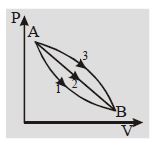
A given mass of gas expands reversibly from the state $A$ to the state $B$ by three paths $1, 2$ and $3$ as shown in the figure. If $w_1, w_2$ and $w_3$ respectively be the work done by the gas along three paths then
The total number of different kind of buffers obtained during the titration of $H _3 PO _4$ with NaOH are:
The reactivities of methyl chloride, propyl chloride and chlorobenzene are in the order
Element $x$ is strongly electropositive and $y$ is strongly electronegative. Both element are univalent, the compounds formed from their combination will be
In which change bond order and number of unpaired $e^-$ both are increased
Identify the $D$ and $E$ in the following reaction

$\begin{array}{*{20}{c}}
  {C{H_3} - CH - CH - C{H_3}\xleftarrow[{ether}]{{Na}}R\,' - Br\,\xrightarrow{{Mg}}'D'\,\xrightarrow{{{H_2}O}}E} \\ 
  {\,\,\,\,|\,\,\,\,\,\,\,\,\,\,\,\,\,|\,\,\,\,\,\,\,\,\,\,\,\,\,\,\,\,\,\,\,\,\,\,\,\,\,\,\,\,\,\,\,\,\,\,\,\,\,\,\,\,\,\,\,\,\,\,\,\,\,\,\,\,\,\,\,\,\,\,\,\,\,\,\,\,\,\,\,\,\,\,\,\,\,\,\,\,\,\,\,\,\,\,\,\,\,\,\,} \\ 
  {\,\,\,\,\,C{H_3}\,\,\,\,\,C{H_3}\,\,\,\,\,\,\,\,\,\,\,\,\,\,\,\,\,\,\,\,\,\,\,\,\,\,\,\,\,\,\,\,\,\,\,\,\,\,\,\,\,\,\,\,\,\,\,\,\,\,\,\,\,\,\,\,\,\,\,\,\,\,\,\,\,\,\,\,\,\,\,\,\,\,\,\,\,\,\,\,\,\,\,} 
\end{array}$

The outer electronic structure $3{s^2}3{p^5}$ is possessed by
The probability of finding electrons in $d_{xy}$ orbital is