Question
Motion in two dimensions, in a plane can be studied by expressing position, velocity and acceleration as vectors in Cartesian co-ordinates $\text{A}=\text{A}_\text{x}\hat{\text{i}}+\text{A}_\text{y}\hat{\text{j}}$ where $\hat{\text{i}}$ and $\hat{\text{j}}$ are unit vector along x and y directions, respectively and Ax and Ay are corresponding components of A Fig. Motion can also be studied by expressing vectors in circular polar co-ordinates as $\text{A}=\text{A}_\text{r}\hat{\text{r}}+\text{A}_\theta\hat{\theta}$ where $\hat{\text{r}}=\frac{\text{r}}{\text{r}}=\cos\theta\hat{\text{i}}+\sin\theta\hat{\text{j}}$ and $\hat{\theta}=-\sin\theta\hat{\text{i}}+\cos\theta\hat{\text{j}}$ are unit vectors along direction in which ‘r’ and ‘$\theta$’ are increasing.
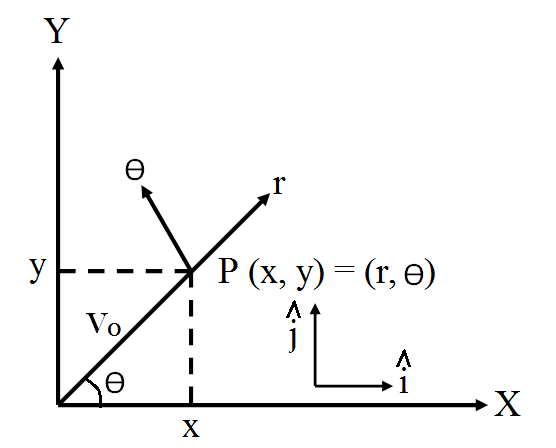
  1. Express $\hat{\text{i}}$ and $\hat{\text{j}}$ in terms of $\hat{\text{r}}$ and $\hat{\theta}$.
  2. Show that both $\hat{\text{r}}$ and $\hat{\theta}$ are unit vectors and are perpendicular to each other.
  3. Show that $\frac{\text{d}}{\text{dt}}(\hat{\text{r}})=\omega\hat{\theta}$ where $\omega=\frac{\text{d}\theta}{\text{dt}}$ and $\frac{\text{d}}{\text{dt}}(\hat{\text{r}})=-\omega\hat{\text{r}}$
  4. For a particle moving along a spiral given by $\text{r}=\text{a}\theta\hat{\text{r}}$ , where a = 1 (unit), find dimensions of ‘a’.
  5. Find velocity and acceleration in polar vector represention for particle moving along spiral described in (d) above.

Answer


  1. According to the problem, unit vector

$\hat{\text{r}}=\cos\theta\hat{\text{i}}+\sin\theta\hat{\text{j}}\cdots(\text{i})$

$\hat{\theta}=-\sin\theta\hat{\text{i}}+\cos\theta\hat{\text{j}}\cdots(\text{ii})$

Multiplying Eq.(i) by $\sin\theta$ and Eq. (ii) with $\cos\theta$ and adding

$\Rightarrow\hat{\text{r}}\sin\theta+\hat{\theta}\cos\theta$$=\sin\theta\cdot\cos\theta\hat{\text{i}}+\sin^2\theta\hat{\text{j}}+\cos^2\theta\hat{\text{j}}-\sin\theta\cdot\cos\theta\hat{\text{i}}$

$=\hat{\text{j}}(\cos^2\theta+\sin^2\theta)=\hat{\text{j}}$

$\hat{\text{r}}\sin\theta+\hat{\theta}\cos\theta=\hat{\text{j}}$

By Eq.(i) $\text{x}\cos\theta-$Eq. (ii) $\text{x}\sin\theta$

$\text{n}(\hat{\text{r}}\cos\theta-\hat{\theta}\sin\theta)=\hat{\text{i}}$

  1. $\hat{\text{r}}\cdot\hat{\theta}=(\cos\theta\hat{\text{i}}+\sin\theta\hat{\text{j}})\cdot(-\sin\theta\hat{\text{i}}+\cos\theta\hat{\text{j}})$

$=-\cos\theta\cdot\sin\theta+\sin\theta\cdot\cos\theta=0$

$\Rightarrow\theta=90^\circ,$ angle between $\hat{\text{r}}$ and $\hat{\theta}$.

  1. Given, $\hat{\text{r}}=\cos\theta\hat{\text{i}}+\sin\theta\hat{\text{j}}$

$\frac{\text{d}\hat{\text{r}}}{\text{dt}}=\frac{\text{d}}{\text{dt}}(\cos\theta\hat{\text{i}}+\sin\theta\hat{\text{j}})$

$=-\sin\theta\cdot\frac{\text{d}\theta}{\text{dt}}\hat{\text{i}}+\cos\theta\cdot\frac{\text{d}\theta}{\text{dt}}\hat{\text{j}}$

$=\omega[-\sin\theta\hat{\text{i}}+\cos\theta\hat{\text{j}}$ $\Big[\because\theta=\frac{\text{d}\theta}{\text{dt}}\Big]$

  1. Given,$\text{r}=\text{a}\theta\hat{\text{r}},$ here writing dimension.

$[\text{r}]=[\text{a}][\theta][\hat{\text{r}}]\Rightarrow\text{L}=\frac{[\text{a}]}{1}$

$\Rightarrow[\text{a}]=\text{L}=[\text{M}^0\text{L}^1\text{T}^0]$

  1. Given, $\text{a}=1$ unit, $\text{r}=\theta\hat{\text{r}}=\theta[\cos\theta\hat{\text{i}}+\sin\theta\hat{\text{j}}]$

By differentiating this equation,we get

Velocity $\text{v}=\frac{\text{dr}}{\text{dt}}=\frac{\text{d}\theta}{\text{dt}}\hat{\text{r}}+\theta\frac{\text{d}}{\text{dt}}\hat{\text{r}}$

$=\frac{\text{d}\theta}{\text{dt}}\hat{\text{r}}+\theta\frac{\text{d}}{\text{dt}}[(\cos\theta\hat{ \text{i}}+\sin\theta\hat{\text{j}})]$

$=\frac{\text{d}\theta}{\text{dt}}\hat{\text{r}}+\theta\Big[(-\sin\theta\hat{\text{i}}+\cos\theta\hat{\text{j}})\frac{\text{d}\theta}{\text{dt}}\Big]$

$=\frac{\text{d}\theta}{\text{dt}}\hat{\text{r}}+\theta\hat{\theta}\omega=\omega\hat{\text{r}}+\omega\theta\hat{\theta}$

By differentiating this equation, we get

Acceleration,

$\text{a}=\frac{\text{d}\theta}{\text{dt}}[\omega\hat{\text{r}}+\omega\theta\hat{\theta}]$

$=\frac{\text{d}}{\text{dt}}\Big[\frac{\text{d}\theta}{\text{dt}}\hat{\text{r}}+\frac{\text{d}\theta}{\text{dt}}(\theta\hat{\theta})\Big]$

$=\frac{\text{d}^2\theta}{\text{dt}^2}\hat{\text{r}}+\frac{\text{d}\theta}{\text{dt}}\cdot\frac{\text{d}\hat{\text{r}}}{\text{dt}}+\frac{\text{d}^2\theta}{\text{dt}^2}\theta\hat{\theta}+\frac{\text{d}\theta}{\text{dt}}\frac{\text{d}}{\text{dt}}(\theta\hat{\theta})\frac{\text{d}^2\theta}{\text{dt}^2}\hat{\text{r}}$

$+\omega[-\sin\theta\hat{\text{i}}+\sin\theta\hat{\text{j}}]+\frac{\text{d}^2\theta}{\text{dt}^2}\theta\hat{\theta}+\frac{\omega\text{d}}{\text{dt}}(\theta\hat{\theta})$

$=\frac{\text{d}^2\theta}{\text{dt}^2}\hat{\text{r}}+\omega^2\hat{\theta}+\frac{\text{d}^2\theta}{\text{dt}^2}\times\theta\hat{\theta}+\omega^2\hat{\theta}+\omega^2\theta(-\hat{\text{r}})$

$\Big(\frac{\text{d}^2\theta}{\text{dtv}^2}-\omega^2\Big)\hat{\text{r}}+\Big(2\omega^2+\frac{\text{d}^2\theta}{\text{dt}^2}\theta\Big)\theta$

Need a full question paper?

Generate a complete, print-ready paper with questions like this in minutes — across 16+ boards, with answer keys.

Start Generating Free