Question
Moving coil galvanometer operates on Permanent Magnet Moving Coil (PMMC) mechanism and was designed by the scientist D'arsonval. Moving coil galvanometers are of two types.
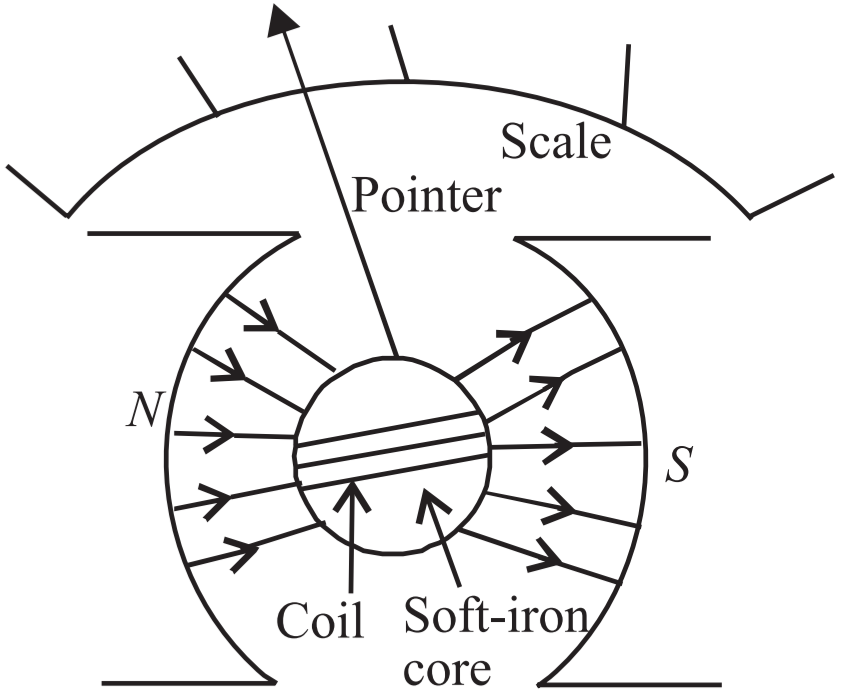
  1. Suspended coil.
  2. Pivoted coil type or tangent galvanometer.
Its working is based on the fact that when a current carrying coil is placed in a magnetic field, it experiences a torque. This torque tends to rotate the coil about its axis of suspension in such a way that the magnetic flux passing through the coil is maximum.
  1. A moving coil galvanometer is an instrument which:
  1. Is used to measure emf.
  2. Is used to measure potential difference.
  3. Is used to measure resistance.
  4. Is a deflection instrument which gives a deflection when a current flows through its coil.
  1. To make the field radial in a moving coil galvanometer.
  1. Number of turns of coil is kept small.
  2. Magnet is taken in the form of horse-shoe.
  3. Poles are of very strong magnets.
  4. Poles are cylindrically cut.
  1. The deflection in a moving coil galvanometer is:
  1. Directly proportional to torsional constant of spring.
  2. Directly proportional to the number of turns in the coil.
  3. Inversely proportional to the area of the coil.
  4. Inversely proportional to the current in the coil.
  1. In a moving coil galvanometer, having a coil of N-turns of area A and carrying current I is placed in a radial field of strength B.
The torque acting on the coil is:
  1. $NA^2B^2I$
  2. $NABI^2$
  3. $N^2ABI$
  4. $NABI$
  1. To increase the current sensitivity of a moving coil galvanometer, we should decrease:
  1. Strength of magnet.
  2. Torsional constant of spring.
  3. Number of turns in coil.
  4. Area of coil.

Answer

  1. (d) Is a deflection instrument which gives a deflection when a current flows through its coil.
Explanation:
A moving coil galvanometer is a sensitive instrument which is used to measure a deflection when a current flows th rough its coil.
  1. (d) Poles are cylindrically cut.
Explanation:
Uniform field is made radial by cutting pole pieces cylindrically.
  1. (b) Directly proportional to the number of turns in the coil.
Explanation:
The deflection in a moving coil galvanometer, $\phi=\frac{\text{NAB}}{\text{K}}.\text{I}$ or $\phi\propto\text{N,}$ N, where N is number of turns in a oil, Bis magnetic field and A is area of cross-section.
  1. (d) NABI
Explanation:
The deflecting torque acting on the coil. $\tau_{\text{deflection}}=\text{NIAB}$
  1. (b) Torsional constant of spring.
Explanation:
Current sensitivity of galvanometer,
$\frac{\phi}{\text{I}}=\text{S}_\text{i}=\frac{\text{NBA}}{\text{K}}$
Hence, to increase (current sensitivity) S;, (torsional constant of spring) k must be decrease.

Need a full question paper?

Generate a complete, print-ready paper with questions like this in minutes — across 16+ boards, with answer keys.

Start Generating Free

Similar questions

Photoelectric effect is the phenomenon of emission of electrons from a metal surface, when radiations of suitable frequency fall on them. The emitted electrons are called photoelectrons and the current so produced is called photoelectric current.
  1. With the increase of intensity of incident radiations on photoelectrons emitted by a photo tube, the number of photoelectrons emitted per unit time is:
  1. Increases.
  2. Decreases.
  3. Remains same.
  4. None of these.
  1. It is observed that photoelectron emission stops at a certain time t after the light source is switched on. The stopping potential (V) can be represented as:
  1. $2(KE_{max}/e)$
  2. $(KE_{max}/e)$
  3. $(KE_{max}/3e)$
  4. $(KE_{max}/2e)$
  1. A point source of light of power $3.2 \times 10^{-3} W$ emits monoenergetic photons of energy 5.0eV and work function 3.0eV. The efficiency of photoelectron emission is 1 for every $10^6$ ncident photons. Assume that photoelectrons are instantaneously swept away after emission. The maximum kinetic energy of photon is:
  1. 4eV
  2. 5eV
  3. 2eV
  4. Zero
  1. Which of the following device is the application of Photoelectric effect?
  1. Light emitting diode.
  2. Diode.
  3. Photocell.
  4. Transistor.
  1. If the frequency of incident light falling on a photosensitive metal is doubled, the kinetic energy of the emitted photoelectron is:
  1. Unchanged.
  2. Halved.
  3. Doubled.
  4. More than twice its initial value.
In a microwave oven, the food is kept in a plastic container and the microwave is directed towards the food. The food is cooked without melting or igniting the plastic container. Explain.
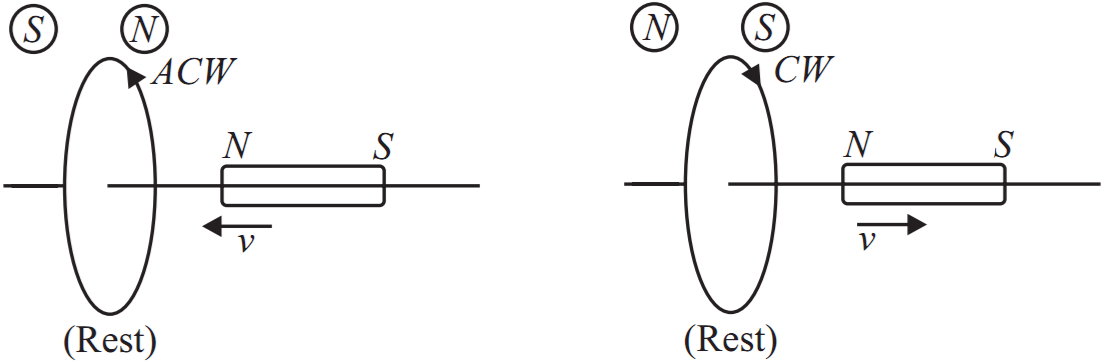
Lenz's law states that the direction of induced current in a circuit is such that it opposes the change which produces it. Tims, if the magnetic flux linked with a closed circuit increases, the induced current flows in such a direction that a magnetic flux is created in the opposite direction of the original magnetic flux. If the magnetic flux linked with the closed circuit decreases, the induced current flows in such a direction so as to create a magnetic flux in the direction of the original flux.
  1. Which of the following statements is correct?
  1. The induced e.m.f is not in the direction opposing the change in magnetic flux so as to oppose the cause which produces it.
  2. The relative motion between the coil and magnet produces change in magnetic flux.
  3. Emf is induced only if the magnet is moved towards coil.
  4. Emf is induced only if the coil is moved towards magnet.
  1. The polarity of induced emf is given by:
  1. Ampere's circuital law.
  2. Biot-Savart law.
  3. Lenz's law.
  4. Fleming's right hand rule.
  1. Lenz's law is a consequence of the law of conservation of:
  1. Charge.
  2. Mass.
  3. Momentum.
  4. Energy.
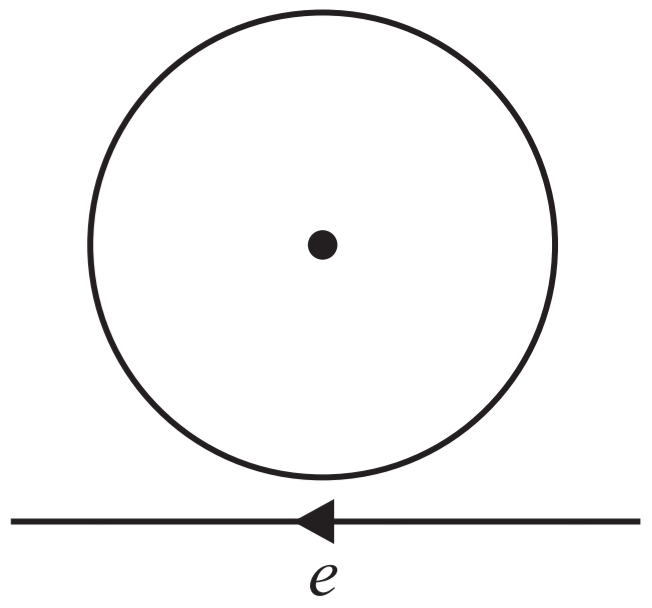
  1. Near a circular loop of conducting wire as shown in the figure, an electron moves along a straight line. The direction of the induced current if any in the loop is:
  1. Variable.
  2. Clockwise.
  3. Anticlockwise.
  4. Zero.
  1. Two identical circular coils A and Bare kept in a horizontal tube side by side without touching each other. If the current in the coil A increases with time, in response, the coil B:
  1. Is attracted by A.
  2. Remains stationary.
  3. Is repelled.
  4. Rotates.
A small object is embedded in a glass sphere $(\mu=1.5)$ of radius 5.0cm at a distance 1.5cm left to the centre. Locate the image of the object as seen by an observer standing.
  1. To the left of the sphere.
  2. To the right of the sphere.
An astronomical telescope is an optical instrument which is used for observing distinct images of heavenly bodies libe stars, planets etc. It consists of two lenses. In normal adjustment of telescope, the final image is formed at infinity. Magnifying power of an astronomical telescope in normal adjustment is defined as the ratio of the angle subtended at the eye by the angle subtended at the eye by the final image to the angle subtended at the eye, by the object directly, when the final image and the object both lie at infinite distance from the eye. It is given by, $\text{m}=\frac{\text{f}_0}{\text{f}_\text{g}}.$ To increase magnifying power of an astronomical telescope in normal adjustment, focal length of objective lens should be large and focal length of eye lens should be small.
  1. An astronomical telescope of magnifying power 7 consists of the two thin lenses 40cm apart, in normal adjustment. The focal lengths of the lenses are
  1. 5cm, 35cm
  2. 7cm, 35cm
  3. 17cm, 35cm
  4. 5cm, 30cm
  1. An astronomical telescope has a magnifying power of 10. In normal adjustment, distance between the objective and eye piece is 22cm. The focal length of objective lens is:
  1. 25cm
  2. 10cm
  3. 15cm
  4. 20cm
  1. In astronomical telescope compare to eye piece, objective lens has:
  1. Negative focal length.
  2. Zero focal length.
  3. Small focal length.
  4. Large focal length.
  1. To see stars, use:
  1. Simple microscope.
  2. Compound microscope.
  3. Endoscope.
  4. Astronomical telescope.
  1. For large magnifying power of astronomical telescope.
  1. $f_0 << f_e$
  2. $f_0 << f_e$
  3. $f_0 << f_e$
  4. None of these.
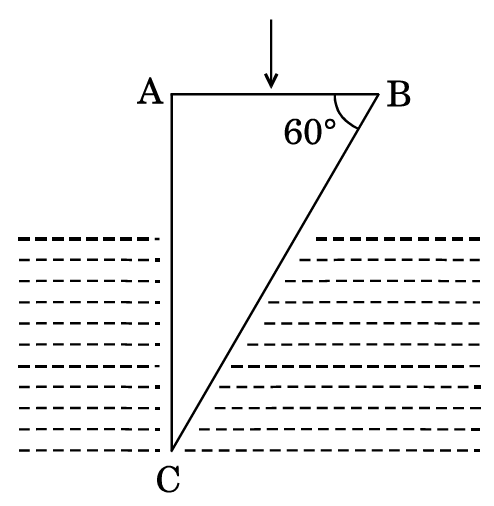
  1. A ray of light is incident normally on the face AB of a right-angled glass prism of refractive index $_{a}\mu_{g} =1.5$The prism is partly immersed in a liquid of unknown refractive index. Find the value of refractive index of the liquid so that the ray grazes along the face BC after refraction through the prism.
  1. Trace the path of the rays if it were incident normally on the face AC.
A uniform magnetic field of $0.20 \times 10^{-3}$ T exists in the space. Find the change in the magnetic scalar potential as one moves through 50cm along the field.
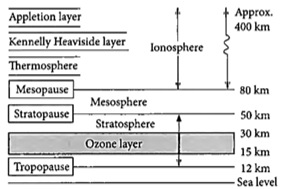
TV signals broadcast by Delhi studio cannot be directly received at Patna which is about 1000km away. But the same signal goes some 36000km away to a satellite, gets reflected and is then received at Patna. Explain.
The electron mobility characterises how quickly an electron can move through a metal of semiconductor when pulled by an electric field. There is an analogous quality for holes, called hole mobility. A block of pure silicon at 300K has a length of 10cm and an area of $1.0cm^2.$ A battery of emf 2V is connected across it. The mobility of electron is $0.14m^2 V^{-1}s^{-1}$ and their number density is $1.5 \times 10^{16}m^{-3}.$ The mobility of holes is $0.05m^2 V^{-1}s^{-1}.$
  1. The electron current is:
  1. $6.72 \times 10^{-4}A$
  2. $6.72 \times 10^{-5}A$
  3. $6.72 \times 10^{-6}A$
  4. $6.72 \times 10^{-7}A$
  1. The hole current is:
  1. $2.0 \times 10^{-7}A$
  2. $2.2 \times 10^{-7}A$
  3. $2.4 \times 10^{-7}A$
  4. $2.6 \times 10^{-7}A$
  1. The number density of donor atoms which are to be added up to pure silicon semiconductor to produce an n-type semiconductor of conductivity $6.4\Omega^{-1}\text{cm}^{-1}$ is approximately (neglect the contribution of holes to conductivity).
  1. $3 \times 10^{22}m^{-3}$
  2. $3 \times 10^{23}m^{-3}$
  3. $3 \times 10^{24}m^{-3}$
  4. $3 \times 10^{21}m^{-3}$
  1. When the given silicon semiconductor is doped with indium, the hole concentration increases to $4.5 \times 10^{23}m^{-3}.$ The electron concentration in doped silicon is:
  1. $3 \times 10^9m^{-3}$
  2. $4 \times 10^9m^{-3}$
  3. $5 \times 10^9m^{-3}$
  4. $6 \times 10^9m^{-3}$
  1. Pick out the statement which is not correct.
  1. At a low temperature, the resistance of a semiconductor is very high.
  2. Movement of holes is restricted to the valence band only.
  3. Width of the depletion region increases as the forward bias voltage increases in case of a p-n junction diode.
  4. ln a forward bias condition, the diode heavily conducts.