Answer
(b) stud.dat
(d) file.seek(pos)
(e) pickle.dump(st,file)
(f) (iii) pickle.dump(LST,FILE)
Need a full question paper?
Generate a complete, print-ready paper with questions like this in minutes — across 16+ boards, with answer keys.
Explore more
Similar questions
Consider the table LOANS given below:
Table: LOANS
| AccNo | Name | Loan Amt | EMI | IntRate | Start Date | Interest |
| 1001 | R.K. Gupta | 300000 | 36 | 12.00 | 19-07-2009 | 1200 |
| 1002 | S. P. Shanna | 500000 | 48 | 10.00 | 22-03-2008 | 1800 |
| 1003 | K.P. Jain | 300000 | 36 | NULL | 08-03-2007 | 1600 |
| 1004 | M.P. Yadav | 800000 | 60 | 10.00 | 06-12-2008 | 2250 |
| 1005 | S.P. Sinlia | 200000 | 36 | 12.50 | 03-01-2010 | 4500 |
| 1006 | P. Shanna | 700000 | 60 | 12.50 | 05-06-2008 | 3500 |
| 1007 | K.S. Dhall | 500000 | 48 | NULL | 05-03-2008 | 3800 |
(a) State the command that will give the output as:
| Name |
| S. P. Shanna |
| K.S. Dhall |
| M.P. Yadav |
| P. Shanna |
| K.S. Dhall |
(i) Select name from LOANS where Name >‘D ’;
(ii) Select name from LOANS where AccNo >1001;
(iii) Select name from LOANS where Loan_Amt >= 500000;
(iv) Select name from LOANS where Loan_Amt >500000 order Loan_AmtDESC;
(b) What will be the output of the following command:
Select name, EMI from LOANS where Loan_Amt >500000 and Int_Rate is NULL;
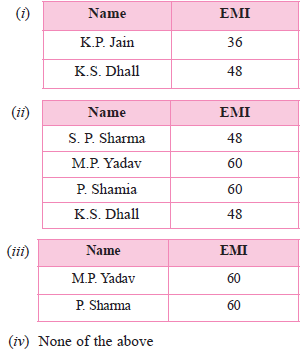
(c) John has given the following command to display the count of all loan holders whose name ends with “Sharma ”:
Select count() from LOANS where Name like ‘Sharma%’;
But he is not getting the desired result. Help him by finding out the correct command fromthe followings:
(i) Select count(*) from LOANS where name Like ‘Sharma%’;
(ii) Select count(*) from LOANS where name Like ‘%Sharma ’;
(iii) Select count( ) from LOANS where name like ‘%sharma ’;
(iv) Select count(Name) from LOANS where name ‘Sharma%’;
(d) State the command to display the maximum Loan_Amt and Cust_Name :-
(i) Select Max(Cust_Name, Loan_Amt) from LOANS;
(ii) Select Cust_Name, max(LoanAmt) from LOANS;
(iii) Select Cust_Name, max(Loan_Amount) from LOANS;
(iv) Select Cust_name, max(Loan_Amt) from LOANS;
(e) Help Ramesh to display the count of all loan holders whose interest is NULL.
(i) Select Count(*) from LOANS where Int_Rate is NULL.
(ii) Select Count() from LOANS where Interest is NULL.
(iii) Select Count(*) from LOANS where Int_rate = NULL;
(iv) Select Count( ) from LOANS where Interest = NULL;
Table: Student
| Admno | Sname | Class | Sec | Fee | Mobile | Area | S_ID |
| 1001 | RAMESH | XII | A | 2500 | 987654321 | Madipur | 10 |
| 1078 | KRISHNA | XII | B | 2400 | 999911111 | Jawala Heri | 30 |
| 1006 | FARDEEN | XII | C | 2600 | 987654321 | Paschim Puri | 40 |
| 1004 | SUBHAM | XII | A | 2500 | 963025874 | Madipur | 20 |
| 1029 | KRITIKA | XI | C | 2700 | 987456210 | Madipur | 30 |
| 1008 | SAMEEKSHA | XII | A | 2450 | 987123456 | Mangol Puri | 20 |
| 1025 | SALMA | XII | B | 2580 | 998877445 | Madipur | 30 |
| 1036 | AMANDEEP | XII | B | 2600 | 999333555 | Khyala | 40 |
| 1037 | TEJAS | XI | C | 2650 | 987951357 | Paschim Puri | 40 |
| 1029 | HIMANSHU | XII | A | 2750 | 951369874 | Jawala Heri | 10 |
Table : Stream
| S_ID | Stream_name |
| 10 | MEDILCAL |
| 20 | NON MEDICAL |
| 30 | COMMERCE WITH MATH |
| 40 | COMMERCE WITH IP |
| 50 | HUMANITIES |
Write SQL commands for the statements (a) to (h) on the above table: Student and Stream
(a) Identify Primary Keys and Foreign Key in the table student and primary key in Stream table given above.
(b) Display stream id and stream-wise total fee collected.
(c) Count no of students from each area.
(d) Display all the student details those who belongs to Madipur Area.
(e) Increase the fees of all students by10%.
(f) Display unique area from the student table.
(g) Display details of those students whose area contains ‘Puri’.
(h) Display the information of those students who are in class XII and section is either B or C.
Answer the following questions.
Table: Employee
| No | Name | Salary | Zone | Age | Grade | Dept |
| 1 | Mukul | 30000 | West | 28 | A | 10 |
| 2 | Kritika | 35000 | Centre | 30 | A | 10 |
| 3 | Naveen | 32000 | West | 40 | 20 | |
| 4 | Uday | 38000 | North | 38 | C | 30 |
| 5 | Nupur | 32000 | East | 26 | 20 | |
| 6 | Moksh | 37000 | South | 28 | B | 10 |
| 7 | Shelly | 36000 | North | 26 | A | 30 |
Table: Department
| No | DName | MinSal | MaxSal | HOD |
| 10 | Sales | 25000 | 32000 | 1 |
| 20 | Finance | 30000 | 50000 | 5 |
| 30 | Admin | 25000 | 40000 | 7 |
(a) Based on these tables write SQL statements for the following queries:
(i) Display the details of all the employees who work in Sales department.
(ii) Display the Salary, Zone, and Grade of all the employees whose HOD is Nupur.
(iii) Display the Name and Department Name of all the employees.
(iv) Display the names of all the employees whose salary is not within the specified range for the corresponding department.
(v) Display the name of the department and the name of the corresponding HOD for all the departments.
(b) Identify the Foreign Keys (if any) of these tables. Justify your choices.
 (a) Which statement will display Not Available?
(i)Statement 9 (ii)Statement 10 (iii)Statement 11(iv)Statement 13
(b) Choose the key from Dictionary.
(i)ADMNO (ii)‘admno’ (iii)101 (iv)“Not Available”
(c) Which statement will display None?
(i)Statement 9 (ii)Statement 10 (iii)Statement 11(iv)Statement 13
(d) Which Statement will display Tejas?
(i) Statement 8 (ii) Statement 9 (iii) Statement 10 (iv) Statement 11
(e) Choose the identifier.
(i) ADMNO (ii) ‘admno’ (iii) setdefault (iv)Not Available
Table: STUDENT
| No. | Name | Age | Department | Dateofadm | Fee | Sex |
| 1 | Pankaj | 24 | Computer | 10/01/97 | 120 | M |
| 2 | Shalini | 21 | History | 24/03/98 | 200 | F |
| 3 | Sanjay | 22 | Hindi | 12/12/96 | 300 | M |
| 4 | Sudha | 25 | History | 01/07/99 | 400 | F |
| 5 | Rakesh | 22 | Hindi | 05/09/97 | 250 | M |
| 6 | Shakeel | 30 | History | 27/06/98 | 300 | M |
| 7 | Surya | 34 | Computer | 25/02/97 | 210 | M |
| 8 | Shikha | 23 | Hindi | 31/07/97 | 200 | F |
Write SQL commands for the following queries
(a) To show all information about the students of History department.
(b) To list the names of female students who are in Hindi department.
(c) To list the names of all students with their date of admission in ascending order.
(d) To display student’s name, fee, age for male students only.
(e) To count the number of students with Age>23.
Table: CARHUB
| Vcode | Vehicle Name | Make | Color | Capacity | Charges |
| 100 | Innova | Toyota | WHITE | 7 | 15 |
| 102 | SX4 | Suzuki | BLUE | 4 | 14 |
| 104 | C Class | Mercedes | RED | 4 | 35 |
| 105 | A-Star | Suzuki | WHITE | 3 | 14 |
| 108 | Indigo | Tata | SILVER | 3 | 12 |
Table: CUSTOMER
| CCode | CName | VCode |
| 1 | Hemant Sahu | 101 |
| 2 | Raj Lal | 108 |
| 3 | Feroza Shah | 105 |
| 4 | Ketan Dhal | 104 |
(a) Write SQL commands for the following statements:
(i) To display the names of all white colored vehicles
(ii) To display name of vehicle, make and capacity of vehicles in ascending order of their sitting capacity
(iii) To display the highest charges at which a vehicle can be hired from CARHUB.
(iv) To display the customer name and the corresponding name of the vehicle hired by them.
(b) Give the output of the following SQL queries:
(i) Select count(distinct make) from cabhub;
(ii) Select max(charges), min(charges) from carhub;
(iii) Select count(*), make from carhub;
(iv) Select vehiclename from carhub where capacity = 4;
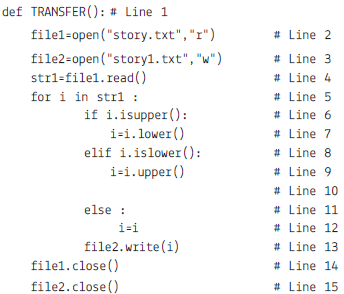
(a) Which line in the above code check for capital letter?
(b) Which line in the above code read the file “story. txt”?
(c) Which line in the above code does not affect the execution of program?
(d) Which line is the above code coverts capital letter to small letter?
(e) Which line is the above code opens the file in write mode?
(f) Which line is the above code saves the data?
(g) Which line(s) is/are the part of selection statement.
(h) Which line(s) is/are used to close story1.txt?
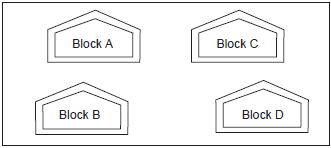
Center to center distances between various blocks :
| Block A to Block B | 50 m |
| Block B to Block C | 150 m |
| Block C to Block D | 25 m |
| Block A to Block D | 170 m |
| Block B to Block D | 125 ill |
| Block A to Block C | 90 m |
Number of Computer:
| Block A | 25 |
| Block B | 50 |
| Block C | 125 |
| Block D | 10 |
(a) Suggest the device which is used to connect all the nodes in particular block.
(i) Repeater (ii) Gateway
(iii) Bridge (iv) Switch
(b) Suggest the most suitable wire to connect all the blocks with high-speed data transfer.
(i) Ethernet Cable (ii) Twisted Pair
(iii) Optical Fibre (iv) Co-axial Cable
(c) The organization is planning to link its front office situated in the city in a hilly region where cable connection is not feasible, suggest an economic way to connect way to connect it with reasonably high speed.
(i) Satellite (ii) Radio Wave
(iii) Microwave (iv) Bluetooth
(d) Suggest the appropriate protocol/way to do the audio-video communication between the different parts of the world.
(i) E-Mail (ii) Blog
(iii) Chat (iv) VOIP
(e) What type of network would be formed if the Mangalore office is connected to their New York office?
(i) LAN (ii) PAN
(iii) MAN (iv) WAN