Question
Multiply: $\big(\frac{3}{5}\text{x}+\frac{1}{2}\text{y}\big) \ \text{by} \ \big(\frac{5}{6}\text{x}+4\text{y}\big)$

Answer

To multiply, we will use distributive law as follows: $\big(\frac{3}{5}\text{x}+\frac{1}{2}\text{y}\big) \ \text{by} \ \big(\frac{5}{6}\text{x}+4\text{y}\big)$ $=\frac{3}{5}\text{x}\big(\frac{5}{6}\text{x}+4\text{y}\big)+\frac{1}{2}\text{y}\big(\frac{5}{6}\text{x}+4\text{y})​​​​​​​$ $=\frac{1}{2}\text{x}^2+\frac{12}{5}\text{xy}+\frac{5}{12}\text{xy}+2\text{y}^2$ $=\frac{1}{2}\text{x}^2+\big(\frac{144+25}{60}\big)\text{xy}+2\text{y}^2$ $=\frac{1}{2}\text{x}^2+\frac{169}{60}\text{xy}+2\text{y}^2$ Thus, the answer is $=\frac{1}{2}\text{x}^2+\frac{169}{60}\text{xy}+2\text{y}^2.$

Need a full question paper?

Generate a complete, print-ready paper with questions like this in minutes — across 16+ boards, with answer keys.

Start Generating Free

Similar questions

The weekly wages (in rupees) of 28 workers of a factory are given below: $668, 610, 642, 658, 668, 620, 719, 720, 700, 690, 710, 642, 672, 654, 692, 706, 718, 702, 704, 678, 615, 640, 680, 716, 705, 615, 636, 656$. Construct a frequency table with equal class intervals, taking the first of the class intervals as $610-630$, where $630$ is not included.
If $\Big(\text{x}+\frac{1}{\text{x}}\Big)=4$ Find the values of: $\Big(\text{x}^4+\frac{1}{\text{x}^4}\Big)$
Verify the following:$\Big(\frac{3\text{p}}{7}+\frac{7}{6\text{p}}\Big)^2-\Big(\frac{3}{7}\text{p}+\frac{7}{6\text{p}}\Big)^2=2$
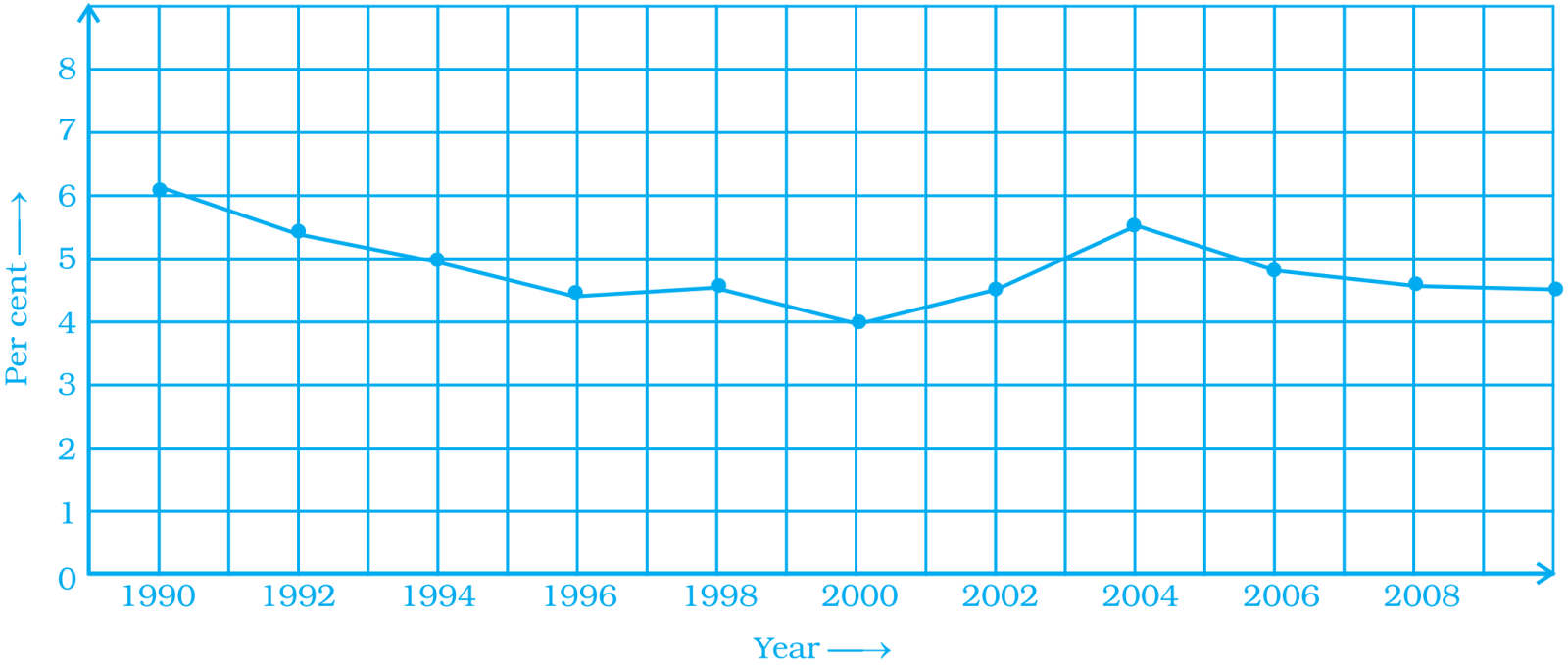
This graph shows the per cent of students who dropped out of school after completing High School. The point labelled $A$ shows that, in $1996$, about $4.7\%$ of students dropped out.

$a.$ In which year was the dropout the rate highest? In which year was it the lowest?
$b.$ When did the per cent of students who dropped out of high school first fall below $5\%?$
$c.$ About what per cent of students dropped out of high school in $2007?$ About what per cent of students stayed in high school in $2008?$
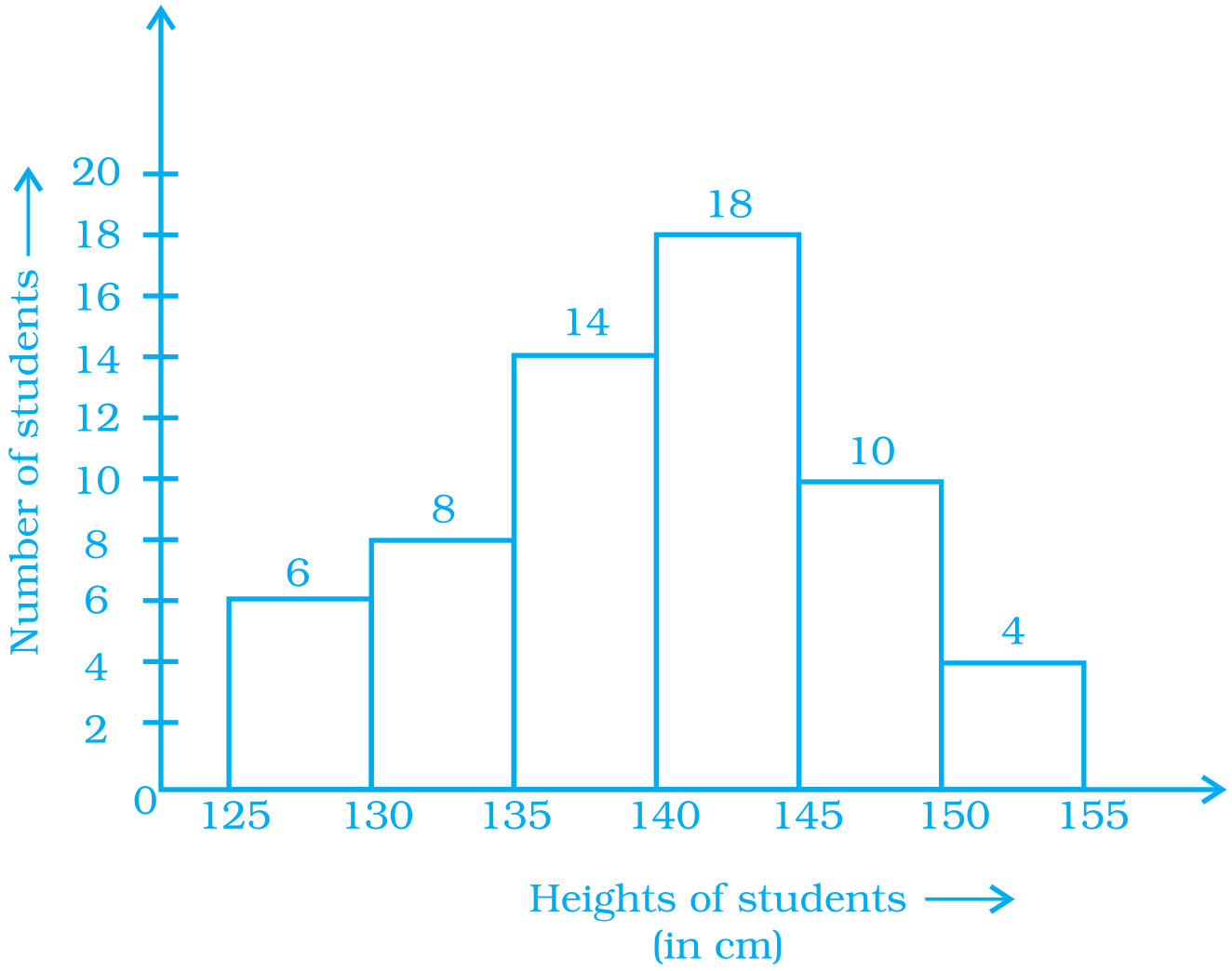
Look at the histogram below and answer the questions that follow.

$a.$ How many students have height more than or equal to $135\ cm$ but less than $150\ cm?$
$b.$ Which class interval has the least number of students?
$c.$ What is the class size?
$d.$ How many students have height less than $140\ cm?$
Show that the following numbers is a perfect square. Also, find the number whose square is the given number in case:$14641$
Hema bought two pairs of jeans for $Rs. 1450$ each. She sold one of them at a gain of $8\%$ and the other at a loss of $4\%$. Find her gain or loss percent in the whole transaction.
$1200$ men can finish a stock of food in $35$ days. How many more men should join them so that the same stock may last for $25$ days?
Following data gives the number of children in $40$ families: $1, 2, 6, 5, 1, 5, 1, 3, 2, 6, 2, 3, 4, 2, 0, 0, 4, 4, 3, 2, 2, 0, 0, 1, 2, 2, 4, 3, 2, 1, 0, 5, 1, 2, 4, 3, 4, 1, 6, 2, 2.$ Represent it in the form of a frequency distribution.
In the year $2001,$ the number of malaria patients admitted in the hospitals of a state was $4375.$ Every year this number decreases by $8 \%$. Find the number of patients in $2003.$