Question
$\mu_\text{V}​>\mu_\text{R}$​ indicates:

Answer

  1. Shift is more for violet colour
Explanaiton:
Since, $\mu_\text{V}​>\mu_\text{R}$​, the shift is more for he violet light than the red light in a given medium.

Need a full question paper?

Generate a complete, print-ready paper with questions like this in minutes — across 16+ boards, with answer keys.
Start Generating Free

Similar questions

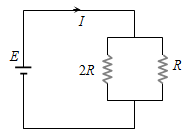
What is the ratio of heat generated in $R$ and $2R$
According to Einstein’s photoelectric equation, the plot of the kinetic energy of the emitted photo electrons from a metal versus  the frequency, of the incident radiation gives a straight line whose slope(a) Is the same for all metals and independent of the intensity of the radiation(b) Depends on the intensity of the radiation(c) Depends both on the intensity of the radiation and the metal used(d) Depends on the nature of the metals used


Assertion :  The setting sun appears to be red.
Reason     :  Scattering of light is directly proportional to the wavelength.(a) If both assertion and reason are true and the reason is the correct explanation of the assertion.(b) If both assertion and reason are true but reason is not the correct explanation of the assertion.(c) If assertion is true but reason is false.(d) If the assertion and reason both are false.


A charged particle is moving with velocity v in a magnetic field of induction B. The force on the particle will be maximum when (a) v and B are in the same direction(b) v and B are in opposite directions(c) v and B are perpendicular(d) v and B are at an angle of 45°
   
   
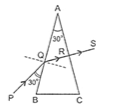
In the diagram, a prism of angle $30^{\circ}$ is used. A ray $PQ$ is incident as shown. An emergent ray $RS$ emerges perpendicular to the second face. The angle of deviation is:
Image
Lenz's law gives:
A plane glass slab is kept over various coloured letters, the letter which appears least raised is(a) Blue (b) Violet(c) Green (d) Red
       
Photoelectric emission is observed from a metallic surface for frequencies $\mathrm{v}_1$ and $\mathrm{v}_2$ of the incident light rays $(\left.\mathrm{v}_1>\mathrm{v}_2\right).$ It the maximum values of kinetic energy of the photoelectrons emitted in the two cases are in the ratio of $1: \mathrm{k},$ then the threshold frequency of the metallic surface is
A 25 W, 220 V bulb and a 100 W, 220 V bulb are connected in parallel across a 440 V line(a) Only 100 watt bulb will fuse(b) Only 25 watt bulb will fuse(c) Both bulbs will fuse(d) None of the bulbs will fuse
   
   
According to Bohr, only those states are stable, in which angular momentum of electron will be :