MCQ
Myopia is due to
  • Elongation of eye ball
  • B
    Irregular change in focal length
  • C
    Shortening of eye ball
  • D
    Older age

Answer

Correct option: A.
Elongation of eye ball
a
(a) In myopia, eye ball may be elongated so, light rays focussed before the retina.

Need a full question paper?

Generate a complete, print-ready paper with questions like this in minutes — across 16+ boards, with answer keys.
Start Generating Free

Similar questions

$A$ long solenoid of $N$ turns has a self inductance $L$ and area of cross section $A$. When a current $i$ flows through the solenoid, the magnetic field inside it has magnitude $B$. The current $i$ is equal to:
The focal length of lens of refractive index $1.5$ in air is $0.30 m.$ When it is immersed in a liquid of refractive index $\frac{4}{3}$, then its focal length in liquid will be......$cm$
Weights of $1\,g,2\,g.....,100\,g$ are suspended from the $1 \,cm, 2 \,cm, ...... 100\, cm, \,marks$ respectively of a light metre scale. Where should it be supported for the system to be in equilibrium ...... $cm$ mark.
A bird weighs $2 kg$ and is inside a closed cage of $1 kg$. If it starts flying, then what is the weight of the bird and cage assembly  ........... $kg$
The reactance of a coil when used in the domestic ac power supply ($220\,volts $,$\,50 $  cycles per second) is $50 \,ohms$. The inductance of the coil is nearly.......$henry$
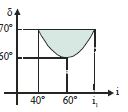
The curve of angle of incidence versus angle of deviation shown has been plotted for prism. The value of refractive index of the prism used is
As shown schematically in the figure, two vessels contain water solutions (at temperature $T$ ) of potassium permanganate $\left( KMnO _4\right)$ of different concentrations $n_1$ and $n_2\left(n_1>n_2\right)$ molecules per unit volume with $\Delta n=\left(n_1-n_2\right) \ll n_1$. When they are connected by a tube of small length $\ell$ and cross-sectional area $S , KMnO _4$ starts to diffuse from the left to the right vessel through the tube. Consider the collection of molecules to behave as dilute ideal gases and the difference in their partial pressure in the two vessels causing the diffusion. The speed $v$ of the molecules is limited by the viscous force $-\beta v$ on each molecule, where $\beta$ is a constant. Neglecting all terms of the order $(\Delta n)^2$, which of the following is/are correct? ( $k_B$ is the Boltzmann constant)-

$(A)$ the force causing the molecules to move across the tube is $\Delta n k_B T S$

$(B)$ force balance implies $n_1 \beta v \ell=\Delta n k_B T$

$(C)$ total number of molecules going across the tube per sec is $\left(\frac{\Delta n}{\ell}\right)\left(\frac{k_B T}{\beta}\right) S$

$(D)$ rate of molecules getting transferred through the tube does not change with time
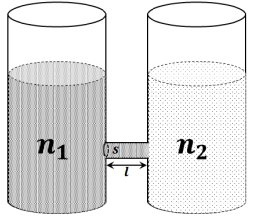
Which of the following statements is true
Which source is associated with a line emission spectrum
The potential difference applied to an $X-$ ray tube is $5kV$ and the current through it is $3.2 mA$. Then the number of electrons striking the target per second is