Question

n identical bulbs, each designed to draw a power p from a certain voltage supply, are joined in series across that supply. The total power which they will draw is

(a)  

(b) p/n

(c) p

(d) np

Answer

(b) p/n

Need a full question paper?

Generate a complete, print-ready paper with questions like this in minutes — across 16+ boards, with answer keys.

Start Generating Free

Similar questions

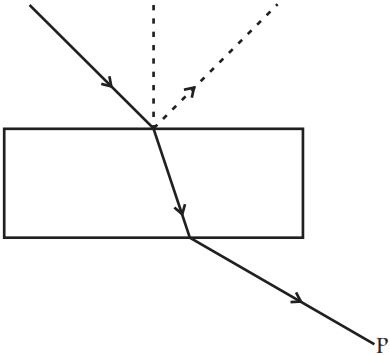
Consider a light beam incident from air to a glass slab at Brewster's angle as shown in Fig. A polaroid is placed in the path of the emergent ray at point P and rotated about an axis passing through the centre and perpendicular to the plane of the polaroid.

To charges  and  are placed 30 cm apart, shown in the figure. A third charge  is moved along the arc of a circle of radius 40 cm  from C  to D. The change in the potential energy of the system is , where k  is

(a) 8 

(b)  

(c)  

(d)  

The net resistance of a voltmeter should be large to ensure that:

A parallel plate capacitor has circular plates of 0.08m  radius and 1.0   separation. If a P.D. of 100 volt is applied, the charge will be

(a) 1.8  

(b) 1.8  

(c) 1.8  

(d) None of these

Which of the following is the most suitable material for making permanent magnet?
The inductance of a resistanceless coil is 0.5 henry. In the coil, the value of alternating current is 0.2 A, whose frequency is 50 Hz. The reactance of circuit is.

In NPN transistor the collector current is 10 mA. If 90% of electrons emitted reach the collector, then

(a) Emitter current will be 9 mA

(b) Emitter current will be 11.1 mA

(c) Base current will be 0.1 mA

(d) Base current will be 0.01 mA

In optical instruments, the lenses are used to form images by:
If a charged body is moved in an electric field against the Coulomb force, then ________?

The charge density in a nucleus varies with distance from the centre of the nucleus according to the curve in Fig.

(a)

(b)

(c)

(d)