MCQ
${N_2}$ combines with metal to form
  • Nitride
  • B
    Nitrate
  • C
    Nitrite
  • D
    Nitrosyl chloride

Answer

Correct option: A.
Nitride
a
(a) Nitrogen react with metal to form a nitride.

$6Li + {N_2} \overset{450^\circ}\longrightarrow 2L{i_3}N$(Lithium nitride)

Need a full question paper?

Generate a complete, print-ready paper with questions like this in minutes — across 16+ boards, with answer keys.
Start Generating Free

Similar questions

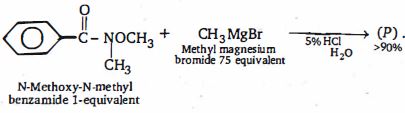
Product $(P)$ is
The boiling point of water in a $0.1$ molal silver nitrate solution (solution $A$ ) is $x ^{\circ} C$. To this solution A, an equal volume of $0.1$ molal aqueous barium chloride solution is added to make a new solution $B$. The difference in the boiling points of water in the two solutions $A$ and $B$ is $y \times 10^{-2}{ }^{\circ} C$.

(Assume : Densities of the solutions $A$ and $B$ are the same as that of water and the soluble salts dissociate completely.)

Use: Molal elevation constant (Ebullioscopic Constant), $K _{ b }=0.5 K kg mol ^{-1}$; Boiling point of pure water as $100^{\circ} C$.)

($1$) The value of $x$ is

($2$) The value of $|y|$ is

Acetaldehyde reacts with semicarbazide product will be
Acidic property of phenol can be explained when it is reacted with
An element of $3d-$ transition series shows two oxidation states $x$ and $y,$ differ by two units then
Which of the following does not reduce Tollen’s reagent
$B$ is
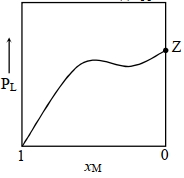
For a solution formed by mixing liquids $L$ and $M$, the vapour pressure of $L$ plotted against the mole fraction of $M$ in solution is shown in the following figure. Here $x_{L}$ and $x_M$ represent mole fractions of $L$ and $M$, respectively, in the solution. The correct statement(s) applicable to this system is(are)

(image)

$[A]$ Attractive intermolecular interactions between $L-L$ in pure liquid $L$ and $M-M$ in pure liquid $M$ are stronger than those between $L-M$ when mixed in solution

$[B]$ The point $Z$ represents vapour pressure of pure liquid $M$ and Raoult's law is obeyed when $x_{L} \rightarrow 0$

$[C]$ The point $Z$ represents vapour pressure of pure liquid $L$ and Raoult's law is obeyed when $x_{\mathrm{L}} \rightarrow 1$

$[D]$ The point $Z$ represents vapour pressure of pure liquid $M$ and Raoult's law is obeyed from $x_{L}=0$ to $x_{L}=1$
In which of the following mixtures dipole-dipole attraction is mainly found?
When two perfect solutions with volume V each are combined, What is the volume of the solution as a result?