Question
Name and define three classes of levens and give two examples for each kind

Answer

(i) Lever of 1st order
A lever in which the fulcrum acts in the middle, the load on one side and the effort on the other side is called lever of the 1st order.
Scissors and crow-har are the examples of lever of 1st order.
(ii) Lever of 2nd order
A lever in which the load acts in the middle, the effort on one side and fulcurm on the other side is called lever of 2nd order.
A nut cracker and a wheel barrow are the examples of lever of 2nd order.
(iii) Lever of 3rd order
A lever in which effort acts in the middle, the load on one side and fulcrum on the other side is called lever of 3rd order.
A fire tong and fishing rod are examples of lever of 3rd order

Need a full question paper?

Generate a complete, print-ready paper with questions like this in minutes — across 16+ boards, with answer keys.

Start Generating Free

Similar questions

A fish swimming in a pond seems nearer than it really is. Explain.
What is a couple?
Name two isotopes of uranium.

Which of the isotope mentioned in part (a) above is easily fissionable? Give reason.

State whether the neutron needed for fission reaction of the isotope mentioned in part (b) above, is slow or fast?

400 g of wax at $10^{\circ} C$ is beated to $80^{\circ} C$, when it starts melting. On complete melting wax is further heated so that temperature rises to $130^{\circ} C$. Calculate (a) Heat energy required to bring the wax to its melting point (b) Heat energy required to melt the wax (c) Heat energy required to bring the molten wax to $130^{\circ} C$.
[sp, beat capacity of solid wax $=1.5 Jg ^{-10} C ^{-1}$; sp. heat capacity of liquid wax $=1.8 Jg ^{-19} C ^{-1}$ and sp . latent heat of wax $\left.=20 Jg ^{-1}\right]$
If the speed of a body is doubled, what happens to its kinetic energy?
What is the effect on the atomic mass and the atomic number of a radioactive element, after the emission of an α-particle?
Distinguish between a real and a virtual image.
Write the SI units for:
(a) Electric current
(b) Potential difference

(c) Charge.

(a) Is it possible for a hydrogen ( ${ }^{( H )}$ ) nucleus to emit an alpha particle? Give a reason for your answer.
(b) (i) Define nuclear fission.
(ii) Rewrite and complete the following nuclear reaction by filling in the atomic number of Ba and mass number of Kr :
$\text { 238U }+bn \longrightarrow{ }_{144} Ba+{ }_{36} Kr+3 dn+\text { Energy }$
(c) (i) Why is a nuclear fusion reaction called a thermo nuclear reaction?
(ii) Complete the reaction:
${ }^3 He_2+{ }^2 H_1 \longrightarrow{ }^4 He_2+\ldots \ldots \ldots \ldots \ldots+\text { Energy }$
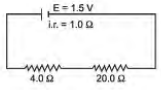
(i) A cell of e.m.f. 1.5 V and internal resistance $1.0 \Omega$ is connected to two resistors of $4.0 \Omega$ and $20.0 \Omega$ in series as shown in the figure.
Calculate the :
(a) current in the circuit.
(b) potential difference across the 4.0 ohm resistor.
(c) voltage drop when the current is flowing.
(d) potential difference across the cell.
Image
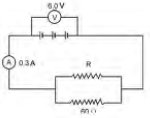
(ii) In the figure, the ammeter A reads 0.3 A shown alongside,
Calculate :
(a) the total resistance of the circuit.
(b) the value of R .
(c) the current flowing through R .
(iii) (a) State Ohm's law
(b) Name two materials whose resistance decreases when the material is heated.
Image