Question
Name and explain different types of reserves in details.

Answer

Types of Reserves:
  1. Revenue Reserve: It is an amount set aside out of revenue profits for distribution of dividends. For example, general reserve, investment fluctuation fund, capital reserve and workmen compensation fund. It is not a charge against profit but it is appropriation of profit shown in the profit and loss account. It is beneficial for the smooth function of the business. The retention of profit in the form of reserves reduces the amount of profit to distribute among the business owners. This is further classified in to general reserve and specific reserve.
  • General reserve Means a reserve which is not maintained for specific purpose. It helps to strengthen the financial status of the business. It is also known as free reserve and contingency reserve.
  • Specific reserve Means a reserve which is maintained for specific purpose. For example, dividend equalisation reserve is created to maintain dividend rate. This reserve amount is utilised to maintain the rate dividend in the year of low profit. Likewise, the workmen compensation fund is maintained to provide claims of the workers, investment fluctuation fund is used at times of decline in the value of investment and debenture redemption reserve is used to provide funds for redemption of debentures.
  1. Capital Reserve: It is an amount set aside out of capital profits which is not available for distribution as dividend among the shareholders. It is used for writing capital losses/ issue of bonus share in a company. Examples of capital reserves are.
  • Profit prior to incorporation.
  • Premium on issue of shares or debentures.
  • Profit on redemption of debenture.
  • Profit on forfeiture of share.
  • Profit on sale of fixed assets.
  • Capital redemption reserve.
  • Profit on revaluation of fixed assets and liabilities.

Need a full question paper?

Generate a complete, print-ready paper with questions like this in minutes — across 16+ boards, with answer keys.
Start Generating Free

Similar questions

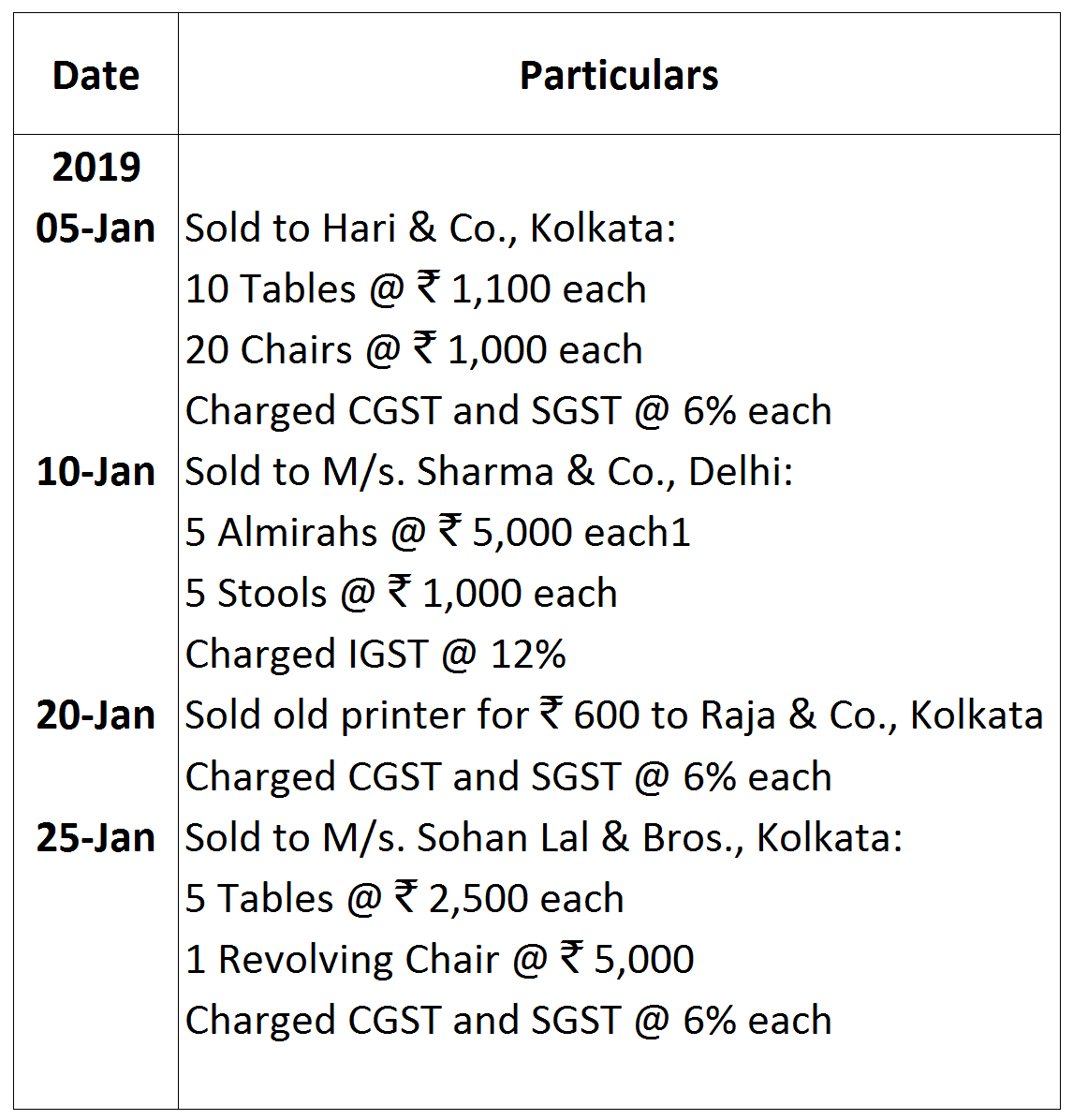
From the following particulars, prepare Sales Book of Gupta & Co., Kolkata who deals in furniture:
Show the Posting from Sales Book to Ledger Accounts.
On Jan 15, 2016 Raghu sold goods worth ₹ 35,000 to Devendra and drew upto the latter three bills of exchanges. The first bill was for ₹ 5,000 payable after one month, the second bill was for ₹ 20,000 payable after three months and third bill for balance amount for 4 months. Raghu endorsed the first bill in favour of his creditor Dewan in full settlement of a debt of ₹ 5,200. The second bill was discounted by Raghu @ 6 % p.a. and the third bill was retained by Raghu till the date of maturity. Devendra dishonoured the bill on maturity and the bank paid ₹ 30 as noting charges. Four days before the maturity of the third bill Raghu, sent the same for collection to his bank. The third bill was also dishonored by Devendra and the bank paid ₹ 200 as noting charges. Five days after the dishonour of the bill Devendra paid the entire amount due to Raghu along with interest ₹ 1,000 for this purpose Devendra obtained a short term loan from his bank. You are requested to record the necessary journal entries in the books of Raghu Devendra and Dewan and also prepare Devendra’s account in Raghu’s books and Raghu’s account in Devendra’s account.
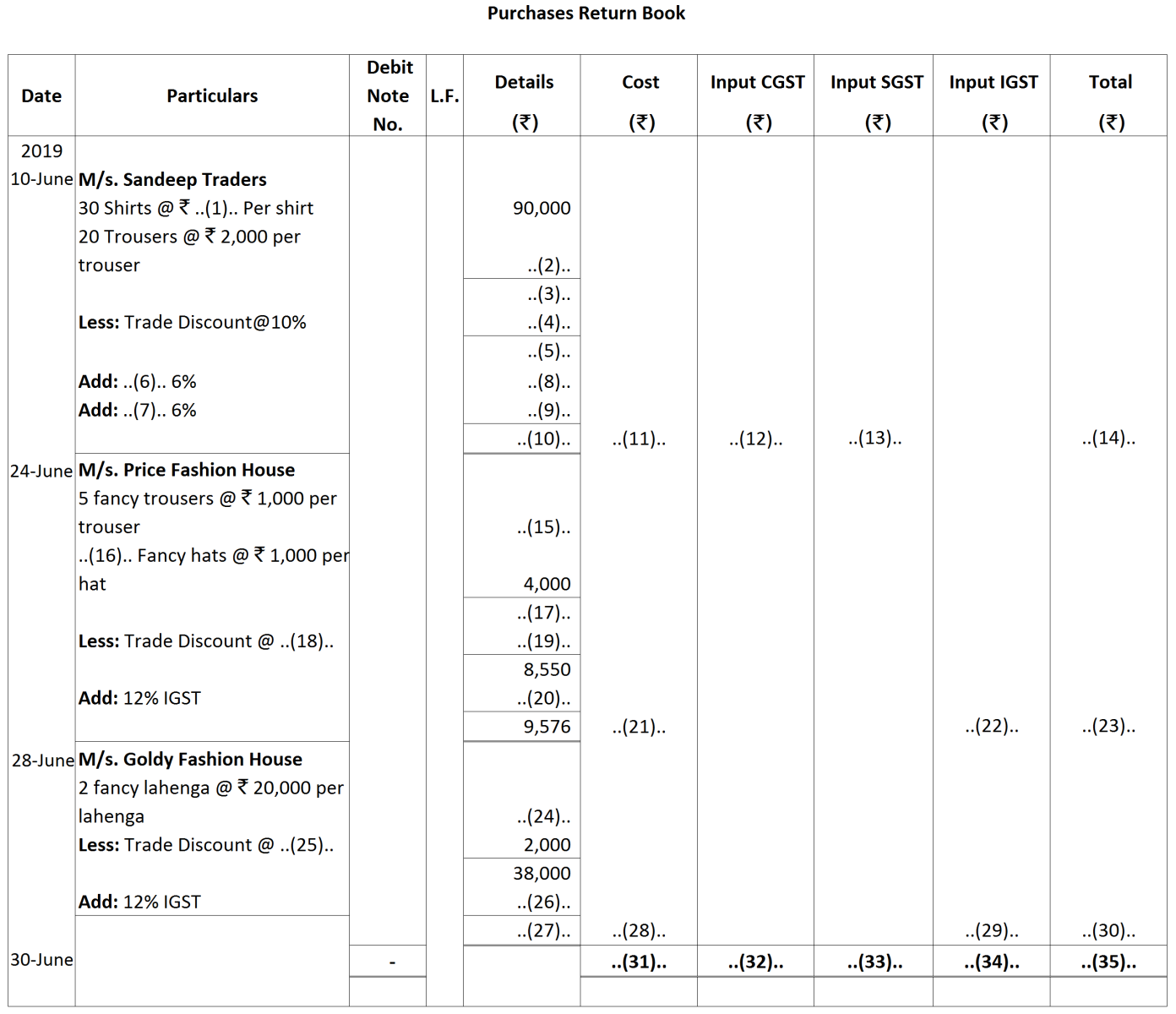
In the following Purchases Return Book, determine the missing information:
Rajesh Kumar was unable to reconcile his Trial Balance as on 31st March 2014 and has opened a suspense account from the difference. Later on the following errors were discovered:-
  1. There were three compensating errors:-
  1. The total of Sales Return Book was overcast by ₹ 100.
  2. The total of one page of the Purchase Book was carried forward as ₹ 1,286 instead of ₹ 1,826.
  3. Goods purchased from C for ₹ 400 was debited to his account as ₹ 40.
  1. ₹ 425 paid for wages to workmen for making office table were debited to wages account.
  2. Rent paid ₹ 1,500 were posted to the credit of Rent account as ₹ 150.
  3. Cash received from Ghanshyam ₹ 500 were correctly recorded in cash book but were posted to his account as ₹ 50.
  4. ₹ 720 paid to Kamal has been debited to Kamlesh A/c as ₹ 520.
  5. The total of Purchase Return Book ₹ 2,500 was left unposted.
Pass rectifying entries and prepare Suspense A/c.
Following was the position of Harish & Co. as on 1st April, 2017: Cash in Hand ₹ 10,000; Cash at Bank ₹ 16,800; Furniture ₹ 8,000; Stock ₹ 50,000; Debtors−Ram ₹ 8,000; Shyam ₹ 12,000; Creditors−Anil ₹ 4,000; Sunil ₹ 5,000. Following transactions took place during April, 2017:
2017
 
April 2
Received a cheque from Ram in full settlement of his account after deducting 5% cash discount.
April 4
Deposited the above cheque into Bank.
April 5
Goods purchased for ₹ 20,000 at 10% trade discount and 5% cash discount. Payment made by cheque.
April 6
Discount allowed to him ₹ 140. Cheque deposited into the bank on the same day.
April 10
Cash paid to Anil after deducting 2% cash discount.
April 15
Old furniture sold for ₹ 800.
April 16
Sold goods to Shiv Parshad of the list price of ₹ 10,000 at a trade discount of 15%.
April 18
Shiv Parshad returned goods of the list price of ₹ 1,000.
April 20
Paid for furniture repairs to Bahadur Singh ₹ 100.
April 25
Received a cheque from Shiv Parshad after deducting 4% cash discount. Cheque was deposited into bank.
April 28
Bank charged ₹ 50 for 'Bank Charges'.
April 30
Received Commission ₹ 200.
Pass Journal entries for the above transactions.
What is IFRS? State any two benefits of IFRS.
On 30th June 2014, the bank balance as per Sanjay Yadav's Cash Book was ₹ 1,500. On comparing with the Pass Book the following information was received:-
  1. Cheques amounting to ₹ 7,290 were issued on 28th June, of which one cheque of ₹ 1,300 was presented in the bank for payment on 4th July.
  2. Cheques deposited into bank for ₹ 10,000, but of these cheques for ₹ 4,000 were cleared and credited in July.
  3. Interest and Dividend on investments ₹ 580 collected by bank and credited to his account but he did not have any information for this.
  4. Life Insurance Premium ₹ 750 paid by bank according to his standing orders.
  5. Bank Charges ₹ 25 not recorded in the Cash Book.
Prepare a Bank Reconciliation Statement.
Journalise the following transactions of Raj Kumar Traders, timber merchants:
  1. Purchased timber from Kuldeep Kumar, for cash ₹ 2,000 and credit ₹ 10,000.
  2. Paid to Kuldeep Kumar in full settlement of his account ₹ 9,950.
  3. Paid rent in advance ₹ 10,000.
  4. Purchased machinery for ₹ 1,00,000 by cheque and carriage ₹ 2,000 and installation charges ₹ 1,000 paid in Cash.
  5. Purchased goods for ₹ 50,000 from Govind and sold it to Manohar for ₹ 65,000.
Mention the subsidiary books in which following transactions are recorded along with reason thereof:
  1. Purchase of furniture on credit for use in shop.
  2. Sale of goods on credit.
  3. Goods returned by Debtors.
  4. Purchase of stock on credit.
  5. Providing for interest on capital to proprietor.
  6. Goods returned to creditors.
  7. Sale of goods for cash.
On 1st January 2017, Amar sold goods to Akbar for ₹ 60,000. Akbar accepts two bills of ₹ 25,000 for 2 months, and ₹ 35,000 for 3 months.
The first bill was discounted from bank on 3rd January 2017 for ₹ 24,900 and 2nd bill endorsed to Anthony on 15th January 2017.
First bill was met on maturity but second bill got dishonoured and noting charges of ₹ 200 being paid. Amar charged ₹ 300 as Interest and drew another bill for the amount due for further 2 months. This bill was met on maturity.
Pass the necessary Journal Entries in the books of Amar, Akbar and Anthony.