Question
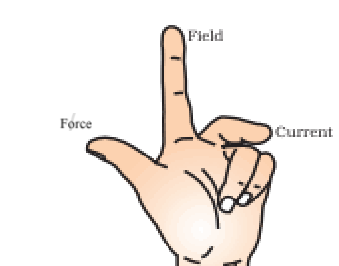
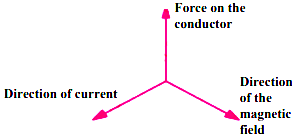
Name the following diagram and explain the concept behind them.

Image

Answer

It represents Fleming's left hand rule used for finding the direction of magnetic force when a current carrying conductor is placed in a magnetic field.
Image

This rule states that if you stretch the thumb, index finger, and middle finger of your left hand such that they are mutually perpendicular to each other, then your index magnetic finger represents the direction of the field, the middle finger represents the direction of the current, and the thumb represents the direction of the force experienced by the conductor.

Need a full question paper?

Generate a complete, print-ready paper with questions like this in minutes — across 16+ boards, with answer keys.

Start Generating Free

Similar questions

Construction of a compound microscope:
(1) A compound microscope consists of a metal tube fitted with two convex lenses at the two ends. These lenses are called the objective lens (the lens directed towards the object) and the eyepiece (the lens directed towards the eye). Both the lenses are small in size, but the cross section of the objective lens is less than that of the eyepiece. The objective lens has a short focal length. The focal length of the eyepiece is more than that of the objective lens.(2) The metal tube is mounted on a stand. The principal axes of the objective lens and the eyepiece are along the same line. The distance between the object and the objective lens can be changed with a screw. It is possible to change the distance between the objective lens and the eyepiece.
Working:
(1) The object to be observed is illuminated and placed in front of the objective lens, slightly beyond the focal length of the objective lens. Its real, inverted and enlarged image is formed by the, objective lens on the other side.
(2) This intermediate image lies within the focal length of the eyepiece. It serves as an object for the eyepiece. The eyepiece works as a simple microscope. The final image is virtual, highly enlarged and inverted with respect to the original object. It can be formed at the minimum distance of distinct vision from the eyepiece. The final image is observed by keeping the eye close to the eyepiece.
Use: This microscope is used to observe blood cells, microorganisms, etc.
1.In a compound microscope, which lens has greater focal length?
2.Where do you place the object to be observed with a compound microscope?
3.State which distance is adjusted to observe the object with a compound microscope.
4.State the nature of the final image in compound microscope relative to the object.
5.State the use of a compound microscope.
The following is a food chain that ends with human:
plants → bee → human
  1. Explain how plants provide food for bees.
  2. How do bees provide food for humans?
  3. How does this food chain differ form a usual food chain involving human such as : plants → goat → human?
  4. Do you think that the food chain given in this question can really be regarded as a food chain? Explain your answer.
An electric circuit consisting of a 0.5m long nichrome wire XY, an ammeter, a voltmeter, four cells of 1.5V each and a plug key was set up.
  1. Draw a diagram of this electric circuit to study the relation between the potential difference maintained between the points ‘X’ and ‘Y’ and the electric current flowing through XY.
  2. Following graph was plotted between V and I values:
What would be the values of ratios when the potential difference is 0.8V, 1.2V and 1.6V respectively? What conclusion do you draw from these values?
  1. What is the resistance of the wire?
 An electric iron of 1100 W is operated for 2 hours daily. What will be the electrical consumption expenses for that in the month of April? (The electric company charges ₹ 5 per unit of energy.)
How can you relate the formation of water droplets on the outer surface of a bottle taken out of a refrigerator with formation of dew?
Explain the process of spore formation.
Explain with examples types of asexual reproduction in unicellular organism.
Atomic number of chlorine is 17.
(a) Write the electronic configuration of chlorine.
(b) What is the number of electrons in the valence shell of chlorine ?
(c) Write the molecular formula of chlorine.
(d) Name the type of bond in the formation of chlorine molecule.
(e) Draw the electron dot structure of a chlorine molecule.
Write in brief about progressive changes in animal classification?
If the absolute refractive index of water is $1.36$, find the speed of light in water. (Speed of light in vacuum $= 3 \times 10^8 m/s.$)