Question
Name the force which builds the universe.

Answer

Quark - Quark force caused by the exchange of particles called 'gluons' is the basic force.

Need a full question paper?

Generate a complete, print-ready paper with questions like this in minutes — across 16+ boards, with answer keys.
Start Generating Free

Similar questions

What are the two conditions when a real gas follow the ideal gas equation PV = nRT?
What change is observed when a wave gets reflected from a hard, rigid support?
A copper cube of mass $200\ g$ slides down on a rough inclined plane of inclination $37^{\circ}$ at a constant speed. Assume that any loss in mechanical energy goes into the copper block as thermal energy. Find the increase in the temperature of the block as it slides down through $60\ cm$ . Specific heat capacity of copper $=420 \mathrm{Jkg}^{-1} \mathrm{~K}^{-1}$.
Magnetic scalar potential is defined as$\text{U}(\overrightarrow{\text{r}_2})-\text{U}(\overrightarrow{\text{r}_1})=-\int\limits^{\vec{\text{r}}_2}_{\vec{\text{r}_1}} \vec{\text{B}}.\text{d}\vec{\text{l}}.$
Apply this equation to a closed curve enclosing a long atraicht wire. The RHS of the above equation is then $-{\mu}_\text{o} \text{ i}$ by Ampere's law. We see that $\text{U}(\vec{\text{r}_2})\neq\text{U}(\vec{\text{r}_1})$ even when $\vec{\text{r}_2}=\vec{\text{r}_1}.$Can we have a magnetic acalar potential in this case?
If the angular momentum of a body is found to be zero about a point, is it necessary that it will also be zero about a different point?
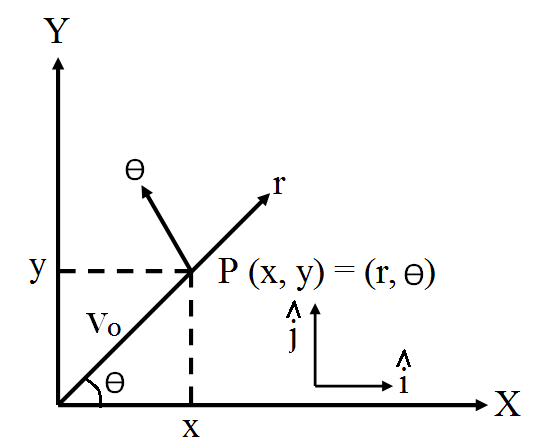
Motion in two dimensions, in a plane can be studied by expressing position, velocity and acceleration as vectors in Cartesian co-ordinates $\text{A}=\text{A}_\text{x}\hat{\text{i}}+\text{A}_\text{y}\hat{\text{j}}$ where $\hat{\text{i}}$ and $\hat{\text{j}}$ are unit vector along x and y directions, respectively and $A_x$ and $A_y$ are corresponding components of A Fig. Motion can also be studied by expressing vectors in circular polar co-ordinates as $\text{A}=\text{A}_\text{r}\hat{\text{r}}+\text{A}_\theta\hat{\theta}$ where $\hat{\text{r}}=\frac{\text{r}}{\text{r}}=\cos\theta\hat{\text{i}}+\sin\theta\hat{\text{j}}$ and $\hat{\theta}=-\sin\theta\hat{\text{i}}+\cos\theta\hat{\text{j}}$ are unit vectors along direction in which ‘r’ and ‘$\theta$’ are increasing.
  1. Express $\hat{\text{i}}$ and $\hat{\text{j}}$ in terms of $\hat{\text{r}}$ and $\hat{\theta}$.
  2. Show that both $\hat{\text{r}}$ and $\hat{\theta}$ are unit vectors and are perpendicular to each other.
  3. Show that $\frac{\text{d}}{\text{dt}}(\hat{\text{r}})=\omega\hat{\theta}$ where $\omega=\frac{\text{d}\theta}{\text{dt}}$ and $\frac{\text{d}}{\text{dt}}(\hat{\text{r}})=-\omega\hat{\text{r}}$
  4. For a particle moving along a spiral given by $\text{r}=\text{a}\theta\hat{\text{r}}$ , where a = 1 (unit), find dimensions of ‘a’.
  5. Find velocity and acceleration in polar vector represention for particle moving along spiral described in (d) above.
Write the value of specific heat ratio $\left(\frac{ C _{ P }}{ C _\gamma}\right)$ for oxygen gas.
a. Calculate the energy released if ${ }^{238} \mathrm{U}$ emits an $\alpha$-particle.
b. Calculate the energy to be supplied to ${ }^{238} \mathrm{U}$ it two protons and two neutrons are to be emitted one by one. The atomic masses of ${ }^{238} \mathrm{U},{ }^{234} \mathrm{Th}$ and ${ }^4 \mathrm{He}$ are $238.0508 \mathrm{u}, 234.04363 \mathrm{u}$ and $4.00260 u$ respectively.
If the molecules were not allowed to collide among themselves, would you expect more evaporation or less evaporation?
Answer with reason: In an elastic collision of two billiard balls, is the total kinetic energy conserved during the short time of collision of the balls (i.e., when they are in contact)?