Question
Name the molecules which contribute to the flexibility exhibited by the plasma membrane.

Answer

Lipid bilayer contributes to the flexibility exhibited by the plasma membrane.
Explaination:
According to fluid modaic model, cell membrane is made of lipid bilayer with protein molecules embedded in between (like a sandwich).
Lipid molecules make the cell membrane elastic & in turn flexible.
Protein channels help in transport of substances across membrane.

Need a full question paper?

Generate a complete, print-ready paper with questions like this in minutes — across 16+ boards, with answer keys.
Start Generating Free

Similar questions

Which object is vibrating when the following sounds are produced?
  1. The sound of a sitar.
  2. The sound of table.
  3. The sound of a tuning fork.
  4. The buzzing of a bee or mosquito.
  5. The sound of a flute.
If the relative density of a substance is 7.1, what will be its density in SI units?
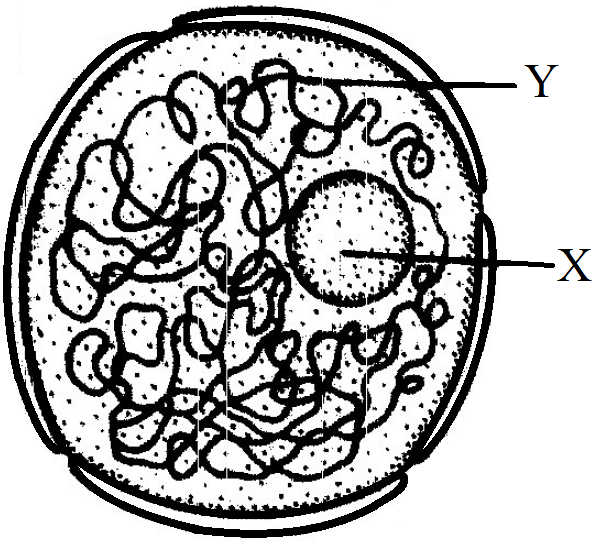
  1. Identify the above figure.
  2. Label X and Y.
  3. What is the function of X?
Classify the following as physical or chemical changes:
  1. Cooking of food.
  2. Boiling of water.
  3. Cutting of trees.
  4. Dissolving salt in water.
  5. Digestion of food.
  6. Melting of ice.
Ice at 0°C is more effective in cooling than water at 0°C. Give reason.
A car weight 20000N climbs up a hill at a steady speed of 8 m/s, gaining a height of 120m in 100s. Calculate:
  1. Work done by the car.
  2. Power of engine of car.
The substance X normally exists in a physical state which can flow easily but does not fill its vessel completely. It also turns anhydrous copper sulphate blue. When substance X is cooled excessively, it changes into a substance Y which has a fixed shape as well as a fixed volume. If, however, the substance X is heated strongly, it changes into a substance Z which has neither a fixed shape nor a fixed volume.
  1. Name the substances (i) X (ii) Y and (iii) Z.
  2. What is the process of conversion of X into Y known as?
  3. At which temperature X gets converted into Y?
  4. What is the process of conversion of X into Z known as?
  5. At which temperature X gets converted into Z?
What is the difference between the density and relative density of a substance?
How will you separate a mixture of iron filings and powdered carbon?
What is the difference between speed and velocity?