Question
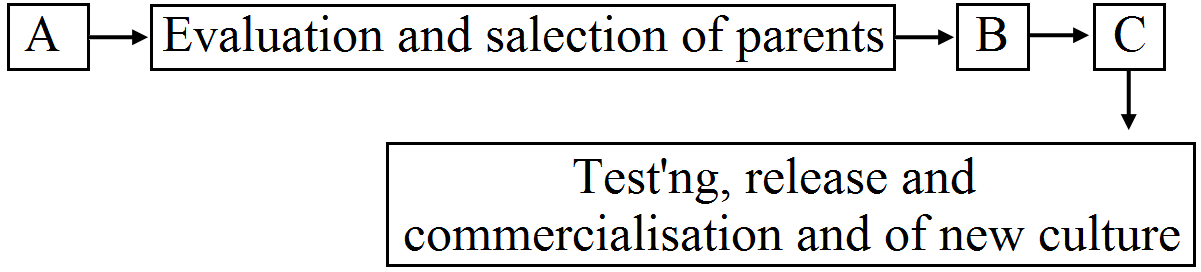
Name the steps represented in the following process:
Answer

  1. A- Collection of germplasm.
  2. B- Cross hybridisation among selected plants.
  3. C- Selection and testing of superior recombinants.

Need a full question paper?

Generate a complete, print-ready paper with questions like this in minutes — across 16+ boards, with answer keys.

Start Generating Free

Similar questions

What are saprotrophs? How do they obtain their nutrition?
Mark the odd one the following groups.
Oogonia, Spermatogonia, Zygote, Ootid.
An infertile couple is advised to adopt test-tube baby programme. Describe two principle procedures adopted for such technologies.
Explain broadly utilitarian argument for conservation of biodiversity.
Explain briefly:
Chitinase
What is inheritance & variation?
What is restriction enzyme? Explain the process of separation and isolation of DNA fragments using gel electrophoresis technique.
Mention the role of pioneer species in primary succession on rocks.
Match Column I with Column II.
S. No.
Column I
S. No.
Column II
A.
Cleavage
1.
Outer layer of the blastocyst that attaches to the endometrium during implantation.
B.
Implantation
2.
Mitotic divisions of the zygote in quick succession.
C.
Inner cell mass
3.
Embedding of the blastocyst in the endometrium of uterus.
D.
Trophoblast
4.
Release of secondary oocyte from the ovary.
E.
 
5.
Group of cells attached to one end of trophoblast that differentiate into embryo proper.
A3' ............ 5'B
C5’ ........... 3'D.
AB and CD represent two strands of a DNA molecule. When this molecule undergoes replication, forming a replication fork between A and C in the above.
  1. Name the templete strand for replication.
  2. Using which strand as the templete, will there be continuous synthesis of a complementary DNA strand
  3. Complementary to which strand will okazaki segments get synthesised, discontinuous synthesis occurs.
  4. What are templete strands and Okazaki pieces?
  5. In which direction is a new strand synthesised?