Question


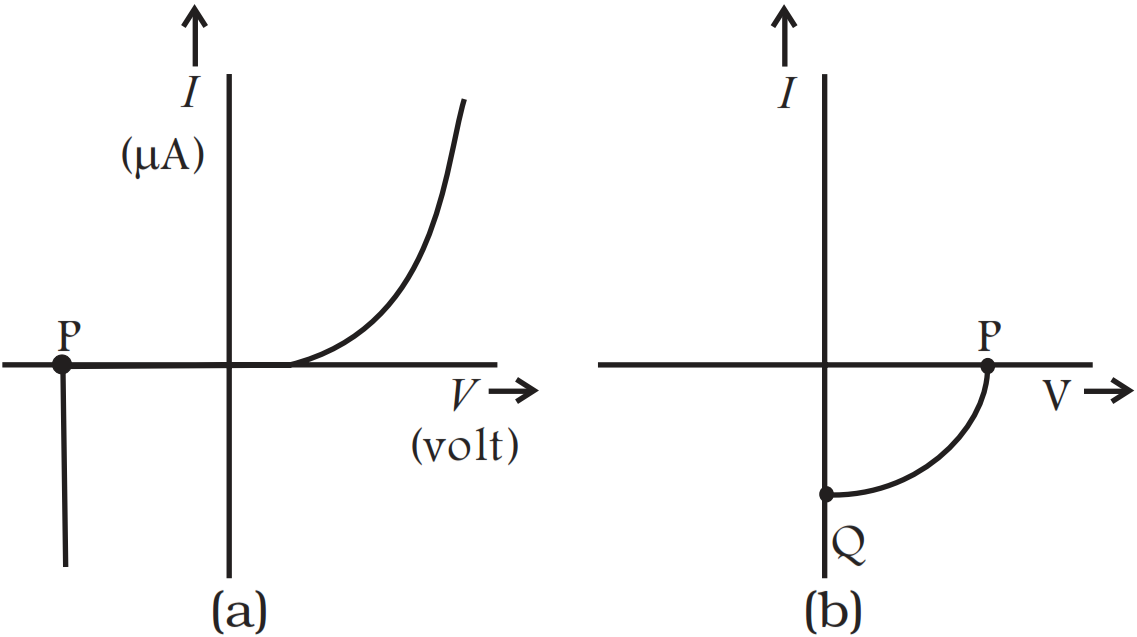
  1. Name the type of a diode whose characteristics are shown in Fig. (A) and Fig. (B).
  2. What does the point P in Fig. (A) represent?
  3. What does the points P and Q in Fig. (B) represent?

Answer

  1. Fig. (a) represents the characteristics of Zener diode and curve (b) is of solar cell.
  2. In fig. (a), point P represents Zener breakdown voltage.
  3. In fig. (b), the point Q represents zero voltage and negative current. Which means the light falling on solar cell with atleast minimum threshold frequency gives the current in opposite direction to that due to a battery connected to solar cell. But for the point Q the battery is short circuited. Hence it represents the short circuit current.

And the point Pin Fig. (b) represents some open circuit, voltage on solar cell with zero current through solar cell.

It means, there is a battery connected to a solar cell which gives rise to the equal and opposite current to that in solar cell by virtue of light falling on it.

Need a full question paper?

Generate a complete, print-ready paper with questions like this in minutes — across 16+ boards, with answer keys.
Start Generating Free

Similar questions

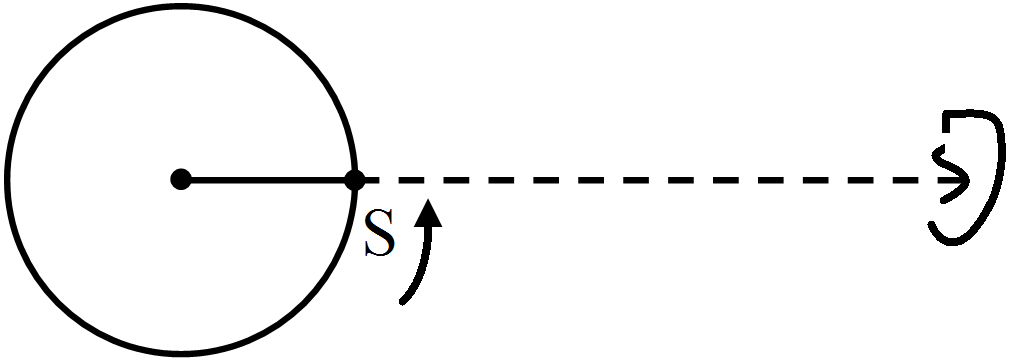
A small source of sound S of frequency 500Hz is attached to the end of a light string and is whirled in a vertical circle of radius 1.6m. The string just remains tight wher the source is at the highest point.

  1. An observer is located in the same vertical plane at a large distance and at the same height as the centre of the circle figure. The speed of sound in air = 330m/s and g = 10m/s 2. Find the maximum frequency heard by the observer.
  2. An observer is situated at a large distance vertically above the centre of the circle. Find the frequencies heard by the observer corresponding to the sound emitted by the source when it is at the same height as the centre.

What is nuclear fusion? How is energy produced in the sun by this process? Explain with necessary equations.
A particle of charge 2.0 × 10⁻⁸C and mass 2.0 × 10⁻¹⁰g is projected with a speed of 2.0 × 10³m/s-1in a region with a uniform magnetic field of 0.10T. The velocity is perpendicular to the field. Find the radius of the circle formed by the particle and also the time period.
Determine the ‘effective focal length’ of the combination of the two lenses in if they are placed 8.0 cm apart with their principal axes coincident. Does the answer depend on which side of the combination a beam of parallel light is incident? Is the notion of effective focal length of this system useful at all.
A capacitance C, a resistance R and an emf $\in$ are connected in series at t = 0. What is the maximum value of (a) the potential difference across the resistor (b) the current in the circuit (c) the potential difference across the capacitor (d) the energy stored in the capacitor (e) the power delivered by the battery and (f) the power converted into heat?
The equation of motion of a particle started at t = 0 is given by $\text{x}=5\sin\big(20\text{t}+\frac{\pi}{3}\big)$ where x is in centimetre and t in second. When does the particle.
  1. First come to rest.
  2. First have zero acceleration.
  3. First have maximum speed?
The two blocks in an Atwood machine have masses 2.0kg and 3.0kg. Find the work done by gravity during the fourth second after the system is released from rest.
  1. Show that the normal component of electrostatic field has a discontinuity from one side of a charged surface to another given by

$(\text{E}_2-\text{E}_1).\hat{\text{n}}=\frac{\sigma}{\in_0}$

where $\hat{\text{n}}$ is a unit vector normal to the surface at a point and σ is the surface charge density at that point. (The direction of $\hat{\text{n}}$ is from side 1 to side 2.) Hence show that just outside a conductor, the electric field is σ $\hat{\text{n}}$0.

  1. Show that the tangential component of electrostatic field is continuous from one side of a charged surface to another.

[Hint: For (a), use Gauss’s law. For, (b) use the fact that work done by electrostatic field on a closed loop is zero.]

  1. Draw a schematic sketch of a cyclotron. Explain clearly the role of crossed electric and magnetic field in accelerating the charge. Hence derive the expression for the kinetic energy acquired by the particles.
  2.  An α–particle and a proton are released from the centre of the cyclotron and made to accelerate.
    1. Can both be accelerated at the same cyclotron frequency? Give reason to justify your answer.
    2. When they are accelerated in turn, which of the two will have higher velocity at the exit slit of the dees?
An electric current flows in a wire from north to south. What will be the direction of the magnetic field due to this wire at a point east of the wire? West of the wire? Vertically above the wire? Vertically below the wire?