Question
Name the types of lenses.

Answer

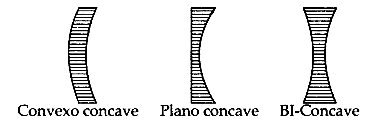
There are two types of lenses: (i) A concave or diverging lens which may be either double-concave, piano-concave or convexo-concave.

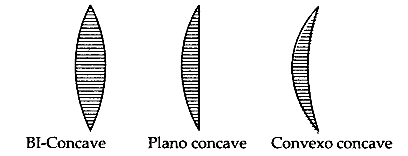
(ii) A convex or converging lens which may be either double convex, piano-convex, or concavo-convex.

Need a full question paper?

Generate a complete, print-ready paper with questions like this in minutes — across 16+ boards, with answer keys.
Start Generating Free

Similar questions

Heat is supplied at a constant rate to $200\  g$ of ice at $0^\circ C$ until finally all the ice is converted into steam at $100^\circ C.$ If the specific latent heat of ice is $3.3 x 10^5\  J/kg$ and that of steam is $2.3 x 10^6\  J/kg$ and the Sp. heat capacity of water is $4200\  J/kg$, draw rough graphs for the following to illustrate the changes which take place as the solid ice is converted into water and finally into steam, the pressure remaining constant all the time.
$(a)$ Volume against temperature,
$(b)$ Temperature against time.
A bulb is connected to a battery of p.d. $4 V$ and internal resistance $2.5 \Omega$. A steady current of $0.5 A$ flows through the circuit. Calculate:The resistance of the bulb
Draw a ray diagram to show the formation of an inverted and diminished image of an object by a lens. Name the lens used. State the position of the object with respect to the lens used. State one more characteristic of the image.
State three ways of obtaining an electron-beam.
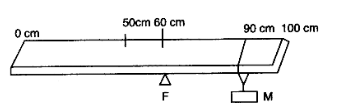
A uniform metre scale is kept in equilibrium when supported at the $60 \ cm$ mark and a mass M is suspended from the $90 \ cm$ mark as shown in the figure. State with reasons, whether the weight of the scale is greater than, less than or equal to the weight of mass M.
Image
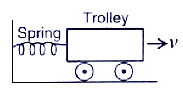
A spring is kept compressed by a small trolley of mass 0.5 kg lying on a smooth horizontal surface as shown in the adjacent fig. when the trolley is released, it is found to move at a speed $v=2 m s ^{-1}$. What potential energy did the spring possess when compressed?

Household wiring for lamp connections can either be done in parallel or in series.Which one would you prefer? Give a reason for your answer.
Figure shows a uniform metre rule placed on a fulcrum at its mid-point O and having a weight 40gf at the 10 cm mark and a weight of 20gf at the 90 cm mark.

How can the rule be brought in equilibrium by using an additional weight of 40 gf ?

A lever of length 9 cm has its load arm 5 cm long and the effort arm is 9 cm long.
What is the mechanical advantage and velocity ratio if the efficiency is 100%?
State the conditions of equilibrium for a rigid body.