MCQ
Name the unit of electrical potential:
- ACoulomb
- BWatt
- CJoule
- DVolt
Explanation:
Electrical potential is a type of potential energy, and refers to the energy that could be released if electric current is allowed to flow.
Generate a complete, print-ready paper with questions like this in minutes — across 16+ boards, with answer keys.
Which of the following phenomena contributes significantly to the reddish appearance of the sun at sunrise or sunset?
As in figure shown, if a capacitor C is charged by connecting it with resistance R, then energy is given by the battery will be
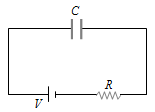
|
(a) |
(b) More than |
(c) Less than |
(d) Zero |
The capacity of an air condenser is 2.0 mF. If a medium is placed between its plates. The capacity becomes 12 mF. The dielectric constant of the medium will be
|
(a) 5 |
(b) 4 |
(c) 3 |
(d) 6 |
Two charge + q and -q are situated at a certain distance. At the point exactly midway between them
|
(a) Electric field and potential both are zero |
|
(b) Electric field is zero but potential is not zero |
|
(c) Electric field is not zero but potential is zero |
|
(d) Neither electric field nor potential is zero |
As the temperature of hot junction of a thermo‑couple is increased (while cold junction is at constant temperature), the thermo e.m.f.
|
(a) Increases uniformly at constant rate |
|
(b) Increases slowly in the beginning and more rapidly at higher temperatures |
|
(c) Increases more rapidly in the beginning but less rapidly at higher temperatures |
|
(d) In minimum at neutral temperature |
Which one of the following have minimum wavelength
|
(a) Ultraviolet rays |
(b) Cosmic rays |
(c) X-rays |
(d) γ - rays |
