Question
Name two types of animal feed and write their functions.

Answer

The dairy cattle is given a balanced ration, which contains all nutrients in proportionate amounts. A ration is the amount of food which is given to the animal during a twenty-four hour period.
The animal feed includes two types of substances.
  1. Roughage: It largely contains fibres such as green fodder, silage, hay (straw of sereals) and legumes, (e.g., berseem, lucerne, cow pea and agathi)
  2. Concentrates: The concentrates used in feed of cattle and bufalloes are a mixture of substances which are rich in one or more of the nutrients, g., cotton seeds, oil seeds, grains of maize, oats, barley jowar, bajra, gram and their byproducts such as wheat bran, rice bran (polish), gram husk, oil seed cakes and molasses.
  1. Green fodder and dry grasses (roughage) = 15 to 20kg
  2. Grain mixture (concentrates) = 4 to 5kg
  3. Water 30 to 35 litres.
Besides above mentioned nutritious food material, dairy animals require certain additive feeds, promote the growth of the animals which contain antibiotic, minerals, and hormones, facilitate good yield of milk and protects them from diseases.
Need a full question paper?

Generate a complete, print-ready paper with questions like this in minutes — across 16+ boards, with answer keys.

Start Generating Free

Similar questions

A ball $X$ of mass $1\ kg$ travelling at $2\ m/s$ has a head-on collision with an identical ball $Y$ at rest. $X$ stops and $Y$ moves off. Calculate the velocity of $Y$ after the collision.
  1. How does a boat float in water?
  2. A piece of steel has a volume of $12\ cm^3,$ and a mass of $96g.$ What is its density: $(i)$ in $g/cm^{3 }(ii)$ in $kg/m^3?$
Two objects having equal masses are moving with uniform velocities of 2m/s and 6m/s respectively. Calculate the ratio of their kinetic energies.
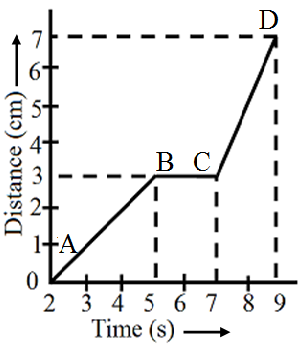
The graph given alogside shows the positions of a body at different times. Calculate the speed of the body as it moves from:
  1. A to B.
  2. B to C.
  3. C to D.
Pressure and temperature determine the state of a substance. Explain this in detail.
Calculate the work done by the brakes of a car of mass $1000kg$ when its speed is reduced from $20m/s$ to $10m/s?$
  1. How does a boat float in water?
  2. A piece of steel has a volume of $12\ cm^3,$ and a mass of $96g$. What is its density: $(i)$ in $g/cm^{3 }\ (ii)$ in $kg/m^3$?
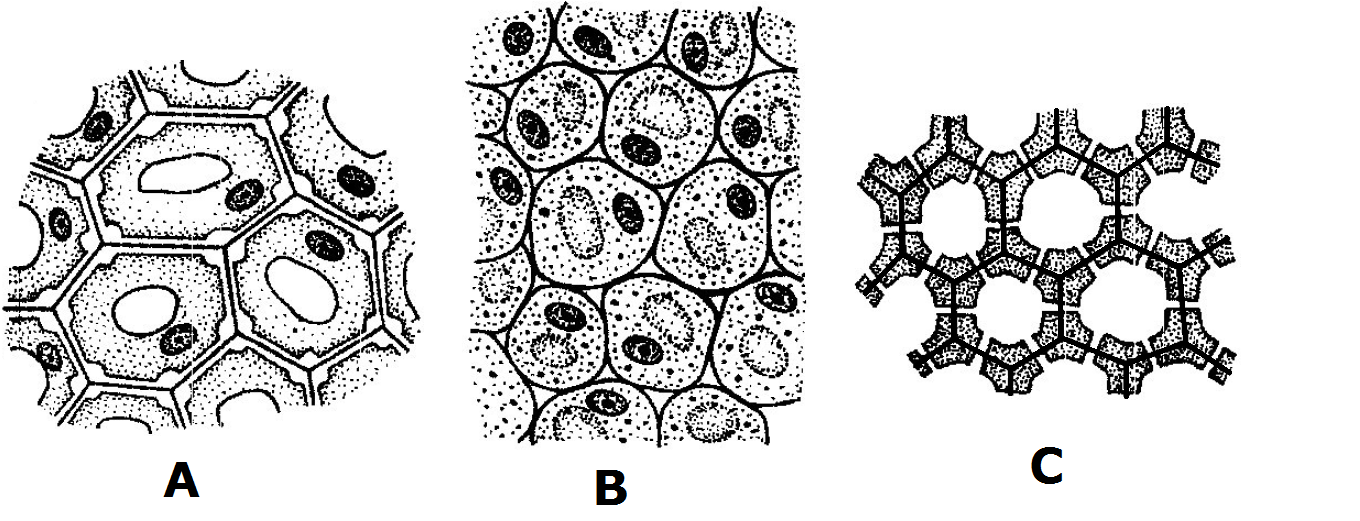
  1. Identify Figure A, B and C.
  2. Which one of them has heavy deposition of lignin?
  3. Which one of them provides both mechanical strength as well as flexibility?
  4. Which one of them can be modified to form air cavities in awuatic plants?
  5. Which one of them is commercially exploited to obtain Hemp and Jute?
How does the force of attraction between the two bodies depend upon their masses and distance between them? A student thought that two bricks tied together would fall faster than a single one under the action of gravity. Do you agree with his hypothesis or not? Comment.
How could you  convince a small child that when ou speak, it is not necessary for air to travel from your mouth to the ear of a listener?