MCQ
$NaOH$ is a strong base because
  • It gives $O{H^ - }$ion
  • B
    It can be oxidised
  • C
    It can be easily ionised
  • D
    Both $(a)$ and $(c)$

Answer

Correct option: A.
It gives $O{H^ - }$ion
a
Strong bases are commonly formed from the hydroxides of alkali metals and alkaline earth metals. $NaOH$ (sodium hydroxide) is a strong base because it gives $OH ^{-}$ ions easily in water.

Need a full question paper?

Generate a complete, print-ready paper with questions like this in minutes — across 16+ boards, with answer keys.
Start Generating Free

Similar questions

$2.5 \mathrm{~mL}$ of $\frac{2}{5} \mathrm{M}$ weak monoacidic base $\left(\mathrm{K}_{\mathrm{b}}=1 \times 10^{-12}\right.$ at $\left.25^{\circ} \mathrm{C}\right)$ is titrated with $\frac{2}{15} \mathrm{M} \mathrm{HCl}$ in water at $25^{\circ} \mathrm{C}$. The concentration of $\mathrm{H}^{+}$at equivalence point is $\left(\mathrm{K}_W=1 \times 10^{-14}\right.$ at $\left.25^0 \mathrm{C}\right)$
The orbital diagram in which both the Pauli's exclusion principle and Hund's rule are  violated as
The property by virtue of which a compound can turn the plane polarised light is known as
Under a given set of experimental conditions, with increase in the concentration of the reactants, the rate of a chemical reaction
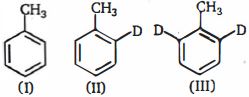
The rate of $o-$ nitration of the above compounds, $(I)$ toluene, $(II)\, 2-D-$ toluene and $(III) \,2, 6-D_2$ -toluene is in the following order
Amongst $LiCl, RbCl,$ $BeC{l_2}$ and $MgC{l_2}$ the compounds with the greatest and the least ionic character, respectively, are
For the following three reactions $a, b$ and $c,$ equilibrium constants are given :

$(i)\,CO(g)+ H_2O(g) \rightleftharpoons  CO_2(g)+H_2(g)\,;\,K_1$

$(ii)\,CH_4(g)+H_2O(g) \rightleftharpoons  CO(g)+3H_2(g)\,;\,K_2$

$(iii)\,CH_4(g) + 2H_2O(g) \rightleftharpoons CO_2(g)+ 4H_2(g)\,;\,K_3$

A molar solution is one that contains one mole of a solute in
The first ionization enthalpies of four consecutive elements present in the second period of the periodic table are $8.3, 11.3, 14.5$ and $13.6\,\, eV,$  respectively. Which one of the following is the first ionization enthalpy of nitrogen ?
Which of the following statement is $correct$