MCQ
Near and far points of a human eye are
  • A
    $0$ and $25\, cm$
  • B
    $0 $ and $\infty$
  • C
    $25\, cm$ and $100 \,cm$
  • $25 \,cm$ and $\infty$

Answer

Correct option: D.
$25 \,cm$ and $\infty$
d
(d) The near point of a human eye is $25 \mathrm{cm}$, which is defined as the shortest object distance that a typical eye is able to accommodate, or to make the image to fall on the retina.

Need a full question paper?

Generate a complete, print-ready paper with questions like this in minutes — across 16+ boards, with answer keys.
Start Generating Free

Similar questions

If ${E_0}$ represents the peak value of the voltage in an ac circuit, the r.m.s. value of the voltage will be
A glass flask contains some mercury at room temperature. It is found that at different temperatures the volume of air inside the flask remains the same. If the volume of mercury in the flask is $300 \,\,cm^3$, then volume of the flask is ........ $cm^3$. (given that coefficient of volume expansion of mercury and coefficient of linear expansion of glass are $1.8 × 10^{-4} (^o C)^{-1}$ and $9 × 10^{-6} (^o C)^{-1}$ respectively)
Image
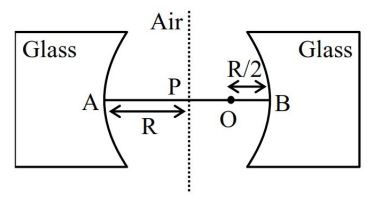
Two concave refracting surfaces of equal radii of curvature and refractive index 1.5 face each other in air as shown in figure. A point object O is placed midway, between P and B. The separation between the images of O , formed by each refracting surface is :
Two projectiles $A$ and $B$ are thrown with the same speed but angles are $40^{\circ}$ and $50^{\circ}$ with the horizontal. Then
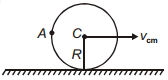
In case of pure rolling, what will be the velocity of point $A$ of the ring of radius $R$ ?
A block of volume $V$ and of density $\sigma _b$ is placed in liquid of density $\sigma _l(\sigma _l > \sigma _b)$ , then block is moved upward upto a height $h$ and it is still in liquid. The increase in gravitational potential energy of the system is
A simple harmonic oscillator has an amplitude $A$ and time period $6 \pi$ second. Assuming the oscillation starts from its mean position, the time required by it to travel from $x=A$ to $x=\frac{\sqrt{3}}{2} A$ will be $\frac{\pi}{x}$ s, where $x=$__________.
A body $A$ is projected upwards with a velocity of $98\,m/s$. The second body $B$ is projected upwards with the same initial velocity but after $4 \,sec$. Both the bodies will meet after...........$sec$
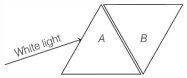
Consider two equivalent, triangular hollow prisms $A$ and $B$ made of thin glass plates and arranged with negligible spacing as shown in the figure. A beam of white light is incident on prism $A$ from the left. Given that, the refractive index of water is inversely related to temperature, the beam to the right of prism $B$ would not appear white, if
An unloaded bus can be stopped by applying brakes on straight road after covering a distance $x$. Suppose, the passenger add $50 \%$ of its weight as the load and the braking force remains unchanged, how far will the bus go after the application of the brakes? (Velocity of bus in both case is same)